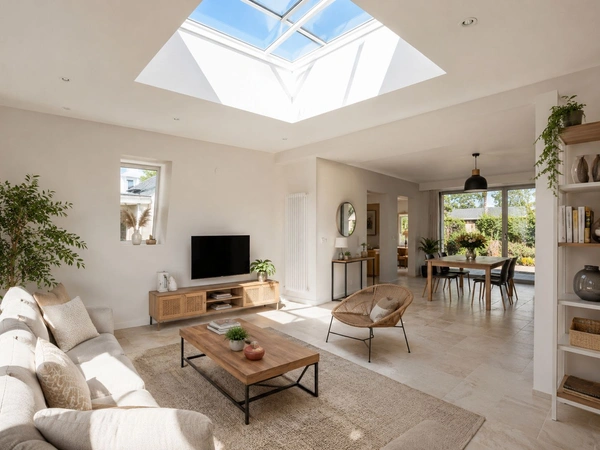
Yes, a house that is too large can indeed slow down its sale, because demand has shifted markedly toward smaller properties that are easier to heat: homes with 6 rooms or more are now selling at an average discount of close to 10%, whereas a studio or a T2 sells in 45 days compared with 70 to 90 days for a large family house. There are three ways to make an oversized property attractive again: divide it into two separate dwellings, reconfigure the existing volumes to create flexible spaces, or simply improve the layout and stage the house to widen the pool of potential buyers. The right choice depends on your budget, your municipality's PLU (local urban planning document), and your objective: selling quickly, renting out part of the property, or passing it on to several generations. This article helps you sort through these options with concrete benchmarks for cost, timeline and regulations.
In summary
- Large houses sell more slowly and with a bigger discount: demand is moving toward compact properties that are easy to maintain and heat.
- Dividing a house into two dwellings costs between €30,000 and €80,000 on average, with a gross rental yield of 5 to 8%, but it requires checking the PLU and setting up a copropriété (co-ownership structure).
- Reconfiguring without major demolition (movable partitions, an independent master suite, a closed-off office) often makes it possible to win back buyers without the burdens of a division.
- A good estimer votre bien immobilier and the advice of a local professional remain the best starting point before embarking on any work.
Why are large houses struggling so much to sell today?
I see it regularly in my portfolio of properties: large family houses, those of 150, 180, sometimes 250 m², stay listed far longer than the others. It is neither a coincidence nor a matter of luck. It is a genuine structural change in the market, and you need to understand it in order to act on it rather than endure it.
A market refocusing on compact properties
The figures speak for themselves: reservations of small homes are up by nearly 19% this quarter according to data from the ministère du Logement, while houses with 6 rooms or more are showing a much sharper decline. The average price of a sale in the existing housing market has also fallen back to around €242,000, compared with €268,000 three years ago. The market is clearly refocusing on more affordable properties that are simpler to finance, and a large house automatically falls outside this core target.
The weight of budget and energy in the purchasing decision
With credit rates that remain demanding and constrained purchasing power, buyers calculate everything: the monthly payment, of course, but also the heating bill, upkeep and the taxe foncière (property tax). A 220 m² house with an F or G DPE (energy performance diagnostic) scares off a good share of potential buyers, quite simply because they no longer have the means or the desire to heat rooms they do not use. It is often here, more than in the asking price, that the obstacle lies.
The expert's view
"In the field, I see many owners who cannot understand why their beautiful family home, the one where they raised their children, is not finding a buyer even though it is in perfect condition; the truth is that the buyer's profile has changed much faster than the property itself, and that you have to be willing to look at your house through the eyes of 2026 and not those of the time when you bought it: a couple with one child visiting today no longer necessarily dreams of six bedrooms to maintain, they dream of a flexible space, of an extra room they can later turn into an office or a teenager's bedroom, and above all of a reasonable energy bill; before rushing into division works that commit time, money and paperwork, I always advise starting with a proper staging of the space and a realistic valuation, because in one case out of two, a better layout is enough to unblock the sale, and in the other case, division or reconfiguration then becomes an informed choice rather than a panic reaction."
Dividing your house into two dwellings: what you really need to know
The urban planning rules to check first
Before even thinking about works, head to the town hall. In France, the Plan Local d'Urbanisme (PLU) often sets precise rules: some municipalities limit the division of detached houses, require a minimum surface area per dwelling created, or restrict the number of parking spaces available per lot. If your project creates no additional living space, or less than 5 m², you will generally not need any authorisation. Between 5 and 20 m² created, a déclaration préalable de travaux (prior declaration of works) is sufficient. Beyond that, you will need to file a permis de construire (building permit). In other words, the first thing to do is call your municipality's urban planning department before drawing up a single plan.
The automatic creation of a co-ownership
As soon as your house becomes two separate dwellings, you effectively create a co-ownership (copropriété), even with only two lots. This requires an état descriptif de division (EDD, a descriptive statement of division) and a règlement de copropriété (co-ownership rules) that specify the designation of each lot and the allocation of shared costs. This is an additional administrative step, often entrusted to a surveyor (géomètre) and a notary, which must be built into your schedule and budget from the outset.
How much does dividing a house cost, and what return can you expect?
A budget to plan for seriously
The average cost of a division generally ranges from €30,000 to €80,000, or roughly €800 to €1,500 per m² of dwelling created. In detail, allow €40 to €80/m² for partitioning, €3,000 to €8,000 for installing a second kitchen, €900 to €2,500 for an individual electricity meter, and €25 to €50/m² for soundproofing between the two dwellings. This last item, often underestimated, is nevertheless essential: no one wants to buy or rent a home where you can hear everything that goes on next door.
An attractive return if the project is well managed
In terms of profitability, dividing in order to rent generally offers a gross rental yield of 5 to 8%, sometimes more in university towns or seaside locations. The logic is simple and borne out in practice: the rent per square metre is always higher on smaller units. A 35 m² two-room apartment (T2) can be rented for €17 to €22/m², whereas an entire 110 m² house rarely exceeds €12/m². Dividing often means turning one capped rent into two combined rents that are significantly higher.
The practical tip
- Always have the technical feasibility checked by a building professional before committing: water supply, electricity, independent access, everything must be planned in advance.
- Request a certificat d'urbanisme opérationnel (operational planning certificate) from the town hall to secure your division project before investing in plans.
- Systematically allow a margin of 15 to 20% on your works budget: surprises on site are the norm, not the exception, on this type of project.
- Compare the cost of the division with the real gain you can expect on resale or rental, relying on comparable property listings in your area.
Reconfiguring rather than dividing: the middle path
Creating modularity without tearing everything down
Dividing is not always the right answer, especially if you want to keep selling the house as a single property. In that case, reconfiguring the spaces is often faster and less costly. A removable partition to turn a large bedroom into two spaces, an independent master suite with its own bathroom, a closed office created in an unused landing or hallway: these are lighter works that require neither a building permit nor a co-ownership, and that immediately appeal to buyers looking for flexibility.
Thinking in terms of use rather than floor area
Today's buyers no longer think solely in square metres; they think in terms of uses. A room with no clear function is a room that causes concern, because it represents a space to heat and maintain with nothing in return. Conversely, a room clearly identified as an office, as a spare bedroom for an elderly parent, or as convertible storage space is immediately reassuring. It is often a matter of staging and presentation more than structural work.
Which target to aim for with a large house that has been reconfigured or divided?
Blended families, a fast-growing audience
With the rise of blended families, demand is shifting toward homes able to accommodate children in shared custody on a week-on, week-off basis, with spaces that can be closed off or opened up as needed. A large, well-redesigned house with several independent suites and generous common areas is exactly suited to this way of life. This is a selling point to highlight explicitly in your listing, because this audience is looking for precisely this type of property and does not easily find it on the conventional market.
Senior house-sharing and intergenerational housing, a growing trend
Since the Elan law of 2018, people aged 60 and over can rent part of their home to people under 30 as part of a supportive intergenerational cohabitation arrangement. This model is developing strongly: in Île-de-France alone, there are now eighteen residences of this type housing more than fifty people, with almost as many projects under way. A large house divided into two or three independent but connected spaces can fit perfectly into this trend, whether for personal use or for a rental investment targeting this rapidly expanding group.
How to decide between division, redesign and simply showcasing the property?
The questions to ask yourself before choosing
Three questions generally help to clarify things. Do you want to sell quickly, or are you ready to invest time and money to enhance the property's value? Do you have a personal use in mind, such as housing an elderly parent, or are you aiming purely for rental yield? Finally, does your municipality allow division under the PLU (local urban plan)? These answers naturally point toward one of the three solutions, and there is no universal right answer, only the right answer for your situation.
Relying on a local professional to decide
It is precisely in this type of decision that local support makes the difference. An advisor who knows your area knows which types of property sell quickly in your neighborhood, what discount is actually applied to large houses, and which solutions have worked for comparable properties. Before committing to major works, it is always worth finding a local real estate advisor who can give you a concrete, figure-based opinion on your specific situation.
Selling as is, an option not to be overlooked
Targeting the right buyers rather than transforming the property
Not every large house needs renovation work in order to sell. Some find a buyer quickly as long as they are offered at the right price and presented to the right buyers: large families, self-employed professionals looking to set up a home-based practice, or investors seeking a property to divide themselves. The advisor's role is precisely to identify this audience rather than systematically push toward works that are not always necessary.
The importance of the right price from the start
An overpriced large house stays on the market for months, which eventually arouses buyers' suspicion, as they wonder what is wrong with it. Conversely, a price set correctly from the outset, backed by a serious valuation, quickly attracts the right profiles and limits the negotiation margin, which currently averages around 10% on this type of property. It is better to have the right price from day one than a gradual reduction that gives the impression of a property that is losing value.
Conclusion
A large house that struggles to sell is not doomed; it simply needs to be rethought in light of buyers' current expectations. Dividing can be an excellent solution if you have the budget, the administrative patience, and a clear rental or family project. Redesigning without tearing everything down is often the fastest and most economical way to restore your property's appeal without complicating it. And sometimes, simply showcasing the property is enough, provided you target the right buyers and set a price consistent with the current market. In any case, the best decision is rarely made alone: surround yourself with a professional who knows your area, have your property accurately valued, and move forward step by step rather than rushing headlong into irreversible works.
FAQ - Frequently asked questions
Is a building permit required to divide a house into two dwellings?
It depends on the amount of living space created. Below 5 m², no authorisation is required. Between 5 and 20 m², a prior declaration of works (déclaration préalable de travaux) is sufficient. Above 20 m², a building permit (permis de construire) is mandatory, and in all cases you must check that the project complies with your municipality's PLU (local urban plan).
How much does it cost on average to divide a house into two dwellings?
The budget is generally between €30,000 and €80,000, or roughly €800 to €1,500 per square metre created, depending on the initial condition of the property, the complexity of the utility networks and the desired level of finish.
Is it more profitable to rent out a divided house than to rent it out whole?
In the vast majority of cases, yes. The rental price per square metre is always higher for small units: a T2 (two-room apartment) can reach €17 to €22/m² compared with €12/m² for a large whole house, which often translates into a gross rental yield of 5 to 8% after division.
What alternatives are there if I don't want to divide my house?
Interior reconfiguration is an excellent alternative: movable partitions, creating a separate master suite, converting a room into an enclosed office. This lighter work generally requires neither a building permit nor the creation of a co-ownership (copropriété), while still broadening the pool of potential buyers.
Why are large houses selling more slowly at the moment?
Demand has shifted towards more compact properties, which are easier to finance and cheaper to heat. Homes with 6 or more rooms are subject to an average discount of close to 10% and take 70 to 90 days on average to sell, compared with 45 days for a studio or small apartment.
Author of the publication

Fabrice DOBROWOLSKI, Director of the Optimhome network
«Benefit from myexpert advice, based on many years of experience in real estate, to ensure the success of your buying or selling project. »