A dark apartment, located on the ground floor or exposed to an unpleasant vis-à-vis (a neighbouring building directly opposite), generally sells at a discount of between 5% and 25% compared with an equivalent property without this flaw, depending on the street, the exposure and whether or not there is an outdoor space. This is not inevitable, however: this type of property always finds a buyer, provided you set the right price, target the right buyers and highlight the home's real strengths. The key is not to hide the flaw, but to acknowledge it from the listing onwards in order to build a relationship of trust with visitors. In this article, I explain how I approach this kind of case in the field, with practical methods that have proven their worth.
In summary
- A street-facing ground-floor apartment suffers an average discount of 10 to 20%, and 10 to 15% on the courtyard side; there is no fixed national scale, and everything depends on the local context.
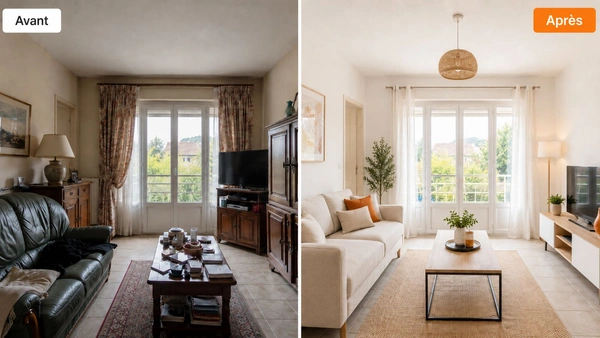
- A lack of light or a vis-à-vis can be largely remedied without building work: mirrors, warm lighting, light-coloured furniture and sheer curtains radically change how a room is perceived.
- The right buyer for this type of property is not always the one looking for a main residence: rental investors, first-time buyers and price-sensitive profiles are often the most receptive.
- Acknowledging the flaw in the listing and during viewings, rather than concealing it, reassures the buyer and speeds up the sale at the right price.
A flaw is not inevitable
Understanding why this flaw frightens buyers
When a buyer visits a dark or ground-floor apartment, the first reaction is almost always emotional before it is rational. It is hard to picture yourself in a room that lacks light, you immediately imagine passers-by looking in through the window, and you think about damp, security and street noise. This is normal, it is human, and that is precisely why these fears need to be anticipated rather than left to take hold during the viewing. A buyer who feels trapped by a late discovery usually runs for the door, even if the property had real arguments in its favour.
What the market really says
In the field, I find that the market is not as ruthless as people imagine. Yes, a ground-floor or dark apartment often sells for a little less than an equivalent, well-exposed property on an upper floor. But that is not because it cannot find a buyer: it is because it does not find the same buyer. An investor who rents out the property year-round does not have the same requirements as a family looking for a main residence for the next twenty years. The ageing of the population even changes the picture: more and more seniors are actively looking for ground-floor apartments to avoid stairs, which restores value to this type of property in certain areas. This is a reality that many sellers overlook, and it completely changes the way the property should be marketed.
The expert's word
"In twenty years in the business, I have sold dozens of apartments that everyone called 'unsellable' because of a vis-à-vis or a lack of light, and every time, the real difficulty was not the property itself but the seller's denial about its flaw: the seller who agrees to lower the price by ten or fifteen per cent from the outset, who is completely transparent in the listing and who lets in as much natural light as possible during viewings generally sells faster and on better terms than the one who insists on asking the price of the neighbour on the fifth floor with full south-facing exposure, because the buyer is no fool, he sees the flaw within two seconds of pushing open the door, and what he remembers above all is the sincerity or dishonesty of what he is told at that moment."
How much does a lack of light or a vis-à-vis really cost?
The discount figures
You have to be honest with the numbers to be credible in front of a buyer. A ground-floor apartment opening directly onto the street generally suffers a discount of 10 to 20% compared with a standard upper floor in the same building, against 10 to 15% for a ground-floor apartment on the courtyard side, which is quieter and often feels more secure. A lack of light, for its part, is assessed case by case: a living room that requires artificial lighting in broad daylight sends a strong negative signal at resale, but the real impact on the price depends enormously on the orientation, the height of the building opposite and whether or not there is an outdoor space that compensates. A ground-floor apartment with a private garden, for example, can sometimes be negotiated at almost the same price as an upper-floor apartment without an outdoor space.
Why there is no universal rule
What matters here is that there is no fixed national discount that applies in the same way everywhere. Within the same building, the price gap between a ground-floor unit and a typical upper floor can range from 5 to 15%, but that figure goes up or down depending on the street, the neighbourhood, the perceived level of safety and the quality of the exposure. That is why a rough-and-ready asking price, based on an average found on the internet, is almost always a mistake. The best way to set a fair price remains a detailed property valuation, which takes into account the specifics of the neighbourhood and not just general statistics. Having your property valued by a professional who knows the area helps you avoid both overpricing, which drives buyers away, and underpricing, which needlessly costs you money.
Turning the drawback into a selling point
The ground floor: for whom it is a real asset
A ground-floor unit ticks boxes that many buyers are actively looking for, even if they do not always say so at the outset. No broken-down lift, no stairs to climb with shopping or a pushchair, convenient direct access for people with reduced mobility or seniors, and often a small garden, a terrace or a courtyard that does not exist on the upper floors. For an investor renting to students or young professionals, these constraints weigh far less than the price per square metre. This is exactly the type of profile to target first when marketing this kind of property.
Being overlooked: more a matter of perception than reality
Being overlooked by the building opposite is frightening because it is instinctively associated with a lack of privacy. But in practice, a moderate degree of overlooking, with light curtains or a simple privacy film on the ground-floor windows, bothers people much less in daily life than buyers imagine during a viewing. It should be addressed openly during the visit rather than hoping the question will not be asked: "yes, there is a view onto the building opposite, here is how the current owners manage privacy, and here is what it changes in practice during the day." This transparency defuses concern far better than an awkward silence.
The practical tip
- Before each viewing, open all the curtains and net curtains, even if the building opposite is visible: it is better to own it than to let buyers guess.
- Place a large mirror opposite the main window to visually double the amount of natural light.
- Replace the bulbs with warm white lighting (2700 to 3000 K) and multiply the light sources rather than relying on a single central ceiling light.
- Repaint the walls and ceiling in white or very light shades: a gloss paint on the ceiling reflects light far better than a matt paint.
- Lighten the furniture: favour light wood, glass and low pieces rather than dark, imposing items that crush the space.
- Take the listing photos in broad daylight, with the windows open, never in the evening or in grey weather.
Preparing the property before viewings
Lighting-focused home staging, a profitable investment
Contrary to a common misconception, major renovation work is not necessary to improve the perceived brightness of an apartment. Clearing the windows of any obstruction, choosing light, sheer curtains rather than thick fabrics, and installing glass coffee tables or glazed doors where possible: these are simple steps that completely change the atmosphere of a room in a few hours. I have seen sellers multiply their positive viewings simply by repainting a dark hallway white and adding two well-placed floor lamps. The budget is minimal compared with the impact on buyers' perception.
Photos and a listing that do not cheat
The temptation is great to retouch the photos to erase the drawback, but it is a poor long-term strategy: a buyer who travels to the property and discovers a gap between the photos and reality immediately loses trust, and the listing ends up with a high drop-out rate after viewings. It is better to have honest photos, taken at the best time of day, with a listing text that clearly mentions the exposure and the context, rather than listings that give false hope. Buyers who browse serious and transparent property listings go to viewings with confidence, which increases the likelihood of turning a viewing into a concrete offer.
Setting the right price without lying to yourself
Avoiding the trap of denial
The natural reflex of many sellers is to compare their property to the best apartment in the neighbourhood, the one on the top floor, south-facing, with no overlooking at all. It's only human, but it's a costly mistake: a price that is too ambitious drives away serious buyers within the first few weeks, and the property lingers on the market, which ends up raising suspicions ("why does nobody want it?"). A property that stays listed for too long almost always loses more value than one that is sold quickly at a price adjusted from the start.
Relying on local expertise rather than national averages
The discount linked to poor orientation varies enormously from one city to another, and even from one street to another within the same city. That is why I always recommend having an on-site valuation carried out, one that compares your property to actual recent sales in the same area, with the same characteristics. It is the only way to set a price that protects your interests without discouraging potential buyers from the very first viewing.
Targeting the right buyers
Investors, first-time buyers: profiles that are often more receptive
An investor looking for rental yield first looks at the price per square metre and the rental potential, much more than at orientation or view. A first-time buyer on a tight budget is often willing to accept a drawback in orientation in exchange for a more affordable price, especially in large cities where every square metre counts. These two profiles are often the most effective target for a property with this kind of constraint, far more so than a family looking for the perfect home in which to settle long term.
The role of the local advisor in the sales strategy
Knowing the local market and knowing who is looking for what in a specific neighbourhood is the core of the real estate advisor's profession. A professional who follows the area on a daily basis generally knows which buyers are actively searching for a property with this profile, and can steer the marketing accordingly rather than publishing a generic listing and hoping the right buyer comes across it by chance. If you are unsure about the strategy to adopt for your property, don't hesitate to find a local real estate advisor who knows the dynamics of your neighbourhood precisely and can support you from choosing the price through to signing.
Conclusion
A dark apartment, a ground-floor unit or an inconvenient overlooking neighbour does not doom a sale, provided you approach the subject with clear-sightedness rather than blind hope. The right approach is to accept the reality of the market, set a price consistent with the drawback, prepare the property to maximise perceived light, and above all target the buyers for whom this drawback genuinely matters less than everything else. By combining transparency, preparation and good targeting, these properties end up finding a buyer, often faster than you might initially imagine. And if you have any doubt about the best way to present your property, a professional in the field remains your best ally for turning a drawback into a mere characteristic of the home.
FAQ - Frequently asked questions
What discount should be applied to a ground-floor apartment?
The discount generally ranges from 10 to 20% for a street-facing ground floor, and from 10 to 15% for a courtyard-facing one, but there is no fixed national rule. The exact amount depends on the street, the neighbourhood, the presence of outdoor space and the perceived level of security, hence the value of a precise local valuation.
Do I need to carry out renovation work to sell a dark apartment?
Not necessarily. Many simple, low-cost solutions exist: clearing the windows, installing mirrors, choosing warm white lighting and repainting in light shades are often enough to transform the perception of a room without undertaking major work.
Should I mention the overlooking or the lack of light in the listing?
Yes, it is better to be transparent from the listing onwards. A buyer who discovers the drawback in person after an overly flattering listing loses trust and often abandons the negotiation, whereas an honest listing attracts visitors who are already prepared to consider the property as it is.
What type of buyer should be targeted for this kind of property?
Rental investors and first-time buyers on a tight budget are often the most receptive profiles, as they generally place more importance on price and yield than on orientation or view.
How can I tell whether my asking price is consistent despite the defect?
The best method remains to compare your property with recent actual sales in your area that have similar characteristics, rather than relying on national averages. A local professional valuation will give you a realistic price, neither too high nor undervalued.
Author of the publication

Fabrice DOBROWOLSKI, Director of the Optimhome network
«Benefit from myexpert advice, based on many years of experience in real estate, to ensure the success of your buying or selling project. »