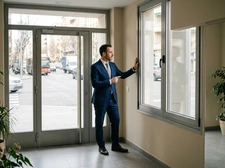
Yes, you can perfectly well sell a property located on a busy road in France, provided you deal with the noise issue before the buyer does it for you. High noise exposure leads to an average price discount of 10 to 20%, and up to 25% for properties right next to a heavily travelled road, but that discount is halved as soon as the soundproofing is adequate. The key, then, is neither to hide the noise nor to put up with it: it is to anticipate it, document it and turn it into managed information rather than a last-minute discovery. In this article, drawing on my perspective as a field advisor, I explain how to prepare, insulate, set a fair price and make the case for selling a home on a noisy street without playing it small or lying by omission.
In summary
- Noise lowers a property's value, but in widely varying proportions: from 5% to 20% depending on the source, the intensity and the distance, with extreme cases close to 25-30% for the most exposed situations.
- Good soundproofing (reinforced double glazing, shutters, a treated façade) greatly reduces this discount and becomes a selling point in its own right, not just a repair.
- Transparency is a legal obligation in certain cases (airport zones in particular) and, beyond the law, it is the best commercial strategy: an informed buyer negotiates less than a buyer who feels deceived.
- A fair price, set with a professional who knows the neighbourhood, is always better than an optimistic price that collapses after the first visit heard "with the window open".
Why noise worries buyers so much
I see it at every viewing: noise is the one flaw in a property that you can't hide behind a nice coat of paint. A cracked wall can be filled. An outdated kitchen can be redone. But the lorry that goes by at 7 a.m., the motorbike accelerating in front of the window, the buyer hears that live, during the viewing, and it leaves a bigger impression than any diagnostic report written in black and white.
An increasingly decisive criterion in the purchase decision
With remote working now firmly established in many households, a quiet home is no longer a comfort, it has become a condition of daily life. Buyers viewing properties today often spend more time at home than they did ten years ago, and they ask far more precise questions about the sound environment than before. It is no longer a detail mentioned at the end of a viewing; it is a question that comes up within the first five minutes.
What the market really says about the noise-related discount
Studies agree on one point: proximity to a busy road lowers a property's value, but the extent varies enormously depending on the source. Some assessments speak of a depreciation of 10 to 20% for the most exposed homes, while others mention discounts that can climb to 25%, or even more, for a property located within 10 metres of a high-traffic road. And beyond about a hundred metres, this effect often becomes negligible. These figures are not absolute truths to be applied mechanically: they provide a range for reasoning, not a magic formula. It is precisely the role of the real estate advisor to refine this figure according to the exact street, the time of day the disturbances occur, and the profile of the buyers looking for this type of property.
Identifying precisely the nature of the noise before selling
Before talking about price or works, you need to establish a clear diagnosis. Not all noises are equal, and they are not all treated in the same way.
Road, rail and air noise: different logics
Continuous road noise (heavy traffic, a boulevard) does not have the same psychological impact as repeated but predictable rail noise, or as aircraft noise that varies according to flight paths and schedules. For homes located in an airport noise exposure zone, the law has in fact required mandatory disclosure since 2020: the seller must inform the prospective buyer of exposure to this nuisance by means of an aircraft noise nuisance statement, included in the technical diagnostic file. Ignoring this obligation, or treating it lightly, exposes you to a risk of litigation far more serious than a simple price negotiation.
Consulting noise maps before setting your strategy
Many municipalities and metropolitan areas publish strategic noise maps, available at the town hall or online, which classify areas according to their level of noise exposure. It is a valuable tool, for you as much as for your adviser: it lets you find out whether your property is really in an area classified as "sensitive" or whether the noise you perceive is greater than the measured reality. This preparatory work changes everything in how you then approach the valuation and the negotiation.
The expert's view
"I have sold dozens of properties by roads or close to railway lines, and I can tell you one thing: noise never kills a sale on its own, it's the silence about the noise that kills it; when a buyer discovers during a viewing that a tram passes every eight minutes under the windows and nobody mentioned it beforehand, they don't think 'that's a nuisance', they think 'what else have they hidden from me', and from then on the whole negotiation starts off on the wrong foot, whereas if the situation is presented from the listing onward, with the soundproofing work already carried out or costed, the price justified accordingly, and even the good points of the location, such as the proximity of transport or shops that are precisely what generate that traffic, the buyer feels respected and negotiates much less aggressively, because they feel they are buying with full knowledge of the facts rather than discovering a problem after the fact."
Soundproofing before selling: an investment, not an expense
This is often the first question that comes up: should you invest in soundproofing before putting the property on the market, or simply lower the price? My answer is almost always the same: a well-insulated property sells better and faster than a discounted one that is still noisy.
Reinforced double glazing, the most cost-effective solution
Replacing single-glazed windows with double glazing with enhanced acoustic insulation remains the most effective way to cut out most outside noise. Allow a budget that varies depending on the materials and the surface area, generally between 150 and 300 euros per square metre of installed glazing. This is not trivial, but set against a potential price reduction of several tens of thousands of euros on the sale price, the equation quickly becomes favourable.
Financial aid to consider before starting the work
Some forms of aid can lighten the bill: MaPrimeRénov' for energy renovation work including glazed surfaces, the éco-prêt à taux zéro (interest-free eco-loan), which can finance a significant part of the project without interest, or the chèque énergie (energy voucher), depending on the household's income. The conditions and amounts of these schemes change regularly, so I always advise checking eligibility at the precise moment you commit to the work, rather than relying on dated information. In any case, keep the invoices and quotes carefully: they will serve as a concrete selling point with a buyer who is hesitating.
Small jobs, big effect: what is often forgotten
Soundproofing is not only about the windows. Thick shutters, a reinforced door seal, a lined curtain, a quiet VMC (mechanical ventilation system), or even simply moving a bedroom to the courtyard side rather than the street side can be enough to change how a home is perceived. These are accessible, quick solutions, and they show the buyer that the issue has been taken seriously.
The practical tip
- Have a soundproofing quote prepared even if you do not intend to carry out the work: presented to the buyer, it shows that a solution exists and that it has a precise cost, which makes the negotiation easier.
- Schedule viewings at different times (early morning, rush hour, quiet evening) so that the buyer gets an honest and complete picture, rather than an impression skewed by a single quiet time slot.
- Highlight the least exposed rooms (bedroom on the garden side, living room with a secondary aspect) in your listing and during the viewing, without concealing the street-facing side.
- Keep a written record (invoices, quotes, diagnostics) of everything that has been done or considered against noise: it is both a selling point and a legal protection.
Setting a fair and defensible sale price
This is often where everything is decided. An overly optimistic price that ignores the noise collapses at the first viewing. A price that is too low out of excess caution loses money unnecessarily.
Relying on real comparables from the neighbourhood
The best way to set a consistent price is to compare your property with genuinely similar properties, sold recently on streets with a comparable level of noise exposure, and not only with the neighbourhood average, which includes quiet streets. That is precisely why it makes sense to have your property valued by someone who knows the area closely, both its busy streets and its quiet ones, rather than relying on an automated online estimate that perceives neither the noise nor the local context.
Adjusting the discount to the targeted buyer profile
A buy-to-let investor does not react to noise the way a family looking for its main residence does. The former looks mainly at yield and proximity to public transport, and may accept a moderate discount in exchange for a stable rent. The latter is often more sensitive to everyday living comfort. Knowing the profile of the buyers who are actively searching in your area allows you to adjust your pitch and even the asking price, for example by looking at similar property listings already online to calibrate your positioning.
Presenting the property without lying or undervaluing it
There is a difference between hiding a flaw and not constantly apologising for it. Many sellers, out of embarrassment, put too much emphasis on the noise in their conversations, which ends up driving away buyers who, once on site, would have found the nuisance perfectly bearable.
An honest listing that does not sabotage itself
Mentioning the situation (busy street, proximity to a train station, shopping thoroughfare) in the listing is not mandatory in every case, but it is often good commercial practice: it filters out visitors who cannot tolerate any noise and concentrates viewings on genuinely interested buyers. On the other hand, there is no need to write a novel on the subject. One factual sentence is enough; the rest can be discussed during the viewing.
The role of the agent in defusing objections
Good support during viewings makes a real difference: knowing how to respond calmly to "you can hear the street a lot, can't you?", with figures, concrete solutions and an honest comparison with other properties in the area, prevents the objection from taking up all the space in the buyer's mind. This is also why many sellers prefer to find a local real estate agent who already knows the street and its residents, and knows exactly what to say at the right moment.
Anticipating the negotiation before it happens
A buyer interested in a property on a noisy street will, almost systematically, try to negotiate on this very point. You may as well prepare for it rather than discover it live.
Preparing figures-based arguments rather than giving in by reflex
If you have already had reinforced double glazing installed, say so and put a figure on it. If you have an insulation quote in hand, show it. If the neighbourhood has offsetting assets (proximity to public transport, shops, schools, planned urban developments intended to reduce traffic), mention them. Negotiation is rarely won on emotion alone: it is won on the ability to show that the asking price already takes the situation into account, which leaves the buyer less room to push further.
Knowing how far to concede, and why
Not all objections are equal. Some are legitimate and deserve a reasonable price adjustment. Others are simply a classic negotiating lever, used by a buyer who, deep down, has already decided to buy. The difference can often be felt in the tone of the exchange, and that is where a professional used to this type of negotiation becomes valuable: they know how to tell a genuine concern from a tactical manoeuvre.
Conclusion
Selling a property on a noisy street is by no means mission impossible, provided you move beyond the reflex of "I'll lower the price and wait for it to pass". The real work is, first, to measure the situation objectively, then to invest intelligently in insulation when it is relevant, then to set a price that already reflects market reality, and finally to present the property with transparency rather than embarrassment. A well-informed buyer negotiates on sound foundations; a buyer who feels trapped negotiates out of mistrust, and that is always harder to recover from. Surround yourself with a professional who knows your street, your neighbours, and the profile of the buyers looking for precisely this type of property: that is often what makes the difference between a sale that drags on and a sale that closes at the right price.
FAQ - Frequently asked questions
How much value can be lost because of noise?
It depends enormously on the source and the distance: studies generally cite a price discount of 10 to 20% for the most exposed properties, with extreme cases close to 25% for a property right next to a very busy road. Good soundproofing greatly reduces this gap.
Am I required to mention noise in my listing?
It is not systematically a general obligation, except for aerodrome noise exposure zones, where the law has required, since 2020, a statement of aircraft noise nuisance to be included in the diagnostic file. Outside this specific case, transparency remains strongly recommended to avoid any dispute after the sale.
Is it better to insulate before selling or to simply lower the price?
In the majority of cases, investing in targeted insulation (windows, shutters, seals) pays off more than a simple price reduction, because it reduces the perceived discount while reassuring the buyer about the actual comfort of the property.
How can I tell whether my property is truly in a noisy area in the legal sense?
Strategic noise maps, which can be consulted at the town hall or online depending on the municipality, allow you to check the official classification of your area. This is a useful starting point before any decision on renovation work or on setting a price.
Can a real estate advisor really help me with this specific type of property?
Yes, absolutely: an advisor who knows your street can compare with similar sales, target the right buyer profiles, and defuse objections during viewings. This is often what makes it possible to sell faster and closer to the fair price than by handling this situation alone.
Thinking of selling? To find out the market value of your property, request a free valuation.
Also read on the blog
- Selling a house with defects (cracks, damp, termites)
- Does home staging really increase the value of a house for sale?
- How to carry out a reliable property valuation?
Author of the publication

Fabrice DOBROWOLSKI, Director of the Optimhome network
«Benefit from myexpert advice, based on many years of experience in real estate, to ensure the success of your buying or selling project. »