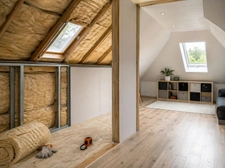
Can your loft really add value to your home when you sell it in the future? Should you prioritize loft insulation or loft conversion to increase your property’s long-term value?
In this comprehensive article, we explore loft insulation and loft conversion to help you assess energy savings, costs, and potential added value. We also cover insulation methods, the technical criteria for convertible lofts, indicative costs, and 2026 grants and incentives (MaPrimeRénov’, Energy Savings Certificates, Anah).
You will find technical benchmarks, costed scenarios, and practical advice to help you prepare your project. For a personalized property valuation of the potential added value of your loft space, contact your Optimhome real estate advisor.
Summary
Loft insulation = improved energy performance (better EPC rating) and possible access to MaPrimeRénov’ and Energy Savings Certificates.
Loft conversion = creation of additional living space if technical criteria are met (height, roof pitch, roof structure) → possible added property value.
Costs and ROI vary greatly: range €350–€1,200/m², average around €600/m²; always request a detailed quote and 3 quotes.
Plan ahead for planning permission, RGE documentation, diagnostics, and tax declarations; contact an Optimhome real estate advisor for a reliable valuation.
Understanding Lofts: Convertible Lofts vs Non-Convertible Attics
The distinction between convertible lofts and non-convertible attics determines the feasibility, cost, and authorization requirements of the work. Convertible lofts provide usable volume without major roof-raising work. Non-convertible attics often require changes to the roof structure or a raised roof to achieve sufficient usable height.
From a regulatory point of view, the Local Urban Planning Scheme (PLU) and municipal regulations may limit such transformations. Before starting any project, consult your town hall’s planning department and check local rules on service-public.fr.
In practical terms, a loft conversion project may involve insulation, electrical work, joinery, and sometimes major structural work such as reinforcement or roof raising. The type of roof structure, access to utilities, and co-ownership status all affect costs and administrative procedures.
Technical Criteria: Ceiling Height, Roof Pitch, and Living Space
A practical rule is to consider a minimum height of 1.80 m over a significant part of the usable floor area in order to classify the space as convertible loft space. This “significant part” varies by municipality, often from one-third to one-half of the area.
Roof pitch also matters: a slope of at least 30–35° makes conversion easier and optimizes usable living space. If the pitch is insufficient, roof raising or structural roof modifications may be required.
From a tax perspective, any increase in habitable floor area must be declared to the tax authorities because it may change the basis for property tax. Seek advice from the local tax office or a real estate advisor to anticipate the impact.
Types of Roof Structure: Traditional Roof Frame vs Trussed Roof Frame
A traditional roof frame often provides more usable volume and makes openings and conversion easier. By contrast, a trussed roof frame contains many braces that divide the space and make conversion more complex.
Converting a trussed roof frame may require structural reinforcement or partial redesign. A structural study by an engineering firm is recommended. Reinforcement costs often range from €100 to €350/m², depending on complexity.
Also check the load-bearing capacity of the floor: if it is insufficient, reinforcement or the installation of a load-bearing floor will be necessary.
Specific Cases: Lofts in Co-Ownership, Technical Lofts, and Undeclared Loft Space
In co-ownership properties, determine whether the loft is private or part of the common areas. The co-ownership regulations and the general meeting may impose restrictions or require a vote before any conversion.
Technical lofts housing boilers or service networks may require costly relocation of equipment and coordination between several trades such as heating engineers, plumbers, and electricians.
Undeclared loft conversions carried out without prior authorization can create risks when selling. It is advisable to regularize the situation with the town hall and notary before listing the property for sale.
Insulating Non-Convertible or Convertible Lofts: Methods, Performance, and Impact on the EPC
Loft insulation is an effective way to improve energy performance and the EPC rating. The roof is the main source of heat loss; improving it reduces energy bills and makes the property more attractive.
Three common approaches are used: internal insulation, external insulation (sarking), and floor insulation. The right option depends on available height, the condition of the roof, and the budget.
From a technical standpoint, thermal resistance R and the lambda coefficient (λ) define performance. In renovation, aiming for an R value of around 6 m².K/W is a useful benchmark. However, airtightness and suitable ventilation are essential to achieve the expected results.
Internal Insulation: Solutions, Thickness, and Loss of Space
Common insulating materials include glass wool, rock wool, cellulose wadding, and wood fiber. Each has its own advantages in terms of price, performance, and moisture behavior.
Internal insulation often requires a thickness of 15–25 cm, which reduces ceiling height and may cause a loss of space. Solutions installed between and under rafters or slimlining systems can help limit this loss.
Indicative price: allow on average €100–€130/m² including installation, depending on the material and region.
External Insulation (Sarking): Advantages, Cost, and Preserving Interior Space
Sarking involves installing insulation above the roof structure. It preserves the full interior surface area, reduces thermal bridges, and improves thermal inertia.
The trade-off is that the roof covering must be removed and replaced, making the project heavier and more expensive. Indicative range: €140–€240/m². Sarking is often chosen when the roof is being renovated or when interior height is insufficient.
Floor Insulation and Acoustic Insulation: Thermal and Sound Comfort
Insulating the floor improves thermal comfort and acoustic insulation by reducing impact noise and airborne noise. Solutions include resilient panels, insulation between joists, doubled joists, and OSB flooring.
As a rough guide, effective sound insulation starts at around €80/m², depending on the method and materials chosen.
Airtightness, Ventilation, and Risks
Airtightness measures such as vapor barriers and thermal continuity prevent moisture from passing through the insulation and causing condensation and mold. Without suitable ventilation, wood can rot.
Recommendations: install suitable mechanical ventilation (humidity-controlled single-flow or double-flow depending on the case), carry out a blower-door test for major projects, and carefully seal service penetrations to limit thermal bridges.
Loft Conversion: Turning Volume into Living Space
Converting loft space follows clear stages: feasibility diagnosis, structural study, floor reinforcement, creation of access, installation of openings, technical connections, and finishing. Close coordination between trades ensures quality and deadlines.
To enhance the space, prioritize natural light, effective insulation, and high-quality finishes. Home staging helps present the space and increases its appeal.
Use a specialist company or project manager to oversee the works and secure the necessary administrative authorizations.
Floor, Reinforcement, and Structural Study
A structural study is often essential. It generally costs between €500 and €1,200 and helps determine the reinforcement needed.
Solutions include doubling joists, installing OSB panels, load-distribution slabs, or steel beams. Indicative reinforcement cost: €40–€350/m² depending on the scale of the work.
Access and Staircase: Opening, Budget, and Constraints
Access options include a ladder staircase for occasional use, a standard straight staircase (around €1,000), or a custom staircase (more than €1,200). Creating a stair opening may require reinforcement and masonry work.
Plan for ergonomics such as headroom and stair pitch, as well as safety elements such as guardrails and compliance with standards to ensure comfort and conformity.
Openings and Light: Roof Windows, Dormers, and Glazed Area
For good natural light, aim for a glazed area of about one-sixth of the living space. Roof windows are often the simplest and most cost-effective solution.
Indicative price: standard roof window around €300–€800 including installation. Dormers are more expensive and change the external appearance.
Plan solar protection such as solar-powered roller shutters or blinds to limit summer overheating and improve year-round comfort.
Bathroom Under the Roof: Plumbing, Drainage, and Costs
Installing a bathroom in loft space requires particular attention to drainage slopes, wastewater lifting systems, and plumbing connections. Waterproofing and efficient ventilation are also essential.
Typical costs: plumbing connections around €400–€1,500; a complete bathroom installation around €3,000–€10,000 depending on the chosen range.
Costs, Indicative Ranges, and Costed Examples for Insulating and Converting Non-Convertible Attics
Prices vary greatly depending on the region, the type of roof structure, and the desired level of finish. A reduced VAT rate of 5.5% may apply under certain conditions upon presentation of the CERFA certificate provided to the contractor.
Before starting any work, always request a detailed quote and compare at least 3 quotes to secure your budget and avoid unpleasant surprises.
Price Ranges per m²: Insulation, Basic Conversion, Full Conversion
Internal insulation: around €100–€130/m².
Sarking (external insulation): around €140–€240/m².
Basic loft conversion: around €500–€900/m².
Full conversion (bathroom, high-end finishes): around €900–€1,500/m². A commonly quoted average is around €600/m².
These are indicative ranges. They vary depending on complexity, location, and roof structure.
Practical Cost Example: 30 m² and 50 m² Scenarios — Total Costs and Cost Items
Scenario A — 30 m² (full conversion, mid-range finish):
Structural study: €800
Floor reinforcement: €1,500–€4,500
Insulation with R≥6 (high-performance internal insulation): €3,000–€4,500
2 roof windows + installation: €1,200–€3,000
Standard staircase + stair opening: €1,000–€2,500
Electricity, heating: €1,200–€3,000
Complete bathroom: €3,000–€8,000
Finishes (flooring, paint): €2,000–€6,000
Approximate total:
€15,000–€45,000
Scenario B — 50 m² (high-end finish):
Expect an indicative range of €25,000–€75,000 depending on finishes and structural modifications.
Possible added value: conservative estimate +€30–€50/m²; optimistic estimate +€100–€200/m² in a tight market and with premium finishes. Example: cost €30,000 → value after works €40,000 → net added value €10,000 → ROI around 33%. These figures vary considerably by location.
Calculating Profitability and Potential Added Value
Simple method: (value after works − value before works − cost of works) / cost of works = profitability. This formula gives an initial idea of ROI.
To make the estimate more reliable, ask an Optimhome real estate advisor to provide a valuation before and after works, and compare the results with three quotes from RGE-certified contractors.
Estimate the potential added value of your loft space to obtain a local, personalized simulation.
Grants, Subsidies, and Taxation for Loft Insulation and Conversion (2026)
In 2026, the main available schemes are MaPrimeRénov’, Anah grants (Habiter Mieux Sérénité for low-income households), Energy Savings Certificates (CEE), the eco-interest-free loan (éco-PTZ), and the reduced VAT rate of 5.5% under certain conditions.
Common conditions include work carried out by an RGE-certified contractor, minimum performance standards such as the target R value, keeping supporting documents, and complying with the procedures required by funding bodies.
Documents to Keep for Grants
Detailed quote from the RGE-certified contractor (including RGE number)
RGE certificate and invoices
CERFA certificate for reduced VAT if applicable
Reports or EPC if required by the funding body
MaPrimeRénov’, Anah, and Habiter Mieux: Conditions and Amounts
MaPrimeRénov’ is adjusted according to income and ecological gain. The MaPrimeRénov’ Sérénité scheme (formerly Habiter Mieux) targets modest-income households and requires a minimum energy gain, generally at least 35% for certain work packages.
Anah funds schemes for eligible households, often in addition to MaPrimeRénov’. Consult the official simulators on France Rénov’ to check your eligibility.
Energy Savings Certificates, Energy Bonus, Eco-PTZ, and Reduced VAT: Combining Schemes and Procedures
Energy Savings Certificates give access to energy bonuses. Conditions and application timing vary depending on the operator; some bonuses require the application to be made before the work starts.
The eco-PTZ can finance a significant part of the works if the property is at least two years old. The reduced VAT rate of 5.5% applies under conditions and requires the CERFA certificate to be given to the contractor.
Use official simulators such as France Rénov’ and ANAH to centralize grants and estimate your remaining out-of-pocket cost.
RGE Requirements and Supporting Documents to Qualify for Grants
Most schemes require the involvement of an RGE-certified contractor. Check RGE status on official portals and keep quotes, invoices, and certificates. Without these documents, the grant may be refused.
Recommended process: obtain detailed quotes, verify the eligibility of the works for available grants, and only then sign with full knowledge of the conditions.
Regulations, Planning, and Diagnostics: Prior Declaration, Building Permit, and EPC
Before converting loft space, check whether a prior declaration or a building permit is required. Thresholds vary depending on the municipality and the local planning scheme. Architects of Historic Buildings may be involved in protected areas.
A property diagnostic, especially the EPC, is mandatory in the event of a sale and may be redone after the works to highlight improved energy performance.
Prior Declaration vs Building Permit
Practical thresholds: creating less than 20–40 m² of living space often falls under a prior declaration; beyond that, a building permit may be required. Rules are local: consult the planning department before filing.
Prepare a complete application file with plans, a descriptive notice, and photographs to speed up processing and reduce requests for additional documents.
Impact on Local Taxation and Property Tax
Creating additional living space changes the tax base and may increase property tax. Declare the works to the tax authorities using the appropriate forms and estimate the tax impact before making a decision.
Diagnostics and EPC: How Insulation Affects the Energy Rating
The EPC rates homes from A to G. Loft insulation reduces energy consumption and improves the rating. Redoing the EPC after the works provides official proof of the improvement and is a useful marketing argument.
Practical Cases and Recommendations by Intended Use
Rental Investment
Prioritize insulation to reduce running costs, and optimize the conversion to increase rental yield and potential rent. Calculate yield before works.
Prestige / Life Annuity
Invest in quality finishes, natural light, and generous volumes; these features create stronger long-term value.
Office / Commercial Conversion
Comply with specific rules for public access buildings and accessibility; conversion may offer strong added value in mixed-use areas or in the context of remote working.
Contact an Optimhome advisor for an accurate valuation and a marketing strategy tailored to your intended use.
Key Watchpoints and Mistakes to Avoid During Insulation and Conversion
Frequent mistakes include neglecting the structural study, poor airtightness, choosing unsuitable insulation, ignoring the local planning scheme, or forgetting to use an RGE-certified contractor in order to qualify for grants. These omissions increase the risk of failure and final cost.
To limit risks: request 3 quotes, appoint an engineering firm if necessary, verify the RGE status of contractors, and keep all supporting documents for grant applications.
A precise schedule and coordination between trades such as carpenter, roofer, mason, plumber, electrician, and joiner help secure quality and deadlines.
Moisture, Thermal Bridges, and Condensation
Causes: poor airtightness, insufficient ventilation, thermal bridges. Solutions: vapor barrier, continuous insulation, treatment of wall-to-roof junctions, and installation of suitable ventilation to prevent condensation and mold.
Undersized Floor and Safety Standards
Risk: a floor not designed for habitable use may crack or sag. Solution: structural study, reinforcement with doubled joists, beams, or a load-distribution slab, and compliance with standards.
Incorrect Estimate of Added Value: Protect Yourself with an Expert
Obtain a before/after valuation from a real estate advisor, adapt the level of finish to the local market, and prioritize works with high added value such as insulation, natural light, and a bathroom where relevant.
2026 Trends and Market Changes for Loft Space
In 2026, buyers value energy performance, summer and winter comfort, and optimized living space. A good EPC and a well-designed loft conversion remain strong selling points.
On the technical side, the sector aims for high thermal resistance values, with R around 6 m².K/W in renovation as a benchmark, and RGE quality has become a standard for access to grants. RE2020 governs new buildings and influences expectations about overall energy quality.
Expected technologies include home automation, solar panel readiness, and effective solar protection such as solar-powered roller shutters and blinds for better year-round comfort.
Expected Standards and Performance
The lambda coefficient (λ) characterizes the thermal conductivity of the insulation. To reach a minimum R value, adapt thickness and density according to the material and climate. Anticipate regulatory developments and choose durable solutions.
Buyer Expectations: Energy Performance and Optimized Space
Buyers look for a good EPC, insulated and bright loft space, and immediately usable areas. Thoughtful conversion and effective home staging speed up the sale and can increase the final selling price.
Use an Optimhome Real Estate Advisor
Your Optimhome advisor can provide a local valuation before and after works, a value-enhancement strategy such as prioritizing works and home staging, and support in preparing grant applications and planning procedures.
Our services include a free personalized valuation, introductions to local RGE-certified contractors, and advice on marketing and wealth enhancement.
Contact an Optimhome real estate advisor to assess the potential added value of your loft space and define a tailored action plan.
Services Offered: Valuation, Value Enhancement Strategy, and Marketing
Benefits: realistic price range, recommendations on priority works, preparation of grant files, professional photographs, home staging, and targeting buyers or tenants.
Cases Where Local Support Makes the Difference
Examples: in tight markets such as the Paris region and major cities, the added value per square meter is significant; in protected areas, a local advisor helps secure material choices and facade approvals.
Summary
Loft insulation improves the EPC and reduces running costs, strengthening the property’s appeal.
Loft conversion creates additional living space and can generate added value if the technical configuration allows it.
Costs: broad range (€350–€1,200/m²) — run simulations, request 3 quotes, and prioritize works with strong added value.
2026 grants: MaPrimeRénov’, ANAH, Energy Savings Certificates, eco-PTZ, and reduced VAT of 5.5% under conditions, with an RGE-certified contractor required.
Regulations: check the local planning scheme, prior declaration or building permit requirements, and plan ahead for the tax declaration affecting property tax.
Manageable risks: moisture, thermal bridges, undersized floors — avoid them with a structural study and suitable ventilation.
To secure your project, contact an Optimhome real estate advisor for a personalized valuation and full support.
FAQ
Is Loft Insulation Profitable for Resale?
Answer: Yes, often. Insulation improves the EPC, reduces running costs, and makes the property more attractive. Profitability depends on the cost of the works, the local market, and the quality of execution. Request a before/after valuation from an Optimhome advisor.
Does Loft Conversion Always Increase the Sale Price?
Answer: Not systematically. If the loft is genuinely convertible and the works are well designed, the additional habitable space generally increases value. A prior expert assessment is essential to avoid spending more than the added value created.
What Grants Are Available to Insulate and Convert My Loft in 2026?
Answer: Main schemes include MaPrimeRénov’, ANAH grants (Habiter Mieux), Energy Savings Certificates, the eco-PTZ, and reduced VAT of 5.5% under conditions. The involvement of an RGE-certified contractor and compliance with performance requirements are necessary for most schemes.
Convertible Loft: What Heights and Criteria Must Be Met?
Answer: Practical rule: at least 1.80 m over a significant part of the floor area and a recommended roof pitch of at least 30–35°. The roof structure, floor load-bearing capacity, and access remain decisive factors.
Do You Need a Permit to Install Roof Windows and Convert Loft Space?
Answer: It depends on the scale of the works. A simple roof window may require a prior declaration. Creating significant living space or altering the external appearance may require a building permit. Check the local planning scheme and consult the town hall or an Optimhome advisor.
What Is a Loft in a House?
A loft is the volume located under the roof, between the top habitable ceiling and the roof covering. This space may be used only as a technical or storage area, or it can become living space if the height, roof pitch, roof structure, and floor allow it.
What Insulation Should You Choose for Loft Space?
The right choice depends on the type of loft, your budget, and the objective. For convertible lofts, internal insulation between and under rafters is often preferred, or external sarking if you want to preserve the full interior area; for non-convertible attics, floor insulation or blown-in insulation are generally the most suitable solutions.
How Much Does Loft Conversion Cost?
The cost depends on the floor area, roof structure, access, level of finish, and the presence of a bathroom. As an indication, this article uses ranges of around €500 to €900/m² for a basic conversion and €900 to €1,500/m² for a full conversion, with an average often quoted at around €600/m² depending on the case.
What Is the Difference Between a Loft and an Attic?
“Loft” is a technical term describing the space under the roof, whether converted or not. “Attic” more commonly refers to a storage space within the loft, without necessarily implying true habitable potential or technical compatibility for conversion.
What Insulation Should You Choose for Non-Convertible Attics?
For non-convertible attics, the goal is generally to use high-performance, cost-effective insulation that is easy to install on the floor or by blowing it in. Glass wool, rock wool, cellulose wadding, and wood fiber are often considered, with the final choice depending on budget, the desired performance, summer comfort, and moisture behavior.
What Insulation Thickness Is Needed for Loft Space?
Thickness depends on the insulation chosen and the targeted thermal resistance. In renovation, this article recommends aiming for a benchmark close to R around 6 m².K/W, which often leads to thicknesses of around 15 to 25 cm for internal insulation, depending on the lambda value of the material used.
How Much Does Loft Insulation Cost?
The price varies depending on the method and material. As an indication, the article mentions around €100 to €130/m² for internal insulation, €140 to €240/m² for external sarking, and additional specific costs if acoustic insulation or structural adaptations are added.
What Is the Difference Between Loft, Non-Convertible Attic, Roof Slope, and Roof?
The loft is the overall volume under the roof. A non-convertible attic is a loft that is not easily habitable because of insufficient height, too shallow a roof pitch, or an obstructive roof structure. The roof slope refers to the interior sloping part that follows the angle of the roof. The roof itself refers to all the exterior covering elements that protect the house.
Author :

Fabrice DOBROWOLSKI - Optimhome Network Development Director
Optimhome offers you personalized support for your real estate project. Benefit from all my advice, based on several years of experience, to ensure the success of your project.