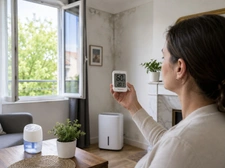
Your home's humidity level plays a vital role in your daily comfort, your family's health, and the value of your property. If it is too high, it encourages mold growth and building deterioration. If it is too low, it dries out the indoor air. In this guide, we explain how to understand humidity levels, identify ideal values, accurately measure humidity, and take effective action whether you are a seller or a buyer.
What Is Hygrometry? Understanding the Percentage of Humidity in a Room
Hygrometry refers to the measurement of the amount of water vapor present in the air inside a home, expressed as a percentage. This humidity level actually represents relative humidity: it indicates the ratio between the amount of water vapor currently in the air and the maximum amount that the air could hold at a given temperature. Simply put, a humidity level of 50% means the air contains half the water vapor it is capable of holding.
This phenomenon plays a key role in everyday comfort and in preserving your property. Properly controlled relative humidity protects walls, finishes, and the health of occupants.
Relative Humidity and Temperature: What Is the Relationship?
Warm air can hold more water vapor than cold air. As a result, when you heat a room, the relative humidity decreases, even if the actual amount of water vapor remains unchanged.
This explains seasonal variations: in winter, indoor heating dries the air and lowers humidity levels. Conversely, in summer or during rainy periods, the ambient air can contain more water vapor, causing humidity levels to rise.
Does Humidity Rise or Fall Inside a House?
Humid air is slightly lighter than dry air, but this difference in density is too small to cause significant vertical movement at room temperature.
Condensation occurs when moisture-laden air comes into contact with cold surfaces such as exterior walls, windows, or poorly insulated ceilings. This is where water vapor turns into droplets, creating visible signs of moisture and encouraging mold growth. This is why it is essential to ventilate regularly and monitor areas that are exposed to outdoor temperatures.
What Is the Normal Humidity Level in a House?
To ensure optimal comfort and preserve your property, it is essential to maintain a balanced indoor humidity level. According to ADEME, the ideal humidity range is between 40% and 60% in living spaces. This range supports both everyday well-being and the long-term preservation of your home by preventing damage caused by excess moisture or excessively dry air.
Ideal Humidity Levels by Room and Season
Humidity requirements vary depending on the room and the season. The following table provides guidance for maintaining appropriate humidity levels throughout your home.
Room | Ideal Summer Humidity | Ideal Winter Humidity |
|---|---|---|
Living Room | 50–60% | 40–50% |
Bedroom | 50–55% | 45–50% |
Bathroom | 40–60% (outside usage periods) | 40–60% (outside usage periods) |
Kitchen | 50–60% | 40–50% |
Basement / Laundry Room | 50–65% | 45–55% |
This table provides useful benchmarks for monitoring humidity levels in your home and taking corrective action when necessary.
Recommended Humidity Levels in a Bedroom and Bathroom
The bedroom deserves special attention because you spend nearly one-third of your time there. The ideal humidity level is between 50% and 55%, promoting better sleep and reducing allergy risks. For children's bedrooms, aim for a slightly broader range between 30% and 55%, adjusting according to the season and your child's comfort.
In the bathroom, humidity spikes are normal after a shower or bath. The important thing is that the excess moisture is quickly removed through effective ventilation such as an extractor fan or mechanical ventilation system. Outside periods of use, humidity should return to the 40%–60% range.
Maximum Humidity Levels in Winter and Summer
Above 60%–65%, risks increase significantly: mold growth on walls and ceilings, deterioration of finishes, unpleasant odors, and respiratory issues. In winter, heating naturally dries the air and lowers humidity levels. In summer, humidity can rise, particularly in warm regions or during periods of heavy rainfall.
Regularly monitor humidity levels to avoid these imbalances and protect the value of your property. If you are preparing to sell or considering a purchase, do not hesitate to contact an Optimhome advisor for recommendations tailored to your project.
How to Measure Humidity Levels in Your Home
Using a Hygrometer for Reliable Measurements
To accurately determine indoor humidity levels, a hygrometer remains the most accessible and reliable tool. Digital and analog models are available from approximately €10 to €30, with more advanced versions featuring easy-to-read LCD displays.
For accurate measurements, place the device at living height and away from heat sources such as radiators or sun-exposed windows. Measure humidity in several rooms, particularly sensitive areas such as bathrooms, kitchens, and bedrooms. Connected indoor air quality monitors offer the additional advantage of measuring both temperature and humidity while tracking changes over several days through a mobile application.
Getting a Professional Assessment for an Older House
If you are planning to buy or sell an older property, having a comprehensive moisture inspection carried out by a professional is highly recommended. An expert can identify issues that are not visible to the naked eye, including rising damp, water infiltration through walls or roofs, and ventilation defects.
This type of assessment is particularly valuable during a real estate transaction because it helps anticipate necessary repairs and avoid unpleasant surprises after completion. Your Optimhome real estate advisor can direct you to qualified professionals and assist you in enhancing your property's value.
Is a Humidity Level of 70% Bad for Your Home?
Yes, a humidity level of 70% is clearly too high and should be considered a warning sign. Above the recommended threshold of 60%, excess moisture creates tangible problems for both occupant health and the durability of the building.
Risks of Excess Humidity for Health and the Building
When humidity reaches 70%, the consequences become apparent quickly. From a health perspective, mold growth on walls and ceilings becomes common, leading to respiratory difficulties, allergies, rhinitis, and asthma, especially among children and sensitive individuals. Musty odors can also become permanently established throughout the home.
From a structural standpoint, the damage can be significant: peeling wallpaper, progressive deterioration of finishes, moisture stains, and condensation on cold surfaces. These issues directly affect a property's value and can complicate negotiations during a sale.
The Effects of Air That Is Too Dry
Conversely, a humidity level below 30%–40% creates a different set of problems. Excessively dry air, which is common during winter heating periods, can cause dry eyes, irritated throats, dehydrated skin, and general discomfort. This environment also promotes the spread of respiratory viruses and can aggravate asthma symptoms.
How to Reduce Humidity Levels in a House?
Ventilating and Airing Out Your Home: Essential Daily Habits
Your first line of defense against excess humidity is daily ventilation. Open your windows wide for at least 10 to 15 minutes each day, ideally in the morning and evening. This simple habit renews indoor air and removes accumulated moisture.
After every shower, ventilate the bathroom immediately for a few minutes. In the kitchen, always use the extractor hood while cooking, especially when boiling water. Avoid drying laundry indoors, as it releases a considerable amount of moisture into the air.
Daily Anti-Humidity Checklist
- Air out all rooms for 10–15 minutes each day
- Always use the kitchen extractor hood
- Dry laundry outdoors or in a well-ventilated room
- Regularly check that the ventilation system is functioning properly
- Monitor walls for signs of moisture
Does Heating Reduce Humidity?
Yes, but with an important caveat. Heating does reduce relative humidity because warm air can hold more water vapor than cold air. However, heating does not solve the underlying problem—it temporarily masks excess humidity without eliminating it.
Be careful not to underheat your home, as this encourages condensation on cold surfaces. When humid air meets a cold wall, water vapor condenses into droplets, creating ideal conditions for mold growth. Maintain a stable temperature throughout the home to minimize this effect.
Mechanical Ventilation, Insulation, and Renovation: Long-Term Solutions
For a lasting solution, consider installing a mechanical ventilation system. A single-flow system removes stale, humid air from the home, while a double-flow system recovers heat from outgoing air to preheat incoming fresh air, offering better energy performance.
Wall insulation and replacing old windows with double glazing help reduce thermal bridges and limit cold surfaces where condensation forms. If your older home shows signs of rising damp at the base of walls, professional treatment may be required.
These energy-efficiency improvements increase property value and may qualify for financial assistance programs such as MaPrimeRénov'. Do not hesitate to contact an Optimhome advisor for guidance and support in maximizing your property's value.
How to Increase Humidity Levels in an Overly Dry House?
The opposite problem can also occur: during winter, heating naturally dries indoor air and may reduce humidity levels below 30%. Excessively dry air causes discomfort such as dry eyes, irritated throats, dry skin, and even a greater sensation of cold despite adequate heating.
Several simple solutions can help increase humidity. An air humidifier is the most effective option, especially in bedrooms and living rooms. Houseplants such as areca palms or ficus trees act as natural humidifiers by releasing water vapor into the air. Occasionally drying laundry indoors can also help raise humidity levels.
However, be careful not to overdo it. Regularly check your hygrometer and aim to maintain humidity between 40% and 60%.
What Impact Does Humidity Have on a Real Estate Project?
When preparing to sell or buy a property, humidity levels play a significant role in how the property is perceived. Buyers are highly sensitive to visible wall stains, persistent odors, and signs of mold that indicate an underlying moisture problem. These issues can slow down a transaction or lead to price negotiations, even when the rest of the property is attractive.
To increase your property's appeal before listing it for sale, consider energy-efficiency improvements such as wall insulation or the installation of a double-flow ventilation system. These upgrades improve indoor air quality, reduce rising damp, and enhance the property's attractiveness. They may also qualify for financial assistance such as MaPrimeRénov' or an eco-interest-free loan, reducing renovation costs while increasing property value.
If you are a buyer, consider requesting a moisture inspection before signing, especially if you notice suspicious signs. Although not mandatory, this assessment provides valuable protection and helps anticipate future repair costs.
If you have a buying or selling project, contact an Optimhome real estate advisor for assistance in evaluating and enhancing your property's value.
Frequently Asked Questions About Home Humidity Levels
What Is the Ideal Humidity Level for a House?
According to ADEME, the ideal indoor humidity level is between 40% and 60%. This range ensures optimal respiratory comfort while preserving the structure of your property. In winter, aim for 40%–50%, while 50%–60% is acceptable during summer. Each room has specific requirements: bedrooms generally require lower humidity levels than bathrooms, where temporary humidity spikes are acceptable if ventilation is effective.
Can a Humidity Level of 70% Damage a House?
Yes. A humidity level above 65% encourages mold growth on walls and wallpaper, causes unpleasant odors, and leads to deterioration of finishes. Health consequences can also be serious, including allergies, respiratory difficulties, and asthma. To protect both your property and your health, maintain humidity levels between 40% and 60% through daily ventilation and effective mechanical airflow systems.
Is a Humidity Level of 70% Suitable for a Bedroom?
No. A humidity level of 70% is far too high for a bedroom. The ideal humidity range is between 50% and 55%, or between 30% and 55% for a child's room. A humidity level of 70% encourages mold growth on walls and wallpaper, causes unpleasant odors, and increases the risk of allergies and respiratory issues. If you notice this level in a bedroom, ventilate the room immediately, check the ventilation system, and consider using a dehumidifier to restore a healthy indoor environment.
Author :

Fabrice DOBROWOLSKI - Optimhome Network Development Director
Optimhome offers you personalized support for your real estate project. Benefit from all my advice, based on several years of experience, to ensure the success of your project.