Getting ready to sell your house and you've heard about home staging? This staging technique, imported from the United States, promises a faster sale at the best price. But does it really deliver? Does home staging really increase the value of a house for sale, or is it just a passing trend?
The beneficial impact of home staging is well recognized when it's done properly, but the answer deserves some nuance. Home staging doesn't transform a property in depth the way major renovation work would, but it acts powerfully on a decisive lever: buyers' perception. In this article, we cover everything you need to know about home staging, its role at every stage of a sale, its different forms — including virtual home staging — its guiding principles, and the pitfalls to avoid so it becomes a genuinely worthwhile investment.
Getting ready to put your house or apartment on the market? Start with a free only property valuation with Opthimhome.
Information current as of 2026.
In summary
· Impact on perceived value:home staging mainly boosts a property's appeal and perceived value, which translates into more qualified viewings, a faster sale, and a stronger negotiating position.
· Not a renovation project: it relies on light, low-cost interventions (decluttering, depersonalizing, minor repairs) — not to be confused with major works.
· Several possible forms:physical, partial, or virtual home staging — the latter, offered by Optimhome advisors, elevates listings and helps buyers picture themselves in the space.
· Worthwhile if kept in check: the goal is a small budget for a strong effect. Beyond that, you're in renovation territory, which follows a different logic.
Need expert advice? An Optimhome advisor knows exactly which adjustments will genuinely add value to your property.
What is home staging?
Before measuring its impact, let's clarify what this technique does and doesn't cover.
Definition and origin
Home staging (literally "staging the home") is a property-valuation method that emerged in the United States in the 1970s. Its principle: present a home at its best to spark love-at-first-sight in as many buyers as possible. The goal isn't to decorate for yourself, but to neutralize and harmonize the space so every visitor can picture themselves living there, regardless of their personal taste.
Home staging is neither decoration nor renovation
This is an essential distinction. Decorating expresses the occupant's personality; home staging, by contrast, seeks to erase it in order to create a neutral, universal setting. Renovation, meanwhile, transforms the property in depth (kitchen, bathroom, structural work) with a substantial budget. Home staging works through light interventions instead: tidying, decluttering, repairing, rearranging, freshening up. Three very different logics that shouldn't be confused.
Key takeaway
• Home staging showcases a property to appeal to as many buyers as possible.
• It's distinct from decorating (personal) and renovation (heavy and costly).
Does home staging really increase the value of a home?
Now for the central question. The answer hinges on one key nuance.
Real vs. perceived value
Home staging doesn't increase a property's real (or market) value the way an extension or a full renovation would: it changes neither the square footage, nor the structure, nor the fittings. What it does strongly influence, however, is perceived value: a clean, bright, tidy, harmonious home comes across as better maintained, more spacious, and more desirable. And it's this perception that sparks the desire to buy — which, often, makes all the difference in the price achieved.
An impact on the final price and negotiation
In practice, a well-staged property sells faster and is negotiated down less. Why? Because a home that sparks an emotional connection attracts more buyers, creates a sense of scarcity, and deprives buyers of leverage to push the price down (visible flaws, an impression of neglect, difficulty picturing themselves there). A neglected property, on the other hand, naturally invites negotiation. Home staging therefore protects your price: it doesn't artificially "inflate" the value, but it helps you sell as close as possible to your valuation, and in better time frames.
Key takeaway
· Home staging affects perceived value, not the property's structural value.
· Result: a faster sale, limited negotiation, and a preserved final price.
When does home staging come into play?
Home staging isn't an isolated step: it runs through the entire sale, from preparation to signing.
Before the estimate and the sale
Ideally, home staging happens upstream, even before photos and the first viewings. Preparing the property ahead of the valuation also means presenting it at its best to the advisor, and starting off with a coherent, defensible price position.
For the listing and photos
This is a decisive moment. Today, nearly all buyers discover a property online: photo quality determines how many inquiries you get. A staged interior produces attractive visuals that stand out on listing portals and drive viewing requests. A polished listing is already half the job done.
During viewings
During viewings, home staging has its full effect: a tidy, bright, depersonalized home lets the visitor picture themselves there immediately and rediscover, in person, the promise made by the listing. The positive emotion felt on-site is often decisive in the purchase decision.
Key takeaway
· Home staging is prepared before the valuation and photos, then produces its effects during viewings and negotiation.
· Its influence runs across the entire sales chain, right through to the final price.
The different types of home staging
Not every situation is the same: depending on the property and the budget, several approaches are possible.
Physical (classic) home staging
This is the original form: you actually intervene in the home. Decluttering, rearranging furniture, depersonalizing, minor refresh work (neutral paint, grout, light fixtures), even furniture rental for a vacant property. Effective, but it requires time and a controlled budget.
Partial or light home staging
Not all rooms carry equal weight. Partial home staging concentrates effort on the spaces that drive the decision — entryway, living room, kitchen, bathroom — for maximum impact at a lower cost. A pragmatic approach, ideal when budget or time is limited.
Virtual home staging (offered by Optimhome)
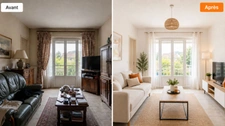
An innovation that has become essential, virtual home staging involves digitally furnishing and arranging a property within the listing photos : visually clearing a cluttered room, furnishing a vacant home, or projecting different styles. This is exactly what Optimhome advisors offer to create high-quality property listings : attractive visuals that help buyers picture themselves in the space even before the viewing. Fast, economical, and especially useful for vacant or unconventional properties, virtual home staging maximizes the impact of the online listing - right where buyers make their cut.
Key takeaway
· Three approaches: physical (real interventions), partial (key rooms), and virtual (digital staging of photos).
· Optimhome's virtual home staging enhances the listing and helps buyers picture themselves there, at a lower cost.
The Key principles of successful home staging
A few simple rules capture most of the effect. Declutter first: remove anything superfluous to open up the space and the volumes. Then depersonalize: put away family photos, collections, and strongly personal items so visitors can picture themselves there. Neutralize colors and style, favoring light, timeless tones. Fix small flaws (a broken handle, blackened grout, a leaking tap, a marked wall) that create an impression of neglect. Optimize brightness by cleaning windows, clearing window areas, and adding light sources. Finally, highlight the volumes and flow of the space so every room feels functional and pleasant. The constant goal: a clean, neutral, bright, welcoming interior.
Home staging: pitfalls to avoid
Done well, home staging pays off; poorly managed, it can cost you dearly for nothing. The first pitfall is confusing it with renovation: undertaking major work (redoing a kitchen, knocking down a wall) goes beyond the logic of home staging and isn't always recouped at resale. The second pitfall: overspending. Home staging should stay low-cost: several small, high-impact actions are worth more than an unreasonable budget. The third pitfall: over-decorating or imposing a particular style, risking the recreation of a personal atmosphere that divides opinion. Conversely, be careful not to hide flaws or conceal a defect: home staging enhances, it doesn't deceive — a hidden flaw will resurface during inspections or the viewing. Finally, avoid misleading virtual home staging: retouched photos must remain faithful to the property's actual condition, or you risk disappointing buyers at the viewing and breaking their trust.
Key takeaway
· Home staging should stay light, neutral, and low-cost: it isn't renovation.
· Never deceive: you enhance, you don't hide flaws.
How much does home staging cost, and is it cost-effective?
The great strength of home staging is its cost-benefit ratio. Unlike a renovation, which can run into the thousands or even tens of thousands of euros, it often relies on a modest budget: a few smart purchases, some paint, time spent tidying, and possibly a staging service or virtual home staging. The guiding idea can be summed up in one sentence: a small investment for a big effect.
The return comes from three levers: a shorter time on the market (fewer monthly payments, less carrying cost), limited negotiation (the price holds up better), and a higher volume of inquiries (more potential buyers). That said, it needs to be carefully calibrated: every euro spent should serve the sale. This is where professional insight proves valuable, to focus effort where it truly counts.
Réussir votre vente avec l'accompagnement Optimhome
Home staging performs best when it's part of a coherent sales strategy: the right price, an appealing listing, targeted staging. Two habits make the difference.
First, an accurate valuation. It sets a realistic, defensible price on which the home staging can build. Optimhome's online property valuation tool gives you a reliable first benchmark of your property's value, for free, in just a few minutes.
Second, support from an advisor. An Optimhome real estate advisor knows exactly which adjustments will genuinely add value to your home, carries out or coordinates virtual home staging to create compelling listings, stages the viewings, and defends your price during negotiation. All of which helps you sell faster and at the best price, without unnecessary spending.
Start with a free online valuation, then get support from an Optimhome real estate advisor near you.
· Home staging increases perceived value, not structural value: it helps you sell faster and better.
· It comes into play before the valuation and photos, then weighs on viewings and negotiation.
· Three forms: physical, partial, and virtual (offered by Optimhome).
· It should stay light, neutral, and low-cost — never a renovation, and never deceptive.
· Get your property valued with Optimhome and get support from an advisor for cost-effective home staging.
FAQ
Does home staging really increase a house’s value ?
It mainly increases the property's perceived value and appeal, which helps it sell faster and helps you better defend your price. It doesn't increase structural value the way a renovation would, but it helps you sell as close as possible to the valuation by limiting negotiation.
How much does home staging cost?
Home staging relies on a deliberately modest budget: tidying, depersonalizing, minor repairs, neutral paint, and possibly a staging service or virtual home staging. The golden rule: a small investment for a strong impact — far less than the cost of a renovation.
What is virtual home staging?
It's the digital staging of a property within the listing photos: furnishing a vacant home, visually decluttering a room, or projecting different styles. Optimhome advisors use it to create attractive listings and help buyers picture themselves in the space. The visuals must, however, remain faithful to reality.
When should you do home staging?
Ideally before the valuation, the photos, and the viewings, so the property is presented at its best from the moment it's listed. Its effects then continue throughout the sale: listing, viewings, and negotiation.
Home staging or renovation work: what to choose to sell?
To sell, home staging (light and low-cost) is generally more cost-effective than major work, which isn't always recouped at resale. Renovation is mainly worthwhile in cases of significant wear and deterioration. An Optimhome advisor can help you decide based on your property and your local market.
What are the pitfalls of home staging to avoid?
Confusing home staging with costly renovation, overspending, imposing too personal a style, hiding flaws (instead of addressing them), or misleadingly retouching photos. Home staging should stay light, neutral, honest, and well-controlled.
Information current as of the publication date (2026). The effects of home staging vary depending on the property, the local market, and the quality of execution; for personalized advice, contact an Optimhome advisor
Publication author

Fabrice DOBROWOLSKI, Director of Network Development at Optimhome
"Benefit from my expert advice, built on many years of experience in real estate, to help ensure the success of your property purchase or sale."