Clay shrinkage and swelling, known in France as retrait-gonflement des argiles or RGA, is a geological phenomenon in which clay soils alternately shrink and swell depending on their water content, causing cracks and structural damage to house foundations. In France, more than one municipality in two is now affected by a medium or high RGA risk, a figure that is constantly rising with climate change and the increasing number of drought episodes followed by intense rainfall. Before buying, it is therefore essential to check a property’s exposure via the Géorisques map and the statement of natural, mining and technological risks, known as the ErNMT, and to assess the consequences for insurance, price negotiation and the diagnostics to request.
Key takeaways
• RGA affects millions of detached houses built on clay soils in France, with the risk increasing due to climate change.
• The ErNMT, a mandatory document appended to any preliminary sale agreement, makes it possible to identify the property’s level of exposure.
• A house located in a high-risk area should not necessarily be avoided, but it requires technical checks and may justify price negotiation.
• Being supported by an Optimhome real estate adviser helps anticipate these points from the viewing stage and secure the transaction.
Understanding the phenomenon of clay shrinkage and swelling in France
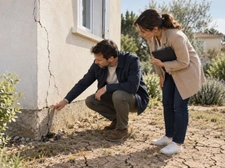
Clay soils have the particularity of changing volume depending on their water content. During prolonged drought periods, clay loses moisture, shrinks and cracks deep underground. When rainfall returns, it swells again as it absorbs water. This alternation of movements places mechanical stress on building foundations, which were not designed to absorb these variations. The most visible consequences are façade cracks, often stair-step cracks around openings, separation between the house and an extension, or damage to buried pipework.
Not all homes are equal when faced with this risk. Detached houses with shallow foundations, built before the 2000s on clay soils, are the most vulnerable. Apartment buildings, which generally have deeper foundations, are overall less exposed, although some cases do exist.
A risk increasing sharply with climate change in France
RGA is not a new phenomenon, but its intensity and frequency have increased over the past decade. Climate change is multiplying summer drought episodes while concentrating rainfall into shorter and more intense periods. This abrupt alternation between very dry soils and waterlogged soils accelerates shrinkage-swelling cycles and worsens damage to foundations.
Insurance companies and public authorities now consider RGA to be one of the main climate risks for detached housing in France, alongside flooding. Several regions that were historically less affected, particularly in the north and west of the country, are seeing new medium- to high-risk areas appear as droughts intensify. This context makes checking clay-related risk essential for any property purchase project, including in areas previously considered to have low exposure.
How to check a property’s exposure before buying in France
The Géorisques map: the first reflex
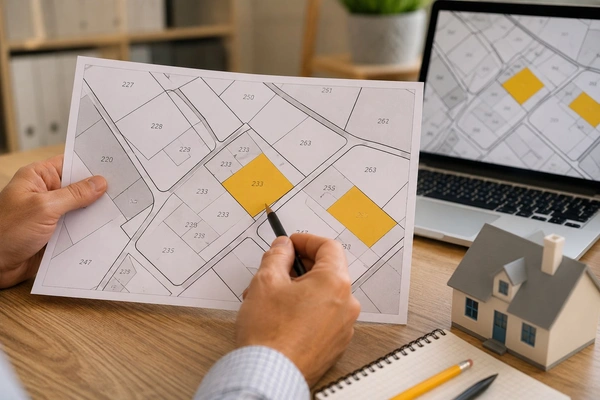
The official Géorisques website, made available by the French Ministry for Ecological Transition, allows you to consult the clay shrinkage and swelling exposure map free of charge for any address in France. The risk level is classified into three categories: low, medium or high. You simply enter the property address to obtain an initial reliable indication, which should then be cross-checked with other sources.
The ErNMT: a mandatory sale document in France
The statement of natural, mining and technological risks, known as the ErNMT, is a document that the seller must provide to the buyer and append to the promise or preliminary sale agreement. It details all natural and technological risks to which the property is exposed, including RGA when the municipality is concerned. This document must be less than six months old at the time of signing. Its absence or inaccuracy may incur the seller’s liability and allow the buyer to request a price reduction, or even cancellation of the sale in certain cases.
• Request the ErNMT from the viewing stage, before making any purchase offer.
• Check consistency between the ErNMT and the Géorisques map.
• Ask the seller about any past damage linked to drought.
• Consult the municipality’s risk prevention plan, or PPR, if one exists.
To refine your project and compare several properties with full knowledge of the facts, an online property valuation gives you an initial value benchmark, to be adjusted according to the identified level of risk.
Impact on home insurance and natural disaster cover in France
RGA is covered by the natural disaster guarantee included in comprehensive home insurance policies, but its activation follows strict rules. Unlike a flood or storm, geotechnical drought must be subject to an interministerial order recognising a state of natural disaster for the municipality concerned and for a given period. Without this order, damage linked to RGA is not compensable under this guarantee, even if the damage is real.
This specificity explains why many owners affected by drought-related cracks encounter difficulties obtaining rapid compensation. Recognition procedures can take several months, or even several years, and the applicable deductibles are generally higher than for other natural disasters. For a buyer, it is therefore useful to check whether the municipality has already been subject to natural disaster orders linked to drought in the past, as this may indicate the area’s vulnerability.
Preventive and construction measures against RGA in France
Several technical measures can limit the effects of clay shrinkage and swelling on a building, whether for an existing property or a new-build project.
• Deep foundations, anchored below the zone influenced by variations in soil moisture.
• A watertight perimeter strip around the house, limiting water infiltration in the immediate vicinity of the foundations.
• Sufficient distance from trees and shrubs with high water absorption capacity, whose roots dry out the soil at depth.
• Controlled rainwater management, with downpipes connected away from the foundations.
• Reinforced horizontal and vertical tie beams on existing buildings located in high-risk areas.
Since 2020, French regulations have required preliminary geotechnical studies for new constructions located in medium- or high-exposure areas, with adapted construction rules. For an older property, these systems are not always present, which justifies particular vigilance when buying.
Consequences for price negotiation and diagnostics to request
A property located in a medium- or high-RGA risk area should not necessarily be ruled out, but this information must be factored into the negotiation. The presence of existing cracks, even old and stabilised ones, deserves careful examination: their shape, location and evolution provide indications of the origin of the disorder. In case of doubt, it is recommended to have a soil study or structural diagnostic carried out by a geotechnical engineering office before finalising the purchase.
This additional diagnostic, although not mandatory in all cases, may cost a few hundred euros but helps avoid unpleasant surprises after signing. Its conclusions can also serve as a negotiation argument: a proven risk, active cracks or the absence of suitable preventive measures often justify a price reduction to cover future strengthening works. Conversely, a property already equipped with reinforced foundations or that has undergone underpinning works can be negotiated with greater peace of mind. In all cases, an Optimhome real estate adviser can direct you to the right technical contacts and help you factor this parameter into your purchase offer.
Conclusion
Clay shrinkage and swelling has become an essential criterion to analyse for any property purchase in France, given how much the phenomenon has increased with climate disruption. Checking the Géorisques map, requiring an up-to-date ErNMT and, where appropriate, commissioning a soil study make it possible to buy with full knowledge of the facts and anticipate potential prevention or repair costs.
This risk should not systematically prevent a purchase, but it should be treated as a factor for negotiation and vigilance. To explore Optimhome property listings while integrating this criterion from the outset, or to estimate a property you wish to sell transparently, support from a local professional remains the best way to secure your project.
FAQ
How can I know whether my future house is in an RGA risk area in France?
You can consult the clay shrinkage and swelling exposure map free of charge on the Géorisques website by entering the property address. This risk level must also appear in the statement of natural, mining and technological risks, or ErNMT, provided by the seller before the sale.
Is the ErNMT really mandatory for all properties in France?
Yes, as soon as the municipality where the property is located is affected by at least one identified risk, including RGA. This document must be appended to the preliminary sale agreement and be less than six months old, otherwise the seller’s liability may be incurred.
Are cracks caused by RGA always reimbursed by insurance?
No, compensation depends on the natural disaster guarantee, which is only activated after an interministerial order recognising a state of natural disaster for the municipality and period concerned. Without this order, drought-related damage is not covered under this guarantee.
Can you buy a house that has already had cracks linked to RGA?
Yes, provided that the origin and stability of the cracks are assessed by a professional before purchase. If strengthening works have already been carried out, this may even provide reassurance about the property’s future structural solidity.
What works can limit RGA risk on an existing house in France?
Moving trees away from foundations or pruning them, installing a watertight perimeter strip and properly managing rainwater drainage are among the most accessible measures. In the most severe cases, underpinning of the foundations may be necessary.
Does RGA risk reduce a property’s value in France?
It can weigh on the price, especially in a high-risk area or where visible structural disorders are present, but it does not systematically devalue a properly built and maintained property. A precise valuation that takes this criterion into account makes it possible to set a fair price, both when buying and when selling.
Author :

Fabrice DOBROWOLSKI - Optimhome Network Development Director
Optimhome offers you personalized support for your real estate project. Benefit from all my advice, based on several years of experience, to ensure the success of your project.