The bail réel solidaire, or BRS, makes it possible to buy a home by paying only for the building itself, while the land remains the property of a community land trust, known in France as an organisme de foncier solidaire or OFS, in return for a modest monthly ground rent. This mechanism, which has been expanding rapidly in major French metropolitan areas since 2024, can reduce the purchase price by 20% to 40% compared with the open market. Reserved for first-time buyers subject to income ceilings, it comes with specific resale constraints that should be understood before committing.
Key takeaways
• The BRS separates ownership of the home, which is purchased, from ownership of the land, which is leased through a monthly ground rent paid to a community land trust.
• The saving at purchase generally reaches 20% to 40% compared with open-market prices in the same area.
• Access is subject to income ceilings and to an obligation to occupy the property as a main residence, with no time limit.
• On resale, the price is capped by the OFS, and the buyer must also meet the eligibility conditions.
The principle of the BRS in France: separating the land from the building
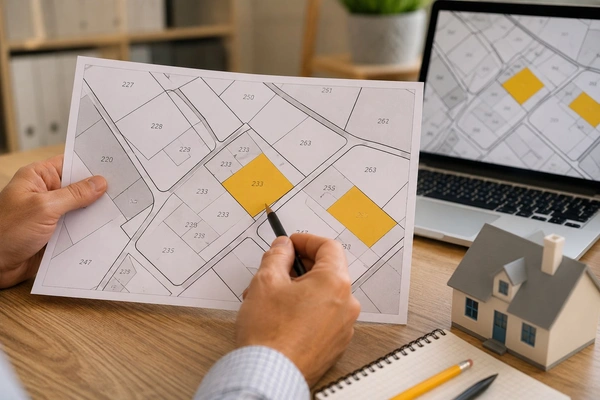
The bail réel solidaire (BRS) is based on a simple idea: the price of a home is made up of the building, meaning the walls and construction, and the land on which it stands. In tight French housing markets, the land can represent up to half, or even more, of the total price of a property. The BRS scheme consists of having this land held by an organisme de foncier solidaire (OFS), a non-profit structure approved by the French state or by local authorities.
In practical terms, the buyer becomes the owner of their home, but not of the land. They sign a very long-term lease with the OFS, generally lasting between 18 and 99 years and renewable, in exchange for a monthly ground rent. This legal structure, governed by the French Construction and Housing Code, ensures that the home remains affordable over the long term, because it can only be resold at a capped price and to a buyer who also meets the income-ceiling requirements.
A ground rent to include in the budget
The counterpart to this separation is the payment of a monthly ground rent to the OFS, generally between €1 and €3 per square metre depending on the area. For a 70 m² home, this represents around €70 to €210 per month, to be added to the mortgage repayment. However, this ground rent is largely offset by the lower purchase price, and it is taken into account when calculating the debt-to-income ratio during the mortgage application.
What real saving can you expect when buying in 2026?
The main argument in favour of the BRS remains financial. By excluding the cost of the land from the equation, BRS homes display prices 20% to 40% lower than comparable properties sold in full ownership in the same neighbourhood. In some French metropolitan areas where the market remains tight, this gap can even exceed 40% for new-build programmes located in city centres.
This price difference makes a concrete difference to a purchase budget. A couple that could only target a one-bedroom apartment on the outskirts may, thanks to the BRS, be able to consider a two-bedroom apartment closer to the city centre or to public transport. Before comparing offers, it is useful to request an online property valuation in order to precisely measure the gap between the price of a conventional property and that of an equivalent BRS property in the same area.
Easier access to subsidised loans in France
Homes purchased under a BRS are eligible for the zero-interest loan, known in France as the PTZ, often under more favourable conditions than in the traditional existing-home market, as well as for certain regulated loans. Reduced VAT at 5.5% also applies to many new-build BRS programmes, further reducing the overall cost for the buyer.
Who can buy under a BRS in France? Eligibility conditions
The BRS is not open to all buyers. It primarily targets modest and middle-income households that struggle to become homeowners in areas where prices are high. Several cumulative conditions must be met.
• Income ceilings set by decree must not be exceeded; these vary depending on household composition and geographical area and are close to those used for the social rent-to-buy scheme.
• The home must be occupied as a main residence, which excludes purchases as a second home or as a conventional rental investment.
• The buyer must not already own their main residence at the time of purchase, except in specific cases such as disability or divorce.
• Where applicable, local criteria set by the OFS or the local authority must be respected, such as priority order or quotas for certain groups, including young professionals or families.
These conditions make the BRS particularly suitable for first-time buyers in France, especially young professionals, single-parent families or households whose income is just above the social housing thresholds but still insufficient to buy on the open market.
The constraints to understand before committing
The BRS offers a real financial advantage at purchase, but it comes with specific rules that must be anticipated, especially at the time of resale.
A capped resale price
Unlike a conventional property, a BRS homeowner cannot resell at the open-market price. The transfer price is governed by a formula set out in the lease, generally indexed to a benchmark index, in order to ensure that the home remains affordable for the next buyer. This means that the potential capital gain is more limited than with a conventional purchase, even though the owner logically recovers their initial investment, revalued, as well as the value of any works carried out.
Approval by the community land trust
Any resale must be validated by the OFS, which checks that the new buyer meets the income ceilings and occupancy conditions. The OFS may also have a right of pre-emption or an intermediary role in some cases, which can lengthen the sale timeframe compared with a conventional transaction. It is therefore essential to read the lease clauses carefully before signing, particularly those relating to exiting the scheme.
Resale remains possible, but regulated
Contrary to a common misconception, the BRS does not prohibit resale: it regulates it. The owner remains free to sell at any time, provided they respect the capped price and find an eligible buyer. An Optimhome real estate adviser can support this process, in coordination with the OFS, to secure each stage of the transaction and avoid procedural errors.
Where can you find BRS homes in France in 2026?
The scheme, created by the French ALUR law and rolled out from 2017 onwards, has accelerated significantly in recent years. In 2026, there are several dozen approved community land trusts across France, with a strong concentration in areas where housing pressure is most marked.
• Major metropolitan areas such as Paris, Lyon, Bordeaux, Rennes or Lille, where several new-build BRS programmes are developed each year.
• Coastal and border areas under strong tourism pressure, where the BRS helps maintain year-round residents despite speculative pressure.
• Medium-sized towns in tight housing markets that are developing their own OFS structures to retain young households and essential workers, such as teachers and healthcare professionals.
The BRS housing stock remains concentrated in the new-build sector, although acquisition-improvement operations in the existing-home market are beginning to develop in some urban areas. To identify available opportunities, it is advisable to regularly consult Optimhome property listings, which include both conventional properties and offers linked to affordable home-ownership schemes depending on the area.
Which buyer profile is the BRS relevant for in France?
The BRS is primarily intended for specific profiles for whom the conventional property-purchase equation does not work in tight markets.
• First-time buyers whose income is too high for social housing but insufficient to buy in the local open market.
• Young professionals and young couples who want to live closer to their employment area without moving to the far outskirts.
• Families looking for a long-term main residence, without a short-term speculative resale objective.
• Households sensitive to the solidarity-based dimension of the scheme, which helps maintain social diversity in high-pressure neighbourhoods.
Conversely, the BRS is not suitable for a rental investment project or for buying a second home, since occupation as a main residence is a mandatory condition of the scheme.
Conclusion
The bail réel solidaire offers a concrete response to the growing difficulty of becoming a homeowner in tight French housing markets, by making it possible to buy a home 20% to 40% cheaper thanks to the separation of land and building ownership. This financial gain has a counterpart: a monthly ground rent paid to the community land trust, income ceilings to respect and a regulated resale price that limits the potential capital gain.
For an eligible first-time buyer ready to commit for the long term to a main residence, the BRS nevertheless remains one of the most effective levers for becoming a homeowner without taking on excessive debt. Before positioning yourself on this type of property or comparing it with a conventional purchase, a precise assessment of the local market and support from a professional remain the best allies for securing the project.
FAQ
Is the BRS reserved for new-build homes in France?
The vast majority of BRS homes concern new-build programmes, but operations in the existing-home market through acquisition and improvement are gradually developing in some cities. However, supply remains more limited in the existing-home market than in the new-build market in 2026.
Can you rent out a home bought under a BRS?
No, the home must be occupied by the owner as their main residence. Renting it out, except in exceptional cases regulated by the OFS, is not authorised under this scheme.
What happens if my income exceeds the ceilings after purchase?
The income ceilings apply at the time of purchase, not afterwards. A change in income after acquisition therefore does not call into question ownership of the BRS home.
Is the BRS compatible with the French zero-interest loan, or PTZ?
Yes, BRS homes are eligible for the PTZ, often under advantageous conditions, which further improves the financial accessibility of the scheme for first-time buyers.
Can a BRS home be passed on to heirs?
Yes, the home can be transferred by inheritance, but the heirs must meet the same eligibility conditions if they wish to live in it; otherwise, the property will have to be resold within the framework regulated by the OFS.
How can you assess whether a BRS property in France is a good deal?
You need to compare the purchase price plus the ground rent with the cost of an equivalent full-ownership property in the same area. An online property valuation and the opinion of a local adviser make it possible to objectify this comparison before making a decision.
Author :

Fabrice DOBROWOLSKI - Optimhome Network Development Director
Optimhome offers you personalized support for your real estate project. Benefit from all my advice, based on several years of experience, to ensure the success of your project.