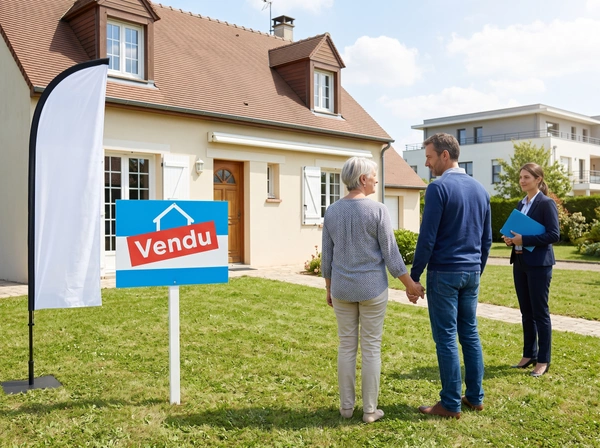
When a couple separates and one partner wants to sell at 320,000 euros while the other refuses to go below 380,000, the situation can quickly stall for months. In practice, the law in France provides several solutions: an adversarial property appraisal (expertise immobilière contradictoire) to set an objective price, mediation to restore dialogue, and, as a last resort, a court-ordered sale known as a licitation, ordered by the court when a co-owner holds at least two thirds of the rights in the property. Most of the time, an estimate carried out by a professional who is independent of the case is enough to unblock the situation before it has to go before a judge. This article explains, step by step and in plain language, how to get out of this kind of deadlock without losing all your savings or years of your life.
In summary
- After a separation, the house remains in joint ownership (indivision) until it is sold or bought out by one of the two ex-partners, and each must agree on the price.
- In the event of a deadlock, there is a graduated range of solutions: direct discussion, adversarial property appraisal, family mediation, and then a court-ordered sale (licitation) if nothing else works.
- The notary plays a central role in dividing the sale proceeds, in particular for calculating equalisation payments (soultes), the accounts between co-owners and any compensatory allowance (prestation compensatoire).
- Having your property valued by a neutral professional from outside the couple is often the quickest and least costly way to resolve the dispute over the price.
Why the sale price so often becomes the number one point of friction
I see it in almost all of my separation cases: the disagreement almost never concerns the principle of selling itself, but the amount. That makes sense when you think about it. The house is often the couple's most valuable asset, full of history and memories, and sometimes of renovation work paid for in unequal shares. Each person has a firm idea of its value, and that idea is rarely neutral: the one who wants to leave quickly will tend to underestimate it, while the one who needs money to find new housing will tend to overvalue it.
The emotional weight in valuing the property
A property is never just a number on a sheet of paper. When you have built your family life in a house, you naturally tend to attach a sentimental value to it that has nothing to do with the market. I have seen ex-partners hold firm on a price 15% above the market simply because "it's the house where the children grew up." That is human, but it doesn't move the case forward by an inch.
Very concrete financial stakes for each person
On the other side, there are very down-to-earth realities: the need for cash to buy another home, reduced borrowing capacity after the separation, child support to pay, a compensatory allowance to settle. The sale price is therefore never just a matter of the property market; it is also a matter of personal cash flow for each of the two ex-partners, which explains why discussions can get bogged down.
The status of the property after the separation: joint ownership, a framework worth understanding well
As long as the house has not been sold, it remains in joint ownership (indivision) between the two ex-partners, whether they were married, in a civil partnership (pacs) or living together without any legal status. In practical terms, this means that each holds a share of the property (often 50/50, sometimes different depending on the initial contribution) and that no major decision can be made without the other's agreement, in particular the sale.
The majority rules that apply
The law distinguishes several levels of decision. Day-to-day management acts (paying the property tax, maintaining the property) can be decided by a two-thirds majority of the rights in joint ownership. But the sale of a jointly owned property, in principle, requires unanimity, unless one goes through the judicial licitation procedure that we detail below, which precisely allows one or more co-owners holding two thirds of the rights to apply to the court.
What a drawn-out joint ownership costs
A joint ownership that drags on is never free. The mortgage keeps running, the property tax has to be shared, the property has to be maintained, and sometimes an occupancy indemnity (indemnité d'occupation) is owed to the other by the one who stays living in the house. The longer the disagreement lasts, the higher the bill climbs for both parties, not to mention the psychological toll. It is often this very concrete argument that finally brings everyone back to the table.
The adversarial property appraisal, often the first effective solution
Before thinking about going to court, there is a much quicker and far less costly step: having a neutral third party carry out an appraisal or valuation. It is, incidentally, the first thing I recommend to clients who are in dispute over a price.
How this appraisal works
In practice, the two ex-spouses jointly appoint an expert (or a recognised local real estate advisor), who visits the property, studies the prices being achieved in the neighbourhood, takes into account the condition of the property and the work that will be needed, and delivers a reasoned valuation. It is also possible to have your property valued by several advisors in order to compare opinions, which generally reassures both parties. If the disagreement persists despite this, the judicial route also provides that the judge may order an expert appraisal, but this takes longer and costs more.
Why an outside opinion often changes everything
What rarely causes the deadlock is the figures themselves, but rather the fact that they come from one side or the other. A figure given by an independent professional, who has no personal interest in the case, carries far more weight. I have seen cases unblocked after a single visit because both parties finally trusted the same source of information.
The expert's view
"In my profession, I spend as much time assessing square metres as I do managing human tensions, and in separation cases, it is often the second part that takes the most time; what I have learned over the years is that you should never negotiate the price directly with both ex-spouses in the same room from the first meeting, because each one stands firm on their position out of pride, whereas by meeting each of them separately and listening to what really lies behind the figure they put forward, you almost always discover that it is not really about money but about recognition, fear of being taken advantage of, or simply the need to mourn the family home; my role is not to decide who is right, it is to put a solid, documented valuation on the table, and to rephrase things in neutral terms until both parties feel they are being treated equally, and once that trust is there, the price is generally negotiated in a single meeting, whereas previously, some cases had been stalled for eight months."
The practical tip
- Have at least two or three independent valuations carried out before any discussion on price, so as to have a realistic and objective range.
- Put the disagreement in writing (exchange of emails or letters) as soon as it arises; this will be useful if you ultimately have to go to court.
- Avoid direct "heat of the moment" negotiations between ex-spouses: always go through a third party, such as a notaire, a real estate advisor or a mediator.
- Anticipate the calculation of the division (soulte, outstanding loan balance, initial contribution) before setting the final price, because the sale price and the division of the proceeds are two related but distinct discussions.
- Do not let the case drag on: each additional month of joint ownership (indivision) has a real cost for both parties.
Family mediation, an option too often overlooked
Many people think that family mediation is only used to settle child custody. In reality, it is just as relevant for resolving a property dispute such as the sale price of a house.
What a mediator concretely brings
The family mediator imposes nothing; they facilitate dialogue. They help each person express their real needs behind the stated position, and understand the other's constraints. In a price disagreement, this often makes it possible to bring out solutions that no one had thought of alone: for example, accepting a price slightly below market value in exchange for a more flexible payment term, or a different split of ancillary costs.
Cost and timelines, compared with court proceedings
Family mediation generally costs a few hundred euros and takes place over two to four sessions, spread over a month or two. This is incomparable with judicial partition proceedings, which can stretch over a year or even longer, and generate much higher lawyer's fees and fees for the notaire appointed to carry out the liquidation. In other words, mediation is worth trying before going any further.
When the disagreement persists: judicial sale, or licitation
If truly no amicable solution succeeds, the law provides a way out: licitation. This is a judicial auction sale organised under the supervision of the court, intended to bring an end to joint ownership (indivision) when no agreement is reached between the ex-spouses.
The conditions for resorting to it
In practical terms, one or more co-owners holding at least two-thirds of the undivided rights may notify the other co-owners of their intention to sell, and then apply to the tribunal judiciaire for authorisation to sell despite the opposition of a minority. A word of caution, however: in a ruling of 5 February 2025, the Cour de cassation reiterated that a co-owner's mere refusal is not enough to automatically justify a licitation (court-ordered sale). The judge assesses on a case-by-case basis whether the continuation of the co-ownership genuinely jeopardises the common interest.
How the procedure works in practice
Once the licitation has been authorised, the court appoints a notaire liquidateur (notary in charge of the liquidation) responsible for organising the public auction and distributing the price among the co-owners, as well as a juge commis (supervising judge) to oversee the proceedings. A cahier des charges (set of sale conditions) is filed with the court registry, a reserve price is set (often below market value to attract bidders), and the sale then takes place publicly. This is a longer procedure, more costly in legal fees, and often less financially advantageous than if the two parties had agreed beforehand on a standard sale through traditional property listings.
The central role of the notaire in dividing the sale price
Whether the sale is made by mutual agreement or by licitation, the notaire is involved in any case to organise the division of the price between the former spouses. Their role is often misunderstood: they are not there to arbitrate a dispute, but to secure the transaction from a legal and tax standpoint.
Calculating soultes and the accounts between co-owners
The notaire first recalculates what each party has actually put into the property: initial contribution, loan repayments made by one more than the other, and works financed separately. These items give rise to "comptes d'indivision" (co-ownership accounts), which adjust the distribution of the sale price in addition to the original share. This is often where surprises are hidden, in one direction or the other.
Tax on the division: what to know for 2025-2026
In the context of a divorce, the division of the property is in principle subject to a droit de partage (partition duty) of 1.10% on the net value of the property divided, a favourable rate compared with a standard sale between private individuals. However, if the sale is made by licitation to a third party outside the couple, higher registration duties, in the region of 5.81%, may apply. This is one more financial argument, often overlooked, in favour of an amicable sale negotiated in good faith rather than a court procedure.
Prestation compensatoire and the sale of the house: two subjects not to be mixed up
Many couples wrongly confuse the sale price of the house with the calculation of the prestation compensatoire (compensatory allowance). They are, however, two distinct legal mechanisms, even though they are often negotiated at the same time at the notaire's office or before the juge aux affaires familiales (family court judge).
How the prestation compensatoire can influence the negotiation
It sometimes happens that a former spouse agrees to sell at a price slightly below market value in exchange for a reduced prestation compensatoire, or vice versa. This is an overall negotiation strategy that can make sense, provided you have good legal support, so as not to end up the loser on the whole case because of an agreement concluded too quickly on a single point.
Why this cross-negotiation should not be rushed
My advice in this kind of situation is always to have the value of the property and the theoretical amount of the prestation compensatoire assessed separately before accepting an overall "package". Otherwise, you risk losing sight of the real value of what you are giving up, drowned in a global negotiation.
Preparing the sale properly to limit tensions from the outset
A good proportion of price disputes can be avoided upstream, simply by setting the framework for the sale of the property correctly.
Choosing a neutral professional accepted by both parties
I always recommend that you find a local real estate advisor who has no special ties to either former spouse, so that both parties trust their valuation and their handling of viewings. This avoids the feeling, always damaging in these cases, that one of the two "has control" over the sale.
Setting clear rules for viewings and offers
It is useful to agree in advance, in writing if necessary, on who receives the offers, within what timeframe each person must give their answer, and what price gap is acceptable without going back to a new discussion. This simple framework avoids a lot of unnecessary back-and-forth once viewings begin and offers start coming in.
Conclusion
A disagreement over the sale price after a separation is never inevitable, even if it can feel that way at the time. In the vast majority of cases, a neutral valuation, well-conducted mediation or support from a notary is enough to unblock the situation without ever setting foot in a court. The licitation (court-ordered sale by auction) exists and is regulated by law, but it remains a last resort, longer, more costly and often less financially advantageous than an agreement reached amicably. The most important thing is not to let the matter drag on: the earlier you act, with objective figures and professional support, the more likely you are to turn the page quickly and under good conditions for both of you.
FAQ - Frequently Asked Questions
Can you force your ex-spouse to sell the house?
Yes, but only under certain conditions. If one or more co-owners in indivision hold at least two-thirds of the rights in the property, they can ask the tribunal judiciaire (judicial court) for authorization to sell despite the refusal of the others, through the licitation procedure. However, the judge does not grant this authorization automatically: they verify that maintaining the indivision is genuinely detrimental.
Who decides the sale price in the event of a disagreement?
First, the two ex-spouses must reach an agreement together, possibly with the help of a real estate expert or a family mediator. If no agreement is reached and the sale goes through a judicial licitation, it is the court, via the notary appointed to handle the liquidation, that sets the reserve price (mise à prix) for the auction sale.
How long can a licitation procedure last?
It varies depending on the courts and the complexity of the case, but you should generally allow between one and two years from the time the judge is seized of the matter to the actual sale, not counting any appeals. This is significantly longer than a standard amicable sale, often completed within a few months through property listings.
Can the notary help us avoid going to court?
Absolutely, and this is often their most useful role in these cases. The notary can organize the amicable division, calculate the accounts between co-owners, propose solutions for buying out the other party's share (soulte), and support both parties through to signing, without ever going through a judicial procedure, provided that a minimum of agreement remains between the ex-spouses.
Is it better to sell before or after the divorce is final?
There is no universal rule; it depends on your situation. Selling before the final judgment can sometimes allow you to benefit from more favorable taxation on the division of assets and to move forward faster in practical terms, but it requires a minimum of understanding between the two parties. In more contentious cases, it is often simpler to wait until the legal framework of the divorce has been established, particularly regarding the prestation compensatoire (compensatory allowance), before finalizing the sale.
Also read on the blog
- Separation: should you sell your property before the divorce?
- Divorce and real estate: managing your home during a separation
- Indivision: how to sell in the event of a disagreement?
Author of the publication

Fabrice DOBROWOLSKI, Director of the Optimhome network
«Benefit from myexpert advice, based on many years of experience in real estate, to ensure the success of your buying or selling project. »