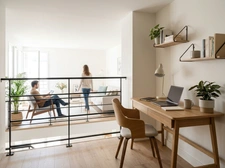
A cluttered basement, a mezzanine that serves no purpose or a storage room full of boxes can cost you several thousand euros when you sell. The solution is simple on paper: give this space a clear function before putting the property on the market, whether as an office, a spare bedroom or a home gym. In 2026, with remote working now widespread and home fitness on the rise, these unconventional spaces are precisely the ones buyers look for the most, provided they are presented as ready to use straight away. This article explains, project by project, how to turn these "undefined" square metres into genuine selling points.
In summary
- An unconventional space (basement, mezzanine, attic, storage room) with no clear function is perceived by buyers as a problem to be fixed, and therefore as grounds for negotiating the price down.
- Converting these spaces into an office, bedroom or gym costs on average between €300 and €2,400/m² depending on the level of finish, a budget that is often more than recouped when you sell.
- The 2026 trend (lasting remote working, home gyms, the need for flexibility) makes these spaces particularly sought after, provided they are presented as functional in the listing and during viewings.
- Simply decluttering, applying a coat of paint and adding careful lighting is sometimes enough to change how a room is perceived without major works, even before you have your property valued.
Why a space with no function puts buyers off
The human brain needs to picture itself in a space
I see it at every viewing: as soon as a buyer opens the door to a room and doesn't understand what it is for, they switch off. It isn't a question of square metres, it's a question of clarity. A basement full of old furniture, a mezzanine cluttered with boxes or a storage room that smells musty tells a negative story: that of a surplus space that will require work and money. And a buyer who has to imagine the works in their head during the viewing is a buyer who will instinctively lower their offer, often by far more than the conversion would really cost.
What this concretely changes on the price
In practice, a non-functional space is almost never valued at its true worth in the sale price. Conversely, a basement converted into an office or a mezzanine turned into a sleeping nook can add real value, sometimes equivalent to an extra room. The difference lies not in the surface area itself, but in what the buyer can do with it without delay. This is exactly what you find in the property listings that perform best: photos showing a specific use, not an empty or cluttered room.
The basement: from cellar to genuine living space
What to check before getting started
Before talking about fitting out the space, there are three points to check carefully: damp, ceiling height and natural light. A damp basement without prior treatment is money down the drain, if there is any window at all. Local planning regulations may also impose specific rules for converting a basement into a habitable room, notably on minimum height and ventilation. I always advise my clients to enquire at the town hall (mairie) before committing any budget; it avoids a lot of disappointment.
Office, games room or relaxation area: very different budgets
In the field, the prices seen in 2025-2026 range from €300 to €600/m² for a basic fit-out such as storage or a boiler room, up to €1,000 to €2,400/m² for a genuine habitable room with insulation, waterproofing and electrics up to standard. In Île-de-France, expect between €1,800 and €2,800/m², compared with €1,300 to €2,200/m² in regions such as Brittany or Hauts-de-France. It is not insignificant, but a budget of €4,000 to €23,000 to turn 15 or 20 m² of unused space into an office or a spare bedroom is often far lower than the added value perceived by the buyer at the time of negotiation.
The expert's view
"I've sold dozens of houses with basements, and I can tell you one thing: buyers aren't looking for raw square metres, they're looking for solutions to their everyday problems, a place to work in peace, a corner to exercise without paying for a gym membership, a bedroom for growing children; so when I visit a property with a basement cluttered with broken bikes and forgotten boxes, I always tell my sellers the same thing, namely that it's not about carrying out €20,000 worth of renovation work but simply about decluttering, painting in a light colour, installing good lighting and possibly adding a desk or an exercise mat so that the buyer immediately visualises the use, because it is this small staging effort, almost free compared with a real renovation, that tips a negotiation in your favour and that, in my view, is largely underestimated by most owners, who prefer to leave these spaces "as is" thinking it won't change anything in the final price, when the opposite is often what happens."
The mezzanine: optimising without cheating on square metres
A space that doesn't count in the Carrez area, but does count in the price
An important point to know: a mezzanine is generally not included in the Carrez area if the ceiling height is insufficient, but that doesn't mean it has no value. By custom, it is valued at around 20% of the property's price per m² Carrez, which remains appreciable on a 10 or 15 m² mezzanine. But be careful: this percentage is only a basis for discussion. A well-designed mezzanine, with a real sleeping area or a built-in desk, often negotiates better than a mezzanine used solely as a storage area.
The uses that appeal most to today's buyers
On the properties I work on, a mezzanine converted into an enclosed or semi-enclosed office corner is a real success, particularly with families who work from home part of the time and are looking for a quiet space separate from the living room. A reading nook or a small dressing room also works very well, especially in small properties where every square metre counts double. The key is to avoid the classic pitfall: the mezzanine that remains a simple empty platform, with no neat railing or carefully planned lighting, which gives more of an impression of danger than of opportunity.
Attics and storage rooms: the hidden potential
Attics that have been lying dormant for years
Unconverted attics are probably the most underused space in older houses. With good insulation, the installation of roof windows and a reinforced floor, a dusty attic can be turned into an additional bedroom or a bright office, a strong argument in a market where remote working has become a lasting fixture. The 2026 trends confirm this logic: properties that can adapt to several uses, including a dedicated home-working space, sell and rent more easily than those offering only a fixed layout.
The storage room: the quickest and cheapest win
No big budget is needed here. A storage room is often a room or a nook that has ended up accumulating everything no one knew where to put. Empty it, clean it, repaint it white or in a light colour, add a shelf and decent lighting: you get a functional utility room, a dressing room or a small spare office, for only a few hundred euros. It is probably the most profitable step in this entire article, and yet the one sellers neglect most often, simply because they no longer regard this space as a room in its own right.
The practical tip
- Declutter thoroughly before any photo shoot or viewing: an empty, clean space is always easier to picture than a cluttered one, even if it hasn't been renovated.
- Choose a single, coherent use for each unusual room (office OR gym OR bedroom), rather than a poorly defined catch-all.
- Focus on light: good artificial lighting radically changes the perception of a basement or storage room, often for less than €200.
- Add a piece or two of furniture that suggest the use (desk, exercise mat, single bed) rather than fully furnishing the room.
- Take photos that show the function, not just the volume: an equipped office sells better than an empty room, even a larger one.
Office, gym, guest room: which use should you choose?
Analysing the typical buyer profile in your area
Before choosing the function to give your unusual space, ask yourself a simple question: who is going to buy this property? In a family-oriented area with good schools nearby, an extra bedroom or a homework nook is worth more than a gym. In an area favored by executives working from home, a closed-off office with good soundproofing becomes a real differentiating argument. This is something your agent generally knows very well, because they follow the local market and the real demands of the buyers who visit properties in the area.
The home gym, a trend that is here to stay
The home gym is no longer a whim; it has become a genuine underlying trend in 2026: exercise bike, multifunctional fitness corner, even indoor golf for more upscale properties. A garage or basement converted into a small gym, with suitable flooring and a wall mirror, can clearly make the difference against a competing property that offers nothing of the kind. It is not a universal solution, but in a market where two properties look alike on paper, it is often this kind of detail that tips the balance on the buyer's side.
How much does it cost, and what return on investment can you expect
Budgets to put into perspective against the sale price
Let's be honest: not all improvements pay off in the same way. Simple decluttering and a coat of paint (a few hundred euros) deliver an almost immediate return on investment. A full basement conversion at €1,500/m² is mainly justified if the property is in a tight market where living space is sorely lacking, or if the work can move the house into a higher price bracket. Between the two, a mid-range conversion (simple insulation, laminate flooring, paint, lighting) at around €600 to €900/m² remains, in my experience, the best cost/benefit compromise for the vast majority of sellers.
Don't over-invest before selling
Beware of the opposite excess: some owners embark on lavish renovations, thinking "the more beautiful it is, the higher the selling price." That is not always true. Before committing a substantial budget, it is wiser to have your property valued with and without the planned work, to check that the investment will be absorbed by the final sale price. It is a simple reflex that avoids many unpleasant surprises and allows you to calmly weigh a simple makeover against a genuine renovation.
How to present these spaces in the listing and during viewings
Wording matters as much as reality
In a listing, writing just "basement" gives the buyer no useful information. Writing "basement that can be converted into an office or games room, direct access to the garden" tells a story, gives a direction, and above all allows the buyer to picture themselves there even before the viewing. This is a principle I apply systematically when I write property listings for my clients: every unusual space must be described with its potential function, not just its raw nature.
During the viewing, guide the buyer's imagination
Verbally, during the viewing, never leave an awkward silence in front of an unusual room. Say explicitly: "here, many of our buyers turn this into an office," or "this space is perfect for a gym; we have already seen clients set up an exercise bike and a treadmill here." This little phrase, almost trivial, steers the buyer's imagination in the right direction and prevents them from dwelling on the flaws rather than the potential. This is exactly the kind of advice a good professional on the ground will give you during a valuation appointment, so do not hesitate to find a local real estate agent to support you on this specific point.
Conclusion
Ultimately, everything comes down to a simple principle: a space with no function raises concerns, while a space with a clear function reassures and raises the perceived value of the property. Whether you have a damp basement, a half-empty mezzanine, dusty attic space, or a simple storage room, the first reflex is not necessarily to undertake major works, but to define a precise use, declutter, and stage the space as a genuine living area. The 2026 trends, with remote working here to stay and the rise of home fitness, clearly favor sellers who know how to enhance these once-neglected corners. And if you are unsure about the level of investment to make before putting your property on the market, a local agent will be able to tell you, based on your area and your budget, what will really pay off on the day of the negotiation.
FAQ - Frequently asked questions
Can a non-habitable basement still increase the sale price?
Yes. Even if it has not been converted into a habitable room in the regulatory sense, a clean, decluttered basement with a clearly defined use (laundry room, workshop, organized storage) reassures buyers and limits the room for negotiation. The real added value comes mainly when the space becomes a full-fledged living area, but simply cleaning it and presenting it well is already enough to change how the property is perceived.
Is a permit required to convert a basement or an attic?
It depends on the floor area created and the nature of the work: a simple prior declaration of works (déclaration préalable de travaux) is often sufficient, but beyond certain floor area thresholds, a building permit (permis de construire) may be required, particularly if the façade is altered by adding windows. It is essential to check these rules with the town hall (mairie) before starting, to avoid any hold-up at the time of sale.
How can you tell whether the investment in the conversion will pay off?
The best approach is to compare the cost of the planned work with the estimated added value on the final sale price, ideally with the help of a professional who knows the local market. In most cases, light improvements (decluttering, paint, lighting, small furnishings) offer the best cost-benefit ratio, whereas major renovations are mainly justified in tight markets where living space is scarce.
Does a mezzanine count towards the property's habitable floor area?
Generally not: if the ceiling height is less than 1.80 metres, the mezzanine is not included in the calculation of the Carrez area. It is nevertheless often valued separately, at around 20% of the property's price per m² Carrez, depending on its layout, its condition and how it can be used on a daily basis.
What budget should you plan to turn a storage room into a useful room?
For a simple storage room, a few hundred euros are generally enough: decluttering, cleaning, light-coloured paint, lighting and a little storage. It is one of the most cost-effective improvements, as it does not require major structural work, only time and a little method to give the space a real identity again.
Are you thinking of selling? To find out the market value of your property, request a free valuation.
Also read on the blog
- Does home staging really increase the value of a house for sale?
- Selling an unusual property: loft, mill, farmhouse, etc.
- How to carry out a reliable property valuation?
Author of the publication

Fabrice DOBROWOLSKI, Director of the Optimhome network
«Benefit from myexpert advice, based on many years of experience in real estate, to ensure the success of your buying or selling project. »