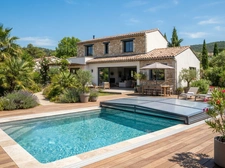
Buying a house with a swimming pool in 2027 is a real pleasure, but it is also a budget item: on average, expect to spend €1,000 to €2,500 a year on maintenance, water, electricity and products, on top of a higher property tax (taxe foncière) and possible repairs. Before buying, check four essential points: the presence of a standardised safety device, which is mandatory for any in-ground or semi-in-ground pool; the declaration of the pool to the tax authorities; the technical condition of the pool shell, the waterproofing and the filtration system; and any restrictions on water use during periods of drought in your département. A well-maintained pool adds value to a house in sunny regions, but it is negotiated as a piece of equipment, not as a magic selling point. Here is everything you need to know to dive in with peace of mind.
In summary
- Every private in-ground or semi-in-ground pool must be fitted with a standardised safety device: a barrier, a cover, an enclosure or an alarm.
- A pool increases the cadastral rental value, and therefore the taxe foncière; it must be declared to the tax authorities.
- The annual cost of a pool is most often between €1,000 and €2,500, excluding major repairs.
- During periods of drought, prefectural orders may prohibit the filling of private pools.
- A pool in good condition adds value to the house, especially in the South; a dilapidated pool becomes a bargaining point.
The dream of a swimming pool: a market that remains dynamic
France has several million private swimming pools, making it one of the largest pool stocks in the world. A pool remains a highly sought-after feature for families.
A highly popular feature
After increasingly hot summers, a pool has become a deciding factor for many buyers, and not only on the Mediterranean coast. Pools are now found in every region.
Buy a house with a pool or build one?
Building an in-ground pool often costs €25,000 to €50,000, or even more, with several months of administrative procedures and works. Buying a house that is already equipped can therefore be more economical, provided the pool is in good condition.
A market where prices are negotiable
In 2026, house prices fell slightly (around −1.3% over one year) and nine out of ten sales are negotiated. Houses with pools are no exception: the feature adds value, but its condition and its maintenance cost are part of the discussion.
Safety: an unavoidable legal obligation
This is the first point to check, because it engages your liability as soon as you become the owner. The official website Service-Public.fr details the mandatory safety devices for private swimming pools.
Which pools are concerned?
All private in-ground or semi-in-ground pools, whether for individual or collective use, must be fitted with a standardised safety device designed to prevent drowning, particularly of young children. Above-ground pools installed without construction work are not subject to this obligation, but vigilance is still necessary.
The four possible devices
Protective barrier, safety cover, pool enclosure or alarm: each must comply with the corresponding French standard. The device must be in working order and used correctly.
Heavy penalties
The absence of a safety device is punishable by a fine of up to €45,000. Above all, in the event of an accident, the owner's liability may be engaged.
What to check when buying
Ask the seller for the technical information sheet for the safety device, test the alarm or the cover, and check the condition of the barrier. If the device is missing or faulty, its replacement should be costed and factored into the negotiation.
Property tax and tax declaration
A pool is not tax-neutral. It is included in the calculation of the taxe foncière, and the tax authorities have equipped themselves with effective tools to identify undeclared pools.
A higher rental value
The swimming pool increases the cadastral rental value of the house, which serves as the basis for calculating the taxe foncière (property tax). The increase depends on the surface area of the pool and the rates set by the municipality.
The mandatory declaration
A swimming pool that has been built must be declared to the tax authorities within 90 days of its completion. For several years now, the administration has been using artificial intelligence to analyse aerial images in order to detect undeclared pools, and tens of thousands of pools have been brought into compliance.
What should you check when buying?
Ask for the latest taxe foncière notice and check that the pool is properly taken into account. An undeclared pool can result in a tax adjustment, generally sent to the owner in place at the time of the regularisation.
The taxe d'aménagement
If you are considering building a pool later on, be aware that a taxe d'aménagement (development tax) applies to pools larger than 10 m², calculated on a flat-rate value per square metre.
How much does a swimming pool really cost each year?
The running cost of a swimming pool is often underestimated by buyers. Here are the main expenses to plan for.
Water
A complete fill represents several tens of cubic metres, to which are added top-ups due to evaporation. A cover greatly limits losses.
Electricity
The filtration pump runs several hours a day during the season. A heat pump to heat the water noticeably increases the bill, but extends the swimming season.
Products and maintenance
Chlorine or salt, pH, flocculant, cleaning: allow a few hundred euros per year. A maintenance contract with a professional can cost more than €1,000 per year.
Repairs
Liner replacement every ten to fifteen years, pump, filter, robot cleaner, salt electrolyser: set aside a provision for these occasional expenses, which can reach several thousand euros.
Drought and water restrictions: a new factor
Drought episodes are becoming more frequent and now affect many regions. They have direct consequences for the use of swimming pools.
Restriction orders
In the event of drought, prefects may issue restriction orders (arrêtés) that prohibit, depending on the alert level, the filling of private pools, and even topping them up. Check the history of restrictions in the département where you are buying.
Solutions for saving water
A cover or shelter against evaporation, efficient filtration that avoids the need to drain the pool, rainwater harvesting: a well-equipped pool consumes much less.
Clay shrinkage and swelling
In exposed areas, a pool can be weakened by ground movement. Check the risk assessment report and look carefully at the coping stones and the surrounding deck.
Technical checks before buying
A pool in poor condition can be very expensive. A few simple checks can help you avoid unpleasant surprises.
Watertightness
An abnormal drop in the water level may reveal a leak. Ask the seller for the year's water consumption and examine the structure: cracks, faded or wrinkled liner, loose tiles.
The technical room
Pump, filter, electrolyser, electrical panel: check their age, their condition and whether maintenance invoices are available.
Administrative compliance
A pool larger than 10 m² requires a prior declaration of works (déclaration préalable de travaux), or even a building permit (permis de construire) depending on its size and any shelter. Ask for the planning authorisations: a pool built without authorisation can cause problems.
A visit in season
If possible, visit the house when the pool is in operation. Cloudy or green water in summer is never a good sign.
Does a swimming pool really add value to the house?
The answer depends on the region, the type of house and the condition of the pool.
In sunny regions
In the South and along the Atlantic coast, an attractive pool is almost standard for family homes and can significantly speed up a sale.
In cooler regions
The added value is more limited: some buyers see mainly costs and constraints, particularly families with very young children.
Condition makes all the difference
A recent pool that is well maintained and secured adds value to the house. An old pool in need of renovation can, on the contrary, lower the price. To compare, browse the listings for houses with a pool on Optimhome in your area and look at the price differences.
Insurance and liability
Your home insurance must cover your pool, and you should check this before signing.
Declaring the pool to your insurer
Tell your insurer about the pool: it may lead to a slight increase in your premium, but it must be covered in the event of damage or an accident.
Civil liability
If a guest or a neighbour's child is injured, your civil liability is engaged. A compliant, working safety device is your first protection.
Equipment
Check that the technical room, the pool enclosure and the heat pump are properly covered, in particular against hail and storms.
Are you selling a house with a pool?
When well presented, a pool is a powerful selling point. When poorly maintained, it can put buyers off.
Preparing the pool
Clear water, a safety device in good working order, a clean technical room and maintenance invoices close at hand immediately reassure visitors.
Choosing the right season
Spring and early summer are the ideal times to sell a house with a pool: buyers can easily picture themselves living there.
Setting the right price
The value added by the pool varies greatly from one area to another. To measure it, get a free online valuation of your house with Optimhome, then refine it with a local advisor.
Which type of pool for which budget?
Not all pools are equal, whether in comfort, maintenance cost or lifespan. Knowing how to recognise the type of pool helps you assess what you are buying.
The masonry or concrete pool
This is the most robust type, with a lifespan that can exceed several decades if it is well maintained. It is generally finished with a liner, a reinforced membrane or tiles. Replacing a liner often costs a few thousand euros; a reinforced membrane lasts longer but costs more.
The polyester shell pool
Installed as a single piece, it is quick to install and easy to maintain thanks to its smooth surface. With age, it may show problems of osmosis or discolouration: check the condition of its surface.
The kit pool
Steel or wooden panels, semi-buried structures: these pools are cheaper but often have a shorter lifespan. A kit pool more than fifteen years old deserves a careful inspection.
Water treatment
Conventional chlorine, salt electrolysis, UV treatment: the treatment method affects the annual cost and swimming comfort. The salt electrolyser must be replaced regularly.
Heating
A heat pump or an enclosure can extend the swimming season by several weeks. It is a real comfort, but also an additional energy cost to factor into your budget.
Example: the annual budget for a family swimming pool
Take an in-ground pool measuring 8 m × 4 m, equipped with a standard filtration system, a salt electrolyser, a bar-type cover and a heat pump used from May to September.
Running costs
Top-up water and any partial refilling: approximately €150 to €300. Electricity for the filtration system: approximately €250 to €400. Heat pump: approximately €300 to €600 depending on the weather. Salt, products and small accessories: approximately €200.
Setting money aside for the future
By setting aside approximately €400 per year for the liner, the pump and the electrolyser, the total annual cost comes to €1,300 to €1,900, or €110 to €160 per month. This is a figure to include in your housing budget, just like the taxe foncière (French property tax).
Practical tip
- Test the safety device during the viewing and ask for its technical datasheet.
- Check that the pool appears on the most recent taxe foncière notice.
- Ask for the water, electricity and maintenance bills from the last season.
- Have the liner, the pump and the filter inspected by a pool specialist if the pool is more than ten years old.
- Look up the history of drought orders in the département.
Professional advice
"The pool is often the love at first sight that triggers the viewing. My role is to help my clients keep a cool head: you don't buy a pool, you buy a house that has a pool. I advise them to calculate the real annual cost and to check the technical condition before making an offer. A well-maintained pool means years of happiness for the family; a neglected pool means a building project that starts the day after signing."
Getting support to find your dream home
Finding a house with a pool at the right price, in the right area and in good condition requires a good knowledge of the local market.
To save time, contact an Optimhome real estate advisor near you: they will present properties that match your criteria and help you assess the real value of the pool in the negotiation.
Conclusion
Buying a house with a pool in 2027 means giving yourself a real quality of life, provided you weigh up the obligations and costs: a standardised safety device, taxe foncière, annual maintenance, possible water restrictions and insurance. Check the technical condition of the pool, its administrative compliance and the real cost of use before making your offer. If chosen well, your pool will be a source of enjoyment… and an asset when it comes to resale.
Know someone who wants to sell their home? Recommend them and be rewarded by becoming an Optimhome business referrer.
FAQ - Frequently asked questions
Is a pool required to have safety features?
Yes, every private in-ground or semi-in-ground pool must be equipped with a standardised safety device: a barrier, a cover, an enclosure or an alarm.
How much does a pool cost per year?
On average between €1,000 and €2,500 per year for water, electricity, products and maintenance, excluding major repairs.
Does a pool increase the taxe foncière?
Yes, it increases the cadastral rental value of the house and therefore the taxe foncière.
What are the risks of having an undeclared pool?
A back-payment of taxe foncière. The tax authorities now detect undeclared pools by analysing aerial images.
Can you fill your pool during a drought?
Not always: depending on the alert level, prefectoral orders may prohibit the filling of private pools.
Does a pool increase the price of a house?
Often yes in sunny regions, if it is in good condition. A dilapidated pool, on the other hand, can weigh on the price.
What is the fine for not having a safety device?
Up to €45,000, not including the owner's liability in the event of an accident.
Is authorisation required for a swimming pool?
Yes, for pools above 10 m²: a prior declaration (déclaration préalable) is required, and in some cases a building permit (permis de construire) for larger pools or certain enclosures.
Should you choose a house with or without a swimming pool?
It depends on your lifestyle, the region and your budget. A house without a pool but with suitable land leaves you free to build one later, to your own taste.
Author of the publication

Fabrice DOBROWOLSKI, Director of the Optimhome network
«Benefit from myexpert advice, based on many years of experience in real estate, to ensure the success of your buying or selling project. »