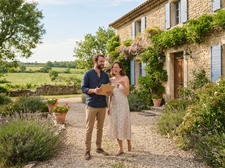
Before buying a house in the countryside in 2027, check six key points first: the quality of the internet connection (fibre or alternatives), the actual travel times to work, schools and healthcare services, the condition of the individual sanitation system (assainissement individuel), inspected by the SPANC, the energy performance and heating method, the natural hazards listed in the risk statement (état des risques), and the possible pre-emption right of the SAFER if the house is sold with agricultural land. Prices there often remain two to three times lower than in cities and the supply of houses is growing, which leaves room to negotiate. But the cost of living in the countryside is not limited to the purchase price: car, heating and upkeep of the land must be part of your budget. Here is the complete checklist to make your move to the countryside a success.
In summary
- The price per square metre in the countryside remains significantly lower than in cities, and houses are often open to negotiation.
- Internet, mobility and local services are the three criteria that determine your quality of life.
- A house not connected to the mains sewer (tout-à-l'égout) must have a sanitation inspection report less than three years old; in the event of non-compliance, the buyer has one year to carry out the work.
- The SAFER may exercise its pre-emption right over certain rural properties sold with agricultural land.
- The PTZ (zero-interest loan) is available for a new-build house anywhere in France and, for older properties requiring renovation work, in zones B2 and C.
Why the countryside is still appealing in 2027
Since the health crisis, the desire for green space has not faded. It has even become a lasting part of the property plans of many French people.
More space for the same budget
With the budget for a three-room apartment in mainland France, you can often buy a 120 m² house with a garden in the countryside. This is the number one argument for families who take the leap.
Remote working, a lasting change
Partial remote working, two or three days a week, has become established in many companies. It makes it possible to live farther from your workplace while maintaining a reasonable pace of life.
A market more favourable to buyers
In 2026, house prices fell slightly over one year (around −1.3%) and the supply of properties for sale is growing. Selling times are getting longer, at around a hundred days on average, and negotiation has become the norm, with an average margin of around 4.8%.
A sought-after quality of life
Calm, nature, a vegetable garden, village life: the countryside answers a deep desire to slow down. But daily life still has to keep up.
Internet and phone: the first thing to check
For many people who have moved to the countryside from the city (néo-ruraux), this is the point that makes or breaks a project. A beautiful house without a decent connection can quickly become a headache if you work from home.
Is fibre available?
The rollout of fibre has progressed a great deal, including in rural areas, but some isolated addresses cannot yet be connected. Consult the official Arcep map for the exact address of the property.
The alternatives
If fibre is not available, fixed 4G or 5G and satellite internet now offer decent speeds. Test the mobile network during the viewing, inside the house and not only in the garden.
The final connection
Even when fibre runs along the street, connecting a house set back from the road may require work (conduit, trench). Find out about the cost from the operators.
Mobility: calculate your actual journeys
In the countryside, a car is often still essential. This is a budget item not to be underestimated.
Do the journey at peak times
Test the commute on a weekday, at the time you will actually be making it. Twenty minutes on a Sunday can become forty-five minutes on a Monday morning.
The cost of a second car
Purchase, insurance, fuel, maintenance: a second car often costs several thousand euros a year. Factor this amount into your comparison with buying in town.
Public transport
A nearby TER train station or a regular coach line is a real plus, both for you and for resale. Teenagers, in particular, appreciate being able to get around on their own.
Schools, healthcare, shops: everyday services
The charm of a village is not enough: you also need to be able to live there day to day, at every stage of life.
School and after-school care
Find out about the village school (single-class schools, intercommunal school groupings), the canteen, the after-school daycare and the school bus service. The collège (lower secondary school) and lycée (upper secondary school) are sometimes far away.
Access to healthcare
General practitioner, pharmacy, paediatrician, emergency services: in some rural areas, finding a médecin traitant (registered family doctor) has become difficult. Check the situation before buying, especially if you have regular needs.
Shops and local life
Bakery, small supermarket, market, community associations: a lively village makes it easier to settle in and makes daily life more pleasant.
Individual sanitation: a major technical point
Many country houses are not connected to the mains sewer and have a non-collective sanitation system (septic tank or fosse toutes eaux, micro-treatment plant).
The mandatory inspection
At the time of sale, the seller must provide an inspection report from the public non-collective sanitation service (SPANC) that is less than three years old. The official website Service-Public.fr details the obligations relating to non-collective sanitation.
In case of non-compliance
If the system does not comply with the regulations, the buyer must carry out the compliance work within one year of the sale. A complete rehabilitation often costs between €8,000 and €15,000, sometimes more depending on the land.
A negotiating argument
A non-compliant system is a legitimate argument for negotiating the price. Have a quote drawn up before making your offer.
Energy and heating: watch out for the bills
Country houses, often old and isolated, can be energy-intensive. The DPE (energy performance diagnostic) deserves your full attention.
The heating method
Heating oil, wood, electricity, heat pump: each method has its own costs. Heating oil is expensive and its replacement is encouraged. Wood is economical but requires organisation. Ask for the bills from the last two years.
The DPE and the energy audit
For a house rated E, F or G, the seller must provide an energy audit, which proposes a costed scenario of works. It is a valuable basis for assessing your budget.
The new 2027 calculation
From 1 January 2027, the electricity conversion factor changes to 1.7, which may improve the rating of a house heated by electricity or by a heat pump.
SAFER, urban planning and land: the rules to know
Buying in the countryside sometimes also means buying land, a barn or a shed. Specific rules apply.
The SAFER's pre-emption right
The Sociétés d'aménagement foncier et d'établissement rural (SAFER) may exercise a pre-emption right over certain rural properties, in particular agricultural land or farm buildings, in order to protect agriculture. The notaire informs them of the sale and they have a set period in which to decide.
The local urban plan
Converting a barn into a dwelling, building a swimming pool or an extension: check what the PLU (plan local d'urbanisme) or the carte communale allows. In agricultural or natural zones, the possibilities are limited.
Easements
Right of way, rural paths, pipelines: easements (servitudes) are common in rural areas. The notaire will check them, but ask the question from the very first viewing.
Maintaining the land
A large plot requires either time or a budget. In some wooded municipalities, clearing brush (débroussaillement) is even mandatory in order to prevent fires.
Natural hazards: read the risk statement
The risk statement (état des risques), appended to the preliminary sales agreement (compromis), lists the natural and technological risks to which the house is exposed.
Clay shrink-swell
Many rural municipalities are exposed to this phenomenon, which weakens foundations during periods of drought. Look carefully at any cracks in the walls.
Flooding
A house beside a river has a lot of charm, but check that it is not in a flood zone and ask the neighbours about past floods.
Home insurance
Ask for an insurance quote before signing: in some exposed areas, premiums rise sharply.
Financing your house in the countryside
Good news: several forms of assistance are particularly well suited to rural projects.
The PTZ
Extended until 31 December 2027, the PTZ finances the purchase of a new house throughout the country and, for existing homes, the purchase of a property with at least 25% of renovation work in zones B2 and C, where most rural municipalities are located.
The éco-PTZ and renovation assistance
To renovate an older house, the éco-PTZ allows you to borrow up to €50,000 interest-free for a comprehensive renovation.
The Action Logement loan
Employees of private-sector companies with ten or more employees can benefit from a loan of up to €30,000 at 1% for the purchase of a new home or for construction.
Finding the right house
To discover the properties available in the villages that interest you, browse the listings of houses for sale on Optimhome and compare prices with those of neighbouring municipalities.
Think about resale right now
Your life may change: a new job, children growing up, retirement. A well-chosen country house can be resold without difficulty.
The criteria that matter
Proximity to a town with shops, a train station or a major road, internet connection, a good DPE (energy performance diagnostic): these criteria support the value of your property over time.
Properties that are harder to resell
Very isolated houses, at the end of an unpaved track, without an internet connection or with very high energy consumption, take longer to find a buyer.
Selling in the city to move to the countryside?
This is the path taken by many households: selling an apartment in the city to finance a house in the countryside.
Knowing your budget
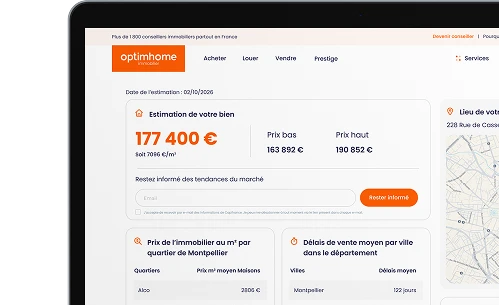
The sale price of your current home determines your down payment and your purchasing power. To build your project on solid foundations, get a free online valuation of your property with Optimhome.
Coordinating the sale and the purchase
Selling first secures your budget; buying first secures the home you fell in love with. A bridging loan (prêt relais) can bridge the gap, but it has a cost: get advice to choose the right order.
Main or second home: two different projects
Buying in the countryside to live there all year round, or to spend weekends and holidays there, are not at all the same project.
For a main residence
Your priority criteria are commuting, school, access to healthcare and internet connection. You can use the PTZ if you are a first-time buyer, and the capital gain on resale will be exempt from tax.
For a second home
Travel time from your main residence becomes the key criterion: beyond two hours' drive, stays often become less frequent. Also take into account the surcharge on second homes (surtaxe d'habitation) voted by many municipalities, garden upkeep while you are away, and the security of the house.
The case of future retirement
Many people buy a country house with their retirement in mind. In that case, think about accessibility: single-storey living or a ground-floor bedroom, proximity to a pharmacy and a doctor, and the possibility of eventually managing without a car.
The practical tip
- Check fibre eligibility at the exact address on the Arcep map and test the mobile network inside the house.
- Do the home-to-work commute on a weekday, during rush hour.
- Ask for the SPANC report and a quote for bringing the system up to standard if the installation does not comply.
- Ask for the heating bills for the last two winters.
- Spend an evening and a Saturday morning in the village before making an offer.
The expert's advice
"I always advise city dwellers who dream of the countryside to visit twice: once in spring, when everything is beautiful, and once in winter, on a rainy day, at the time they would be leaving for work. If you still like the house that day, then it is meant for you. And ask about services: the bakery, the doctor, the school. That is what will make the difference in your daily life, far more than the size of the garden."
Being supported by an advisor who knows the local area
In the countryside, local knowledge makes all the difference: the reputation of villages, real prices, the technical specificities of houses.
To bring your project in the countryside to life, contact an Optimhome real estate advisor near you: they know the municipalities in their area and will help you find the house that suits your lifestyle.
Conclusion
Buying a house in the countryside in 2027 is a great opportunity to gain space and quality of life, in a market where prices are affordable and negotiation is possible. But the success of your project depends on a few simple checks: internet connection, commutes, services, sanitation, energy, risks and urban planning rules. Take the time to picture yourself in your daily life, in every season, and your move to the countryside will be a success.
Do you know someone who wants to sell their house? Recommend us and be rewarded by becoming an Optimhome business referrer.
FAQ - Frequently asked questions
Is it a good idea to buy a house in the countryside in 2027?
Yes, if your commutes, your internet connection and your access to services are compatible with your lifestyle. Prices are affordable and negotiation is common.
Which diagnostics are required for a country house?
In addition to the standard diagnostics (DPE, asbestos, lead, electricity, gas, termites, risk assessment), an inspection of the non-mains sanitation system (assainissement non collectif) carried out less than three years ago is required if the house is not connected to the mains sewer.
What should you do if the sanitation system does not comply?
The buyer must carry out the work within one year after the sale. The cost can be used as an argument to negotiate the price.
Can the SAFER exercise its right of pre-emption on a house?
It can pre-empt certain rural properties, particularly when they include agricultural land or farm buildings.
Is the PTZ available for a house in the countryside?
Yes, for a new-build house anywhere in France, and for an older property with at least 25% of the price in renovation work in zones B2 and C, subject to income conditions.
How can you check a house's internet connection?
Consult the Arcep map at the exact address and test the mobile network during the visit.
Is a country house easy to resell?
Yes, if it is close to a town centre, well connected and energy-efficient. Very isolated or energy-intensive properties take longer to sell.
What budget should you plan for on top of the purchase price?
Notary fees (7 to 8% for existing properties), possible renovation work (sewage systems, energy), and the cost of getting around, often a second car.
Should you choose a village or an isolated house?
A village with shops and services makes daily life easier and helps with resale. An isolated house offers more peace and quiet and more privacy, but makes a car essential for everything.
Author of the publication

Fabrice DOBROWOLSKI, Director of the Optimhome network
«Benefit from myexpert advice, based on many years of experience in real estate, to ensure the success of your buying or selling project. »