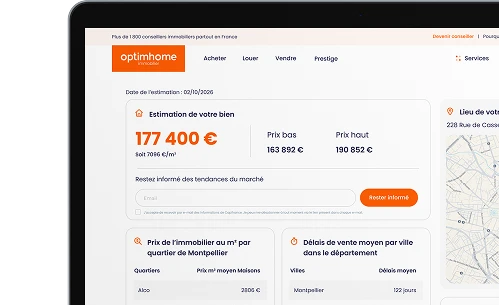
Is December 2026 a good time to buy, sell or invest in property in France? This monthly barometer presents a data-driven analysis of the market as winter begins: mortgage rates, prices, transaction volumes, housing supply, new-build, rentals and regulation. It includes the latest property news (2027 budget, rent control, taxation of capital gains and furnished rentals) and offers an outlook for 2027. For any question, contact your local Optimhome real estate advisor, and don’t forget to request your free property valuation.
Information up to date in November 2026. To read the previous months’ analysis: November 2026 barometer, October 2026 property market and September 2026 (in French).
Summary: state of the French property market in December 2026
- Mortgage rates: lowest rate from 2.80% (10 years) to 3.45% (25 years); average rate from 3.18% to 3.77%; market rate scale stable between 3.48% and 3.98%. The lowest rates gain 0.10 points in one month over 15, 20 and 25 years.
- Prices: prices of existing homes fall by 1.2% over one year in the third quarter of 2026 (houses -1.3%, apartments -1.0%), with a sharper decline in the Île-de-France region (-1.5%).
- Volumes: around 956,000 transactions over twelve months to end-September, a level that is edging down; professionals expect 2026 to land between 900,000 and 920,000 sales.
- Financing: the 10-year OAT crossed 5% on 21 October, a first since 2002. The average mortgage rate reached 3.49% in October according to the Observatoire Crédit Logement, compared with 3.14% a year earlier.
- News: rent control extended by two years, 2027 budget not yet passed, capital gains reform and a cap on LMNP depreciation under discussion, PTZ zero-interest loan extended to the end of 2027.
- New-build: 319,569 housing starts over twelve months to end-October (-4.3% compared with the five-year average) and 373,979 permits granted (-9.7%).
- Our recommendation. A ready project, a strong application and a realistic price remain the keys. Working with a local Optimhome advisor helps secure your purchase or sale.
Overall context of the property sector in December 2026
Macroeconomic situation and property market climate
Short answer: the French economy is slowing, bond markets remain tense and the 2027 budget has not been passed. This combination weighs on household confidence and on the cost of credit.
According to Insee, GDP fell by 0.2% in the third quarter of 2026, after a 0.2% fall in the first quarter. Inflation fell back from 3.4% in October to 2.9% in November, thanks to lower energy prices (a barrel of Brent fell from 113 to 97 dollars in one month). On the debt side, France’s credit rating remains under watch: Moody’s kept Aa3 with a negative outlook at the end of October, and S&P Global Ratings announces its verdict on the evening of 27 November. The ECB raised its rates in June and September (deposit rate at 2.50%), then paused on 29 October; its next decision is expected on 17 December.
Mortgage rate trends in December 2026 (lowest rates, average rates, rate scale)
Term | Lowest rate Dec. 2026 | Average rate Dec. 2026 | Market rate scale Dec. 2026 |
|---|---|---|---|
10 years | 2.80% | 3.18% | 3.48% |
15 years | 3.10% | 3.43% | 3.71% |
20 years | 3.30% | 3.62% | 3.84% |
25 years | 3.45% | 3.77% | 3.98% |
The “lowest rate” is the best offer granted to the strongest applications. The “average rate” reflects the practice observed across the whole market. The “rate scale” is the banks’ standard rate card before any negotiation. Compared with November, the lowest rate rises by 0.10 points over 15, 20 and 25 years and falls by 0.08 points over 10 years. The average rate gains 0.11 to 0.18 points over 15 to 25 years, while the standard rate scale is unchanged: banks are granting fewer discounts, and negotiation is becoming more demanding.
Monthly trend of the lowest rates from January 2025 to December 2026
Month | 10 years | 15 years | 20 years | 25 years |
|---|---|---|---|---|
January 2025 | 3.00% | 3.25% | 3.31% | 3.40% |
February 2025 | 2.99% | 3.16% | 3.24% | 3.32% |
March 2025 | 2.80% | 2.90% | 2.89% | 2.99% |
April 2025 | 2.65% | 2.75% | 2.89% | 2.99% |
May 2025 | 2.79% | 2.85% | 2.90% | 3.00% |
June 2025 | 2.74% | 2.85% | 2.95% | 3.05% |
July 2025 | 2.90% | 2.85% | 2.95% | 3.05% |
August 2025 | 2.73% | 2.81% | 2.92% | 3.05% |
September 2025 | 2.79% | 2.85% | 2.94% | 3.06% |
October 2025 | 2.69% | 2.86% | 2.99% | 3.05% |
November 2025 | 2.69% | 2.86% | 2.99% | 3.05% |
December 2025 | 2.70% | 2.85% | 2.99% | 3.10% |
January 2026 | 2.64% | 2.92% | 3.00% | 3.10% |
February 2026 | 2.64% | 2.92% | 3.00% | 3.10% |
March 2026 | 2.78% | 2.95% | 2.95% | 3.10% |
April 2026 | 2.70% | 2.95% | 3.00% | 3.15% |
May 2026 | 2.74% | 2.85% | 3.00% | 3.15% |
June 2026 | 2.82% | 3.00% | 3.05% | 3.20% |
July 2026 | 2.90% | 3.00% | 3.15% | 3.25% |
August 2026 | 2.82% | 3.00% | 3.10% | 3.20% |
September 2026 | 2.75% | 2.99% | 3.10% | 3.20% |
October 2026 | 2.64% | 2.92% | 3.10% | 3.25% |
November 2026 | 2.88% | 3.00% | 3.20% | 3.35% |
December 2026 | 2.80% | 3.10% | 3.30% | 3.45% |
After a year of stability around 3% over 20 years in 2025, the lowest 20-year rate has gained 0.31 points in twelve months. A turning point is visible in the autumn, with a 0.25-point rise over 25 years between September and December.
Why rates are rising
Four drivers explain the increase: tension on French government debt (10-year OAT at 5.002% on 21 October, before easing to around 4.8%-4.9%), the two ECB rate hikes, budget uncertainty and banks’ strategy, with some having raised their rate cards mid-month (+0.25 points at Crédit Mutuel du Sud-Ouest on 19 October, +0.20 points at Crédit Agricole Île-de-France two days later). The usury rate, to be revised on 1 January 2027, is capped in the fourth quarter at 5.40% for loans of 20 years and over, 4.68% for 10 to 20 years and 4.09% for under 10 years.
Latest property news: what is changing for the market and regulation
Short answer: property regulation is moving fast at the end of the year, but many measures have not been definitively adopted. Only the extension of rent control and the extension of the PTZ zero-interest loan to 31 December 2027 are secured to date.
Date | News | What it changes | Status |
|---|---|---|---|
19 November 2026 | Rent control extended: the National Assembly definitively adopts, by 148 votes to 95, a two-year extension of the experiment, until 23 November 2028. | Rents on new leases remain capped in around sixty municipalities (including Paris, Lille, Lyon and Bordeaux). The Lyon Metropolis withdraws from the scheme and leaves Lyon and Villeurbanne to decide whether to continue it. | Adopted |
4 November 2026 | 2027 budget: the National Assembly rejects the revenue part of the finance bill; the Senate has been examining the text since 20 November. | Housing measures (parenthood PTZ, LMNP, donations, housing benefits) remain open. The government is aiming for a public deficit of 5% of GDP in 2027, compared with 5.4% expected in 2026. | Under discussion |
24 November 2026 | Property capital gains: the Senate votes a reform bringing the tax rate down to 20% for properties held for more than two years (32% below that), with removal of the surtax on high capital gains, from 2028. | Could change the sell-now / sell-later trade-off for second homes and rental properties. The government opposes the measure. | Voted in the Senate, not final |
October-November 2026 | LMNP: the draft budget caps depreciation for non-professional furnished landlords (2.5%, within a limit of €7,000 per year and per tax household). On 24 November, the Senate preserved current rules for some landlords as long as the property stays with the same owner. | Net profitability of furnished investments must be recalculated before any purchase. No rule applies until the budget is adopted. | Under discussion |
End of 2026 | PTZ: the scheme, reformed for 2026, is extended to 31 December 2027. The parenthood PTZ (up to €100,000 for some families) and the extension of the exemption for certain donations intended for a purchase (which ends on 31 December 2026) are not secured. | To date, the parenthood PTZ is not in force. Families preparing a purchase must follow the final budget vote. | Extension secured; expansions under discussion |
25 November 2026 | Eco-PTZ: the Senate votes, against the government’s advice, to extend the zero-interest eco-loan to equipment protecting against extreme heat. | Could finance summer comfort (shutters, solar protection) in older homes. | Voted in the Senate, not final |
October 2026 | MaPrimeRénov’ 2027: the budget annexes plan to continue refocusing the scheme, with €217 million less in funding for Anah; heat pumps could be removed from the scheme. | An energy renovation project in 2027 could receive less support, which weighs on the value of energy-inefficient homes. | Draft |
12 November 2026 | Borrower insurance: from 1 July 2027, switching loan insurance is to become simpler and more standardised. | A saving lever that will be easier to activate for borrowers. | Announced |
October 2026 | Property tax (taxe foncière) 2027: after a revaluation of tax bases of only 0.8% in 2026, a national increase close to 3% is being discussed for 2027. | To be factored into the budgets of owner-occupiers and landlords. | Forecast |
27 November 2026 | New-build construction: housing starts rise by 2% in October (28,290 homes); permits remain almost stable. | Slow recovery in new-build supply, still below the five-year average. | Provisional data |
These developments reinforce a key message of the barometer: you must distinguish an amendment that has been voted from a measure that actually applies. If in doubt, seek the advice of a notary or a tax advisor before signing.
Borrowing capacity and property purchasing power in December 2026
Borrowing capacity depends on the amount borrowed, the rate, the term, the down payment and existing debts. Banks apply a debt-to-income ratio close to 35% of net income, insurance included. Additional costs (notary, agency, works, borrower insurance) reduce real purchasing power accordingly.
Repayment capacity and down payment: a worked example
Take a household with €4,500 net per month, i.e. a maximum monthly payment of €1,575 over 20 years (excluding insurance). Here is how its borrowing capacity changes with rates:
Rate obtained (20 years) | Borrowing capacity at €1,575/month |
|---|---|
3.10% (lowest rate in October) | ≈ €281,400 |
3.20% (lowest rate in November) | ≈ €278,900 |
3.30% (lowest rate in December) | ≈ €276,400 |
3.62% (average rate in December) | ≈ €268,700 |
3.84% (rate scale) | ≈ €263,600 |
In two months, the rise in the lowest rate has cost this household around €5,000 of borrowing capacity. The fall in existing home prices (-1.2% over one year) barely offsets this effect: buyers have to weigh up size, location and the level of works.
Renegotiation and refinancing in December 2026
With rates rising, renegotiating a loan taken out before 2022 or in 2023 is rarely worthwhile. A gap of 0.7 to 1 point is often needed for renegotiation to pay off after fees. However, delegating borrower insurance can reduce the total cost, and switching is due to become simpler from 1 July 2027.
Sales and transaction volumes in December 2026
Comparative transaction review: autumn 2026 and rolling twelve months
Between October 2025 and September 2026, around 956,000 transactions were recorded in France, compared with 959,000 over the twelve months to end-June, a slight 0.3% easing. The Notaires de France had recorded 951,000 sales to end-August (+3.6% over one year) but stress that the recovery is running out of steam. Projections converge on a landing between 900,000 and 920,000 sales for 2026 as a whole, down from the peak seen at the start of the year.
Transaction breakdown: houses vs apartments
In the third quarter, houses fall slightly more (-1.3% over one year) than apartments (-1.0%). Houses, often larger and more expensive, are more sensitive to the rise in the cost of credit over longer terms. Small and medium-sized urban properties remain more in demand.
Urban vs rural areas: market disparities
National averages mask large differences. In Île-de-France, sales fall by 4% over one year in the third quarter according to the Notaires du Grand Paris, and prices by 1.5%. In other regions, the fall in prices reaches 1.1%. According to the SeLoger index, rural areas remain the exception with a 0.1% rise in October, but this trend is slowing.
Property price trends in France in December 2026
Short answer: prices of existing homes fall by 1.2% over one year in the third quarter of 2026 according to the Notaires-Insee index. This is a moderate decline that does not offset the rise in rates.
The market had started the year with stable prices, before a 0.8% fall over one year in the second quarter. According to SeLoger’s property price index, prices fall by 0.1% month on month in October, the first decline since the start of the year.
Property prices in major cities
Among the 11 largest cities, 8 record a fall in October. Rennes falls the most (-0.8%), ahead of Nice (-0.5%) and Montpellier (-0.3%). Toulouse (+0.8%), Lyon (+0.2%) and Lille (+0.2%) stand out with increases. In Paris, existing apartments show an annual fall of 1.3% in the third quarter, after a series of rises since early 2025.
Property prices in rural areas and small towns
Rural areas and mid-sized towns remain an attractive entry point for first-time buyers and investors, with prices well below those of major cities. Their resilience is, however, less marked than in spring.
Housing supply and available stock in December 2026
In a more selective market, buyers negotiate more and sellers must be realistic. Properties that are correctly valued, well presented and supported by a complete set of diagnostic reports continue to find buyers faster. An overpriced property remains the main cause of longer selling times.
Time on the market and selling times
In attractive urban areas, a property at the right price sells faster than an overpriced one. In rural areas or for a property needing works, the selling time may lengthen. The end of the year, traditionally quieter, is also an opportunity to prepare your listing for a launch early in the new year.
Practical advice for sellers in December 2026
- Free property valuation: start with a realistic assessment by a local advisor.
- Exclusive mandate: recommended for a coherent marketing strategy and better visibility.
- Home staging and professional photos: effective levers to attract selective buyers.
- Diagnostics and energy performance certificate (DPE): prepare them in advance so as not to delay the sale, particularly for a home rated F or G.
- Capital gains: if you are selling a property other than your main residence, follow the progress of the reform voted in the Senate before deciding on timing.
Property market trends in December 2026 by buyer profile
First-time buyers: access to the market
First-time buyers can access the market if they prepare a strong application: down payment, stable income and controlled debt. The PTZ, extended to 31 December 2027, remains an important lever. Note: the parenthood PTZ is not in force to date, and expansion measures depend on the final vote on the 2027 budget.
Rental investors: yield and opportunities
Rental yield depends on location and property type. With rates of 3.3% to 3.8%, the net profitability calculation is more demanding. Three points to watch: the possible cap on LMNP depreciation, the extension of rent control until November 2028 in the municipalities concerned, and the debates on the private landlord status. Factor in vacancy, the cost of works, property tax (a national increase is being discussed for 2027) and the tax regime in your calculation before any purchase.
Main residence vs second home buyers
A main residence favours proximity to services and employment, while a second home targets tourist or coastal areas. For a seasonal rental project, study profitability and the applicable taxation before committing, as furnished rentals are the subject of several reform proposals.
New-build market and construction in December 2026
Housing starts and building permits: where does new-build stand?
According to the housing ministry’s provisional data published on 27 November, 373,979 homes were authorised between November 2025 and October 2026, i.e. 9.7% fewer than the average of the previous five years. Over the same period, 319,569 homes were started, 4.3% fewer than the average. In October, housing starts rise by 2% month on month, to 28,290 homes. Permits for individual houses rise by 6.3%, while those for multi-unit housing fall by 2.4%.
The ministry’s statistics service nonetheless notes an upward trend in housing starts since September 2025, with an average monthly level 24.1% higher than in 2025 since January 2026. The recovery is real but slow, and multi-unit housing remains in difficulty.
Regulation, taxation and support schemes
New-build remains governed by the RE2020 standard. The PTZ finances up to 50% of an operation in eligible zones and new individual houses across the country, until 31 December 2027. Mandatory diagnostics (energy performance, lead, asbestos) condition a sale in new-build as in existing homes.
Outlook and forecasts for the property market in 2027
Short answer: the most likely scenario is a selective market, with rates continuing to rise gradually, prices slightly lower and volumes below their level at the start of 2026.
Key dates to watch
- 17 December 2026: ECB decision.
- End of December 2026: adoption (or not) of the 2027 budget.
- 1 January 2027: revision of the usury rate.
- 18 April and 2 May 2027: presidential election.
- 1 July 2027: simpler switching of borrower insurance.
Optimistic scenario: rates calm down in spring 2027
The budget is passed, the OAT eases, energy stabilises and the ECB stays on hold. The lowest 20-year rate would hold between 3.15% and 3.30%, and transaction volumes would recover in the second half.
Prudent scenario: a gradual rise in rates (the most likely)
Tensions persist without worsening. Banks raise their rate cards in small steps: the lowest 20-year rate would reach 3.35% to 3.60% in spring, and the average rate 3.70% to 3.95%. Several brokers anticipate a market average rate close to 4% from the start of 2027. Prices would fall slightly, by around 1% to 2% over one year, with large local disparities.
Pessimistic scenario: renewed tension from budget risk
The budget is not adopted, France’s rating is downgraded or energy prices rise again. The OAT goes durably back above 5% and the ECB raises its rates further. The average 20-year rate could exceed 4%, with stronger pressure on longer terms and smaller budgets.
These ranges are editorial projections, based on December 2026 levels: they are not commitments.
Worked example: a purchase simulation in December 2026
For a €200,000 loan over 20 years (excluding insurance), monthly payments vary with the rate obtained:
Rate (20 years) | Monthly payment | Total interest cost |
|---|---|---|
3.30% (lowest rate) | ≈ €1,140 | ≈ €73,500 |
3.62% (average rate) | ≈ €1,172 | ≈ €81,400 |
3.84% (rate scale) | ≈ €1,195 | ≈ €86,800 |
In November, the same payment was around €1,129 at the lowest rate (3.20%). The gap between the lowest rate and the rate scale represents €55 per month, or around €13,000 of interest over the life of the loan. These amounts are indicative, calculated with the standard annuity formula, excluding insurance and additional costs. For a personalised simulation, contact an Optimhome advisor.
Practical advice for a successful property project at the end of 2026
Steps to buy in December 2026
- Define your budget and search area.
- Simulate your borrowing capacity and obtain a bank pre-approval.
- Visit with precise criteria and compare several properties.
- Make a reasoned offer and sign the preliminary contract with conditions precedent.
- Finalise the financing and sign the deed at the notary’s office.
Steps to sell in December 2026
- Request a free property valuation from a local advisor.
- Carry out the mandatory diagnostics before putting the property on the market.
- Enhance the property: home staging, professional photos, virtual tour.
- Publish the listing on the main portals and networks.
- Negotiate methodically, then sign the preliminary contract and the deed of sale.
Pitfalls to avoid on the property market in December 2026
- Relying on a single loan offer without putting banks in competition.
- Basing an investment decision on a tax measure that has not been definitively adopted.
- Underestimating additional costs: notary, agency, works, borrower insurance, property tax.
- Neglecting diagnostics, which can delay or jeopardise a sale.
- Setting an unrealistic sale price, which mechanically lengthens the selling time.
Why contact an Optimhome real estate advisor in December 2026
Your Optimhome real estate advisor knows the local market and gives you a realistic valuation of your property. They help you optimise the price and visibility of your listing, support you in structuring your financing, and put you in touch with trusted partners (brokers, diagnosticians, notaries). In a context where regulation is changing quickly, they also help you understand the practical impact of measures on your project. Contact your local Optimhome advisor for a free valuation and personalised support.
Conclusion: summary of the property market in December 2026 and recommendations
- Rates: from 2.80% (10 years) to 3.45% (25 years) at the lowest rate, from 3.18% to 3.77% on average; the rise continues over 15 to 25 years. Compare offers and borrower insurance.
- Prices: -1.2% over one year in existing homes in the third quarter, with strong disparities between cities.
- Volumes: around 956,000 transactions over twelve months to end-September; a landing between 900,000 and 920,000 sales is expected for 2026.
- News: rent control extended until November 2028; 2027 budget, capital gains and LMNP still under discussion.
- New-build: slow recovery in housing starts, permits still below the five-year average.
- Buyers: prepare a strong application and simulate several financing scenarios rather than wait for an uncertain fall in rates.
- Sellers: a realistic valuation and good presentation remain the best levers.
- Contact your local Optimhome advisor for a personalised study.
FAQ – frequently asked questions about the property market in December 2026
What are mortgage rates in December 2026?
In December 2026, the lowest rate ranges from 2.80% (10 years) to 3.45% (25 years), the average rate from 3.18% to 3.77%, and the market rate scale from 3.48% to 3.98% depending on the term.
Have rates changed compared with November 2026?
Yes. The lowest rate gains 0.10 points over 15, 20 and 25 years and falls by 0.08 points over 10 years. The average rate rises by 0.11 to 0.18 points over 15 to 25 years. The standard rate scale is stable.
Why are mortgage rates rising?
Mainly because of tension on French government debt (10-year OAT above 5% on 21 October), the two ECB rate hikes in June and September, budget uncertainty and banks’ strategy.
Will property prices fall in 2027?
A moderate fall, of around 1% to 2% over one year, is the most likely scenario, with strong local disparities. A sharp and widespread decline looks unlikely, because supply remains insufficient in many cities.
Has rent control been extended?
Yes. Parliament definitively adopted, on 19 November 2026, a two-year extension of the experiment, until 23 November 2028, in the municipalities concerned.
Is the parenthood PTZ in force?
No, not to date. It is included in the draft 2027 budget but has not been definitively adopted. However, the current PTZ is extended to 31 December 2027.
Will LMNP depreciation be capped?
The draft 2027 budget provides for it (2.5%, limit of €7,000 per year and per tax household), but the Senate revised the reform on 24 November. Nothing applies until the budget is adopted.
When is the best time to buy as winter 2026 begins?
It depends on your situation. For a ready project and a strong application, the current context offers more room for negotiation than in spring, while rates keep rising. If you plan to stay at least seven years in the home, the rise in rates alone is not a reason to give up.
Should I invest in rental property in December 2026?
Rental investment remains relevant provided you choose your location carefully and recalculate your net profitability taking into account current rates, taxation (LMNP under discussion), rent control and property tax.
How can I find out property prices in my town?
Compare recent transactions in your area and request a free property valuation from an Optimhome advisor, who takes into account the specifics of your property and its local environment.
The rates, simulations and projections presented in this article are indicative and constitute neither a loan offer nor legal or tax advice. A loan commits you and must be repaid. Check your repayment capacity before committing.
Author of the publication

Fabrice DOBROWOLSKI, Director of the Optimhome network
«Benefit from myexpert advice, based on many years of experience in real estate, to ensure the success of your buying or selling project. »