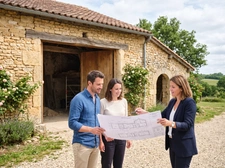
Buying a barn or farmhouse to renovate in France is appealing for its attractive price per m², its exceptional volumes and its authentic character, but this type of project requires a rigorous approach before signing. Between technical surveys, change of use and a renovation budget that is often underestimated, each step determines the feasibility and profitability of the operation. This guide details the essential checks, the planning procedures and the financing options for turning an agricultural building into a successful home.
Key points
- A barn or farmhouse is often negotiated 20 to 40% cheaper than an equivalent habitable house, but the renovation budget can amount to €1,000 to €2,500 per m².
- Before purchasing, have a professional check the roof framework, the presence of asbestos or lead, and access to utilities (water, electricity, sewage).
- Changing the use from agricultural to residential requires a prior declaration or a building permit, sometimes with the opinion of an Architecte des Bâtiments de France.
- Local support, such as that of an Optimhome property consultant, helps secure the negotiation and anticipate the regulatory constraints specific to each municipality.
Why these rural properties are attracting more and more buyers
Barns and farmhouses attract buyers seeking space, character and a living environment away from urban density. The purchase price per square metre is often much lower than that of an already habitable house, as the property is sold in its raw state, without comfort or a fitted interior layout. This initial discount makes it possible to acquire considerable volumes: impressive ceiling heights under the roof framework, generous floor areas, multiple outbuildings and adjoining land.
The architectural character is another major asset: exposed stone, old beams, terracotta tiles or traditional roof frameworks offer aesthetic potential that is rare in new-build properties. For an individual willing to invest time and a substantial renovation budget, this type of project makes it possible to create a bespoke home that is difficult to reproduce with a standard property. Before getting started, it is useful to compare the asking price with the local market value using an online property valuation, which provides a first reliable benchmark on the fair price of the land and the building.
The essential technical checks before buying
The solidity of the roof framework and the structure
The roof framework is the number one point of concern in an old barn or farmhouse. A framework weakened by damp, wood-boring insects or the weight of the years can represent a considerable expense, sometimes exceeding €30,000 for a complete overhaul. It is strongly recommended to bring in a carpenter or a structural engineering firm before making any purchase offer, in order to precisely assess the condition of the timber, the trusses and the roof covering.
Asbestos, lead and hazardous materials
Agricultural buildings built or renovated before the 1990s frequently contain asbestos materials, particularly in the roofing (fibre cement) or cladding. Lead may also be present in old paintwork if the building has had partial residential use. These surveys, mandatory in certain cases depending on the age of the property, must be anticipated as they directly affect the cost and complexity of the asbestos removal work.
Access to utilities and sewage
Unlike a house that is already connected, an isolated barn may have no access to drinking water, electricity or mains sewage. You need to check:
- the distance to the nearest electricity network and the connection cost (sometimes several thousand euros if the substation is far away);
- whether an accessible drinking water network is present;
- the possible sewage system: connection to the mains system or installation of an individual sewage system (septic tank, micro-treatment plant), subject to a soil survey;
- the feasibility of fibre or satellite internet access, often overlooked but essential in rural areas.
Change of use: the planning procedures to know
A barn or farmhouse is generally classified for agricultural use in the planning documents. Converting this building into a home involves a change of use, governed by the French planning code (code de l'urbanisme), which must imperatively be validated before purchase, or at the very least before work begins.
Prior declaration or building permit
Depending on the scale of the project, two regimes apply:
- a prior declaration of works is sufficient for a change of use with no modification to load-bearing structures or the façade;
- planning permission (permis de construire) is mandatory as soon as the project alters the external appearance, creates openings, affects the structure or exceeds certain surface area thresholds.
It is essential to consult the Local Urban Plan (PLU) or the municipal land use map (carte communale) of the relevant commune, as certain agricultural zones purely and simply prohibit any change of use, except for exceptions provided for in the regulations.
The opinion of the Architecte des Bâtiments de France
If the property is located within the protection perimeter of a historic monument or in a listed zone, the binding approval of the Architecte des Bâtiments de France (ABF) will be required. This approval may impose constraints on materials, façade colours, the type of joinery or the preservation of heritage features, which extends processing times and can increase the works budget. Enquiring in advance with the town hall's urban planning department avoids unpleasant surprises after signing.
Renovation budget: anticipating the real costs
Renovating a barn into a home often represents an investment greater than the purchase price of the building itself. Depending on the condition of the structure and the desired level of finish, the budget generally ranges between €1,000 and €2,500 per m², or even more for a high-end renovation incorporating enhanced thermal insulation, an efficient heating system and complete interior fittings.
Expense items to include in the financing plan include:
- repair of the roof frame and roofing;
- possible asbestos removal;
- connection to utility networks and sewage treatment;
- thermal insulation and installation of a heating system suited to the volume;
- creation of partition walls, intermediate floors and openings;
- interior finishes (electricity, plumbing, coverings).
Several forms of assistance can ease the bill, subject to income conditions and targeted energy performance: MaPrimeRénov' for insulation and heating works, the interest-free eco-loan (éco-prêt à taux zéro), or local assistance offered by certain rural authorities keen to combat the vacancy of agricultural buildings. A local advisor generally knows the schemes active in your geographical area.
Specific financing: works loan and progressive release of funds
Financing a barn renovation project differs from a conventional purchase. Banks often distinguish between the property loan financing the acquisition of the building and land, and the works loan covering the renovation, the latter being able to be included in an overall loan or taken out separately.
The release of funds is generally done progressively, as the work progresses and upon presentation of invoices or works statements. This mechanism protects the borrower but requires personal cash flow to advance certain expenses before reimbursement. It is advisable to:
- draw up detailed quotes before applying for the loan, item by item;
- allow for a safety margin of 10 to 15% for unforeseen events, which are common with this type of old building;
- check the release conditions with the bank (in instalments, upon the company's call for funds);
- anticipate the cost of dual housing if the works prevent immediate occupation.
Negotiating the purchase of an unusual property effectively
Negotiating a barn or a farmhouse requires a different approach from that of a conventional property, as there are fewer points of comparison. Relying on the technical surveys carried out beforehand (condition of the roof frame, presence of asbestos, lack of utility connections) constitutes a solid argument to justify an offer below the listed price.
It is also worthwhile to precisely cost the change of use and the works before making an offer, in order to propose a price consistent with the overall budget of the project. Calling on a professional on the ground makes it possible to gain efficiency: an Optimhome real estate advisor knows the local specificities, the constraints of the municipal PLU and the prices applied to comparable properties recently sold in the area. Consulting Optimhome property listings also makes it possible to compare several available rural properties and refine one's negotiation strategy before committing.
Conclusion
Buying a barn or a farmhouse to renovate remains an interesting opportunity for those seeking space, character and a bespoke project, provided each stage is approached methodically. Technical surveys, planning procedures and the works budget must be anticipated from the search phase onward, not after signing, in order to avoid unpleasant financial surprises.
Professional support often makes the difference between a well-managed project and a renovation that runs well over the planned budget. By relying on a reliable valuation of the property and on the local expertise of an advisor, you secure every stage, from the initial negotiation through to the delivery of your future rural home.
FAQ
Is a building permit always required to convert a barn into a dwelling?
Not always: a prior declaration (déclaration préalable) is sufficient if the project does not affect the load-bearing structure or the external appearance beyond certain thresholds. A building permit becomes mandatory as soon as the created floor area or the façade modifications exceed the limits set by the code de l'urbanisme. It is essential to check this point with the urban planning department of the town hall before any purchase.
How can you find out if the land allows a change of use from agricultural to residential?
The answer can be found in the Plan Local d'Urbanisme (Local Urban Development Plan) or the carte communale of the municipality, which specifies whether the agricultural zone allows this type of transformation. Some municipalities strictly prohibit it in order to preserve farming activity, while others allow it under certain conditions. A local real estate advisor can help interpret these rules before making a commitment.
What budget should be planned to renovate a barn into a primary residence?
The budget generally ranges between €1,000 and €2,500 per m², depending on the initial condition of the structure and the desired level of finish. This amount often includes roof frame repairs, insulation, utility networks and interior finishes. It is essential to obtain several detailed quotes before finalising the financing plan.
Is the opinion of the Architecte des Bâtiments de France always required?
No, this opinion is only required if the property is located within the protection perimeter of a listed historic monument or in a zone classified for heritage protection. In that case, the ABF may impose constraints on the materials and the external appearance of the building. Enquiring in advance with the town hall makes it possible to anticipate these requirements.
How can the works be financed if the bank releases the funds progressively?
Progressive release of funds means having personal cash flow available to advance certain expenses before reimbursement by the bank, or synchronising fund releases with the progress of the works. It is recommended to draw up precise quotes and to allow for a safety margin of 10 to 15% for unforeseen costs. A broker or a bank advisor can help structure this specific type of financing.
What financial assistance is available for renovating a farmhouse (corps de ferme)?
Depending on the works carried out and the household's income, schemes such as MaPrimeRénov' or the éco-prêt à taux zéro (zero-interest eco-loan) may apply, particularly for insulation and heating. Some rural local authorities also offer local grants to encourage the renovation of vacant agricultural buildings. Enquiring with the town hall and the Agence nationale de l'habitat helps identify the assistance available depending on the property's location.
Author of the publication

Fabrice DOBROWOLSKI, Director of the Optimhome network
«Benefit from myexpert advice, based on many years of experience in real estate, to ensure the success of your buying or selling project. »