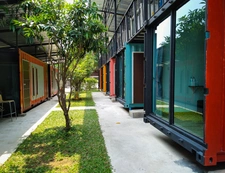
Are you wondering whether a container home makes it possible to build quickly on a buildable plot of land without hidden extra costs? Are you hesitating between a new or a second-hand container and the real budget to plan for?
Container homes are presented here in a clear way to help you understand their strengths, limits and uses. We also detail how modular housing has evolved and how it differs from a traditional house.
This practical guide explains the budget, land selection, insulation, construction methods and environmental impact in 2026.
Contact your local real estate advisor to get personalised and secure support.
Understanding the concept of a container home: definition and background
A container home is a dwelling designed using recycled or new shipping containers. Standard modules (20 or 40 feet, often High Cube) are used as a base to create modular housing. Modules can be placed side by side, stacked, or cut to create different layouts.
The concept emerged in the 1990s, initially for temporary housing and site offices. Since then, it has evolved into fully developed residential projects. Architects and builders now offer solutions that comply with current standards, including RE2020.
Common benefits include fast delivery, reuse of a robust structure and modularity. Compared with a traditional house, a container home often reduces build time and some costs. However, it requires specific technical care: reinforced insulation, anti-corrosion treatment and suitable ventilation.
Projects possible in 2026 range from a 20 m² container studio to a large modular family home. You will also find container extensions, offices or short-term holiday rentals.
The origins and evolution of container homes
The first projects used containers for emergency needs. In the 2000s and 2010s, the practice became more professional. Insulation and fit-out techniques improved.
Today, container homes meet standards close to those of conventional new builds. Regulation—especially RE2020—has pushed stakeholders to raise quality levels.
Container types and choosing between new and used
The most common containers are 20 and 40 feet, while the High Cube version provides around 30 cm of extra usable height.
Choosing a new container ensures a near-new condition and a longer service life. A used or “one-trip/last trip” container is cheaper, but it may require work (cleaning, anti-corrosion treatment, floor repairs).
Always inspect structural condition before buying and ask the supplier for the technical sheet.
The price of a container home in 2026: drivers and overall estimate
The price of a container home depends on the build approach: self-build, a container kit home, or a turnkey container home.
Key cost items include purchasing the modules, insulation, foundations, utilities connections and administrative fees. In 2026, typical turnkey ranges are generally €1,500 to €2,500 per m². Kit solutions are often €1,200 to €1,500 per m². Self-build can drop below €1,000 per m² depending on your involvement and technical choices.
Watch out for additional costs: land, servicing (utilities), transport and crane lifting often represent 30% to 40% of the total budget. Ignoring these items leads to budget overruns. Plan a safety margin of at least 10% for contingencies and material price fluctuations.
Detailed budget: structure, insulation, finishes and connections
Indicative breakdown: shipping containers (10–20%), structural reinforcement (15–25%), insulation and airtightness (15–25%), second-fix works (20–30%) and finishes (10–20%).
RE2020 requires strong thermal performance and careful airtightness. Ventilation—ideally a double-flow MVHR (VMC double flux)—and the heating system are key technical items.
On flat plots, screw piles or pads may be sufficient. On sloped land, grade beams or reinforced foundations increase costs.
Concrete example: costing an 80 m² container home project
Indicative estimate for an 80 m² “ready-to-finish” kit container home:
Containers (2 × 40 ft High Cube): €10,000 – €12,000
Structural modifications and reinforcements: €15,000
RE2020 insulation and airtightness: €18,000
Second-fix (electrics, plumbing, heating): €20,000
Interior finishes and joinery: €12,000
Transport, crane lifting and coordination: €6,000
Light foundations and utility connections: €10,000
Admin fees and contingency margin: €7,000
Approximate total: €98,000 – €110,000, i.e. about €1,200 to €1,375 per m².
These amounts vary by region, site access and the chosen finish level.
Choosing the ideal plot for a container home
A buildable plot determines feasibility and cost. Prefer flat, serviced land with good access for module delivery. Sufficient access for a crane truck is essential.
Sloped or landlocked plots generate extra foundation and earthworks costs. Before buying, carry out a geotechnical study and a logistics study for delivery.
Check the Local Urban Plan (PLU). Some towns require specific cladding or forbid an exposed metal look. In protected areas, input from the Architects of the Buildings of France (ABF) may be required.
Contact the local planning office early in the pre-design phase to remove uncertainties.
Administrative steps linked to the plot and installation
Depending on the surface area, you must file either a prior declaration or a building permit. The file includes plans, a descriptive note, a thermal study and sometimes a visual integration study.
Processing time is usually 2 to 3 months for a building permit. Plan ahead and talk to the town hall early to reduce delays and additional requests.
How the plot’s characteristics affect the project
A sloped plot can offer interesting architectural options, but it often requires support points and reinforced foundations.
Non-serviced land implies significant costs for utilities connections and wastewater treatment. Also assess logistics constraints: parking, manoeuvring areas and storage.
Insulation, thermal comfort and interior layout in a container home
Container steel creates significant thermal bridges. Without careful insulation, the home becomes uncomfortable in summer and winter.
Two main approaches: interior insulation for self-build, and exterior insulation for performance. Bio-based insulation materials offer a good ecological footprint and useful thermal phase shift in summer.
Ventilation and a properly installed vapour barrier are essential to prevent condensation.
High-performance insulation techniques compliant with RE2020
To comply with RE2020, aim for high thermal resistance and controlled airtightness. External insulation reduces thermal bridging but costs more.
Bio-based insulation (wood fibre, hemp, cellulose) improves acoustics and comfort. Ensure vapour barrier continuity and manage junctions at floor/wall and ceiling/wall connections.
Optimising space: interior layout and modular furniture
A standard container offers an internal usable width of about 2.30 m after insulation. Think in functional zones to separate day and night areas.
Fold-away furniture and vertical storage maximise usability. A mezzanine is common when height allows. Large openings and natural light make the space feel bigger.
Construction models and options available in 2026
Three main formats exist: self-build, kit homes and turnkey container homes.
Self-build saves money but requires technical skills. A “ready-to-finish” kit reduces complex steps while keeping room for customisation. Turnkey offers peace of mind, controlled timelines and warranties (including the 10-year structural warranty).
Choose based on budget, skills and your willingness to manage the site.
Self-build: benefits, precautions and essential skills
Self-build can significantly reduce the overall cost. However, it requires skills in welding, cutting and insulation.
Use professionals for electrics, plumbing and structural items. Take short training courses and consider a technical inspector to validate safety.
Kit or turnkey solutions: speed and peace of mind
Kits are delivered “watertight and airtight” and speed up the build. Turnkey ensures full project management and standards compliance.
Check warranties, the builder’s reputation and project references. Compare container services and pricing, and request detailed quotes before deciding.
Environmental impact and durability of a container home
The main environmental benefit is reusing an existing structure. Reusing a container avoids producing new structural materials.
To reduce the final carbon footprint, choose bio-based insulation and renewable energy. Prefabrication reduces on-site waste and improves build quality.
Durability depends on anti-corrosion treatment and regular maintenance.
Levers for an eco-responsible container habitat
Add solar panels and collect rainwater if possible. Choose bio-based insulation and low-VOC finishes.
Plan cladding or protection to limit corrosion. Passive design (orientation, solar shading) reduces energy needs.
Lifespan and maintenance: ensuring long-term durability
With proper treatment, the estimated lifespan is 40 to 60 years. Regularly monitor corrosion and the watertightness of flat roofs.
Check ventilation performance to prevent mould. Keep technical documentation to make resale or maintenance easier.
Support from a local real estate advisor to make your project a success
A local real estate advisor knows the market and available plots. They assess feasibility based on the PLU and advise on logistics.
They can connect you with builders, engineering offices and tradespeople. They help budget the entire project, including additional costs.
Contact an Optimhome advisor near you to secure your project.
Conclusion
A container home is a viable, modular and often fast-to-build alternative.
Plan the full budget including module costs, transport, foundations and connections.
Prioritise insulation and ventilation to comply with RE2020 and ensure lasting comfort.
Choose accessible, serviced land, and carry out a geotechnical study before buying.
Prefer eco-responsible solutions (bio-based insulation, solar panels, protective cladding).
Depending on your profile, choose self-build, a kit, or turnkey.
To secure land purchase, valuation and administrative steps, contact your local Optimhome real estate advisor.
FAQ
How much does a container home cost?
In 2026, the average price is generally between €1,500 and €2,500 per m², depending on the build approach. Add land, foundations and connections.
How do you build a container home?
Key steps: choose land, design, file permits if needed, buy modules, insulate, assemble, build foundations, connect utilities and complete finishes. Professional support is recommended.
How do you insulate a container home?
Insulation can be internal or external. Use high-performance—ideally bio-based—materials. Proper ventilation reduces condensation and thermal bridging.
How does a container home age?
Well designed and maintained, it can last 40 to 60 years. Anti-corrosion treatment and ventilation checks are key.
What land should you choose for a container home?
Prefer flat or gently sloped, serviced land with good access for delivery. Check the PLU with the town hall.
What foundations are used for a container home?
On flat, serviced land, pads or screw piles may be enough. On sloped land, grade beams or reinforced foundations are often needed after a geotechnical study.
What permits are required for a container home?
Once the surface exceeds 20 m², a building permit is generally required. Below that, a prior declaration may be sufficient depending on the town. For details, check service-public.fr.
Which towns accept container homes?
Most towns accept them if local planning rules are respected. Check with the town’s planning office for each area.
What is a converted container and what is it used for?
A converted container is a shipping container transformed into habitable space. It can be used as a main home, studio, office, extension or seasonal rental.
Is a container home comfortable all year round?
Yes—provided insulation, ventilation and heating are well designed. Comfort depends mainly on design quality and compliance with RE2020.
Where can you find container home plans suited to your project?
Plans can be provided by an architect, a specialist builder, or included in a kit/turnkey offer, with adaptations to the plot and PLU.
How do you choose a reliable container home builder?
A good builder has references, offers warranties (including the 10-year warranty), and masters technical, regulatory and energy constraints.
Are there turnkey container homes for sale?
Yes, some are sold turnkey by specialist builders or developers, sometimes with land and sometimes without.
What is the price of a 100 m² container home in 2026?
Typically €150,000 to €220,000, excluding land, depending on finish level, build method and region.
Can you build a container home in France without difficulty?
It is allowed if it complies with local planning rules, RE2020, and construction standards. Exterior appearance often needs to blend with the local context.
What are the advantages of a turnkey container home?
A turnkey offer provides a controlled budget, shorter timelines, a single point of contact and warranties—strongly securing the project.
How do you buy a container for a home?
Buy from specialist suppliers. Verify condition, origin, compliance and the technical sheet before purchase.
Is a container home suitable for Brittany?
Yes, but pay special attention to insulation, humidity, exterior cladding and local planning rules.
What’s the difference between a shipping-container home and a classic modular home?
A shipping-container home uses steel transport containers as structure, while classic modular homes use modules designed specifically for housing.
What is the price of a 120 m² container home?
Typically €180,000 to €260,000, excluding land, depending on specifications, insulation and build approach.
Can you create a home extension with a container?
Yes, a container extension is fast and modular, but it requires planning permission and good architectural integration.
Can you create a container apartment for rental?
Yes, subject to compliance with habitability standards, planning rules and energy performance requirements.
Author :

Fabrice DOBROWOLSKI - Optimhome Network Development Director
Optimhome offers you personalized support for your real estate project. Benefit from all my advice, based on several years of experience, to ensure the success of your project.