Article updated on 10/10/2026
Usufruct, bare ownership, split ownership: these concepts come up as soon as donation, inheritance or investment are discussed. Who can live in, let or sell the property? How is each right valued? Optimhome explains.
Key points
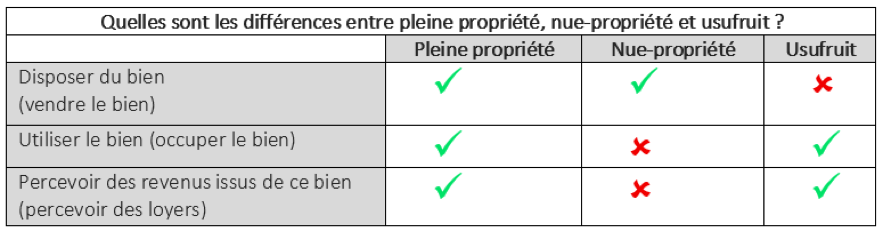
- Full ownership combines usufruct (using the property and receiving its income) and bare ownership (disposing of it).
- The usufructuary maintains the property and pays the running costs; major repairs fall to the bare owner.
- The value of each right depends on the usufructuary’s age (scale in article 669 of the CGI) or on the duration of a temporary usufruct.
- Usufruct ends in particular on the usufructuary’s death: the bare owner then becomes full owner.
Update of 10 October 2026
In 2026, the €100,000 allowance per parent and per child, renewable every 15 years, remains unchanged and its amounts are frozen until 2028. Donating the bare ownership of a property while keeping the usufruct therefore remains one of the most effective levers for passing on property: duties are calculated only on the value of the bare ownership, which depends on the usufructuary’s age on the day of the donation.
Source: Auguste Patrimoine, 2026.
Full ownership is made up of usufruct and bare ownership. The right of ownership gives the owner 3 kinds of prerogatives:
- The right to use the property, i.e. to live in it,
- The right to receive income from the property, i.e. to let it,
- The right to dispose of the property, i.e. to sell it. Full ownership can be divided: this is known as split ownership (démembrement).
What are usufruct and bare ownership?
Full ownership can be divided into 2 groups:
- Usufruct, which includes the right to use the property and to receive the income from it. The person who holds the usufruct is called the “usufructuary”.
- Bare ownership, which includes the right to dispose of the property. The person who holds the bare ownership is called the “bare owner”.
WHAT ARE THE RIGHTS AND OBLIGATIONS OF THE USUFRUCTUARY?
a) The usufructuary’s rights
- The right to use the property: the usufructuary can use the property or let it. In some cases, the bare owner’s consent will be required, as for rural, commercial or craft leases, etc.
- The right to receive the income from the property: the usufructuary receives crops, interest on a sum of money, rents. This income is received for the entire duration of the usufruct.
At the end of the usufruct, the usufructuary cannot claim compensation for having improved the property.
b) The usufructuary’s obligations
The usufructuary’s main obligations are as follows:
- Have an inventory drawn up,
- Ensure that the property is properly preserved,
- Provide a guarantee to the bare owner, unless the latter waives it,
- Pay the property tax and, if they use it as a second home, the housing tax (housing tax on main residences was abolished in 2023). If the property is let, the usufructuary receives the rent and remains liable for the property tax.
- Carry out all maintenance repairs. Major repairs are the responsibility of the bare owner unless they result from the usufructuary’s lack of maintenance (for a property, major repairs only concern the structural work).
What are the rights and obligations of the bare owner?
a) The bare owner’s rights
- The right to dispose of the property: the bare owner can sell, give away the property or contribute it to a company. This right only applies to the bare ownership of the property. Consequently, the buyer of a bare ownership right will be able neither to occupy the property nor to let it. The usufructuary continues to enjoy the usufruct unless they have formally waived it.
- The right to monitor the property: the bare owner has a right of supervision over the property which allows them to take action against the usufructuary if the latter does not fulfil their obligations or commits abuses of enjoyment that may lead to the forfeiture of the usufruct.
b) The bare owner’s obligations
The bare owner’s main obligations are as follows:
- Obligation not to act, i.e. not to disturb the usufructuary in the exercise of their right (article 599 of the Civil Code).
- Obligation relating to major repairs provided for by article 606 of the Civil Code.
How are the value of the usufruct and the value of the bare ownership calculated?
1 - The split of a property’s value between usufructuary and bare owner is set by a tax scale based on the usufructuary’s age. This scale is set out in article 669 of the French General Tax Code.
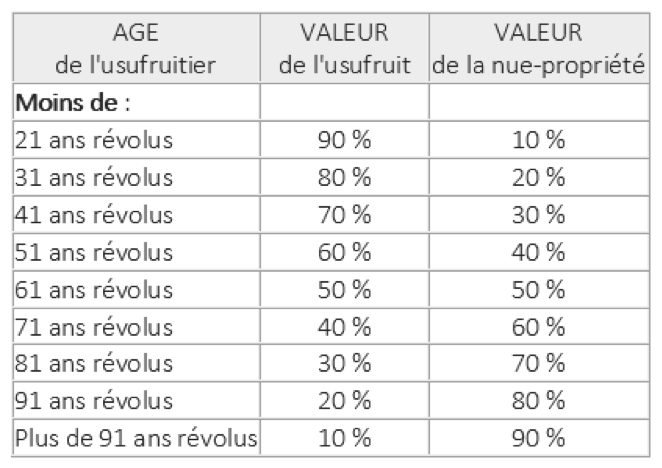
2 - If the usufruct is set for a fixed period, known as temporary usufruct, its tax value is set at 23% of full ownership per 10-year period (23% from 0 to 10 years, 46% from 11 to 20 years and 69% from 21 to 30 years). This tax scale for valuing temporary usufruct is used in particular to calculate registration duties, for example in the case of a donation.
What is economic usufruct?
Usufruct and bare ownership can be valued using another method: economic usufruct. The economic value of the usufruct can be freely determined and will result from the meeting of demand for usufruct and demand for bare ownership. The economic price is therefore the price that balances demand for usufruct and demand for bare ownership. Beyond this market value, it is possible to determine a pivot value, a benchmark value, calculated mathematically according to precise criteria. Behind this apparent simplicity, the calculations are complex. To calculate the economic value of a usufruct, the starting point is the discounted gross rental yield over the duration of the usufruct. The value of the bare ownership will be the value of the property in full ownership, minus this value of the usufruct. Although the parties may freely negotiate the values of the usufruct and bare ownership based on the economic valuation, the legislator has specified that, to determine the tax bases for transfer duties, whether free of charge or for consideration, and whatever the private arrangements between usufructuary and bare owner, the scale in article 669 of the CGI must be used.
How does usufruct end?
Usufruct ends in the following situations:
- Death of the usufructuary,
- Expiry of the agreed period (temporary usufruct),
- Usufruct and bare ownership being united in the same person,
- Non-use for 30 years,
- Waiver of the usufruct,
- Total loss of the property,
- Abuse of enjoyment by the usufructuary (damage to the property or lack of maintenance).
The difference between usufruct and the right of use and habitation
Usufruct should not be confused with the right of use and habitation. The right of use and habitation is a real right, but strictly personal and non-transferable, and it is limited to living in the home (without being able to let it), whereas usufruct is a real right and can apply to both immovable and movable property (e.g. a securities portfolio). Only the holder of the right of use and habitation, members of their close family (children, spouse) or third parties named in a deed may use the property. However, the holder of the right of use and habitation cannot:
- Transfer, give away or mortgage this right,
- Let the property occupied under this right. While split ownership can bring advantages, it raises two major difficulties: the division of management powers and uncertainty about the amount of income going to the usufructuary. Diverging interests between usufructuaries and bare owners and the division of powers are often a source of tension.
Reference texts: articles 382 to 386 of the Civil Code, articles 578 to 581 of the Civil Code, articles 582 to 599 of the Civil Code, articles 600 to 616 of the Civil Code, articles 617 to 624 of the Civil Code, article 767 of the Civil Code, articles 625 to 636 of the Civil Code.
Also on the blog
- Property donation: how does it work?
- How to avoid inheritance tax on a property
- New law on joint ownership and inheritance: what changes in 2026
- Can you sell a share of your house to your spouse?
- SCI: the advantages of this structure for property investment in 2026
Author of the publication

Fabrice DOBROWOLSKI, Director of the Optimhome network
«Benefit from myexpert advice, based on many years of experience in real estate, to ensure the success of your buying or selling project. »