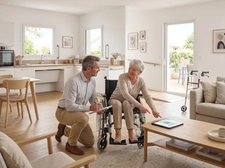
Adapting a home for reduced mobility involves carrying out targeted work (widening access points, installing a walk-in shower, a stairlift, ramps, grab bars) in order to secure movement within the home and enable people to continue living at home, particularly elderly people or people with disabilities. In 2026, these adaptations are made easier by financial schemes such as MaPrimeAdapt', grants from the Anah and from pension funds, which can cover a significant part of the budget depending on the household's resources. Beyond day-to-day use, this work is also becoming a genuine asset in terms of property value, as the market of senior buyers and families planning ahead for the future is expanding considerably.
Key takeaways
- The ageing of the French population is prompting a rethink of existing housing stock, which is largely unsuited to reduced mobility.
- The most common adaptation works (walk-in shower, ramp, stairlift, door widening) cost from a few hundred to several thousand euros depending on their scale.
- MaPrimeAdapt', Anah grants and pension fund assistance can finance a large part of this work, subject to means and age conditions.
- An adapted or adaptable home is becoming an increasingly important selling point on resale, particularly for senior buyers and multigenerational families.
A demographic challenge that is durably transforming housing
France today has several million people aged over 75, and this proportion will continue to grow over the coming decades. However, the vast majority of the older housing stock was built without anticipating needs related to reduced mobility: narrow staircases, cramped bathrooms, no ramps or step-free access. Since staying at home is the preference of a large majority of seniors over moving into a specialised facility, adapting housing is becoming a public health issue as much as a concrete property matter for millions of households.
For owner-occupiers as well as investors, anticipating this demographic shift helps secure a property's use value over the long term, while meeting a real and growing need.
The most common adaptation works
Adapting a home for PMR does not necessarily mean a major renovation. Several targeted interventions are often enough to secure movement and gain independence.
Circulation and access
- Widening interior and exterior doors to allow passage of a wheelchair or a walking frame (recommended minimum width of 80 to 90 cm).
- Installing an access ramp at the entrance to the home, with a suitable slope to limit effort.
- Removing thresholds and isolated steps, replaced by level, step-free surfaces.
Bathroom and sanitary facilities
- Replacing the bathtub with a walk-in shower, with no lip, to prevent falls.
- Installing grab bars near the shower and toilet.
- Installing a raised toilet and a washbasin at a suitable height.
Floors and vertical movement
- Installing a stairlift, with or without a straight rail, depending on the staircase configuration.
- In some cases, installing a small lift or a vertical platform for homes spread over several levels.
The cost of this work varies widely: a few hundred euros for grab bars, several thousand euros for a complete walk-in shower, and often more than 5,000 euros for a stairlift, depending on the model and the layout of the premises.
Accessibility standards: what changes depending on the type of home
Regulatory accessibility requirements differ significantly depending on whether the property is an individual or collective home, and whether it is new or older.
New collective housing
New collective buildings are subject to strict accessibility standards set out in the Code de la construction et de l'habitation (Building and Housing Code): common areas must be accessible to people with reduced mobility, and a percentage of dwellings must meet precise criteria (width of circulation areas, height of fittings, absence of obstacles). These rules have evolved in recent years to introduce the concept of "evolutive" housing, that is, housing that can easily be converted into fully accessible homes.
Individual housing
A detached house built for personal use is, however, not subject to any strict accessibility requirement, unless it is intended for rental or for sale as part of a new grouped development programme. The owner is therefore free to adapt their property according to their needs, but this freedom also means that no regulatory constraint encourages anticipating these adaptations before they become necessary.
Existing housing
For existing housing, there is no retroactive obligation to bring the property up to accessibility (PMR) standards, except during major renovation work or a change of use. It is precisely for this reason that adapting existing buildings relies largely on the initiative of owners, supported by financial assistance schemes.
Financial assistance available in 2026
Financing often remains the main obstacle to carrying out this work, but several schemes make it possible to significantly reduce the remaining cost to be borne.
- MaPrimeAdapt': this assistance, paid by the Anah, targets owner-occupiers and tenants over 70 years of age (or with a disability) wishing to adapt their home. It can cover a significant share of the cost of eligible work, subject to means-testing, with a reduced remaining cost for the most modest households.
- Standard Anah assistance: in addition to or as an alternative, certain adaptation works may also be included in overall renovation applications, particularly when they accompany energy renovation work.
- Pension fund assistance (Carsat, MSA, supplementary schemes): these offer grants or loans at favourable rates for adapting the homes of retirees, often combinable with MaPrimeAdapt' under certain conditions.
- Tax credit and reduced VAT rate: certain accessibility (PMR) equipment benefits from a VAT rate of 5.5% instead of 10% or 20%, which directly reduces the bill.
It is strongly recommended to put together the application before starting the work, as these schemes are generally subject to prior approval. A specialist professional or an occupational therapist can also help identify the genuinely priority adaptations.
Impact on the property's value and attractiveness on resale
Long seen as a constraint, accessibility (PMR) adaptation work is becoming a genuine selling point. Population ageing is fuelling growing demand for single-storey properties that are easy to access and already equipped, particularly among senior buyers who wish to plan ahead for the loss of independence without having to move a second time.
- A ground-floor property or one with a lift, fitted with an adapted bathroom, stands out clearly on the market compared with similar unadapted properties.
- Multigenerational families, looking for a home that can accommodate an elderly parent, also value these features.
- A property that is already partially adapted reduces the work budget perceived by the buyer, which can speed up the sale and support the negotiated price.
To put a figure on this added value, an online property estimation provides an initial order of magnitude, before refining the analysis with a professional in the sector who knows the precise expectations of the local market.
Planning ahead properly: when buying or for a property already owned
Whether you have owned your property for several years or are in the process of buying, anticipating future accessibility needs avoids having to carry out work in a rush, which is often more costly and less well thought out.
When buying
- Where possible, favour a single-storey property or a building with a lift, especially with a view to a long-term main residence.
- Check the width of the doors, the layout of the bathroom and the technical feasibility of a future stairlift before signing.
- Get support from an Optimhome property consultant, who can direct the search towards properties that are genuinely adaptable at the best value for money.
For a property already owned
- Have an accessibility assessment carried out by a professional in order to prioritise the most useful work.
- Spread the adaptations out over time, starting with the most critical safety points (shower, stairs, main entrance).
- Put together the financial assistance application before committing to any work, so as not to lose the benefit of the available grants.
In both cases, browsing Optimhome property listings makes it possible to spot properties that are already partially adapted or that offer strong potential for adaptation, a criterion that is increasingly sought after on the residential market.
Conclusion
Adapting a home for reduced mobility is no longer a marginal issue reserved for a few specific situations: it is a structural challenge, driven by the ageing population and the growing desire of French people to grow old in their own homes. Between routine works, standards that differ according to the type of property and the financial assistance available in 2026, the means exist to make these projects accessible to most households concerned.
Beyond the everyday comfort they provide, these adaptations also constitute a relevant property investment, in a market where demand for adapted housing continues to grow. Whether it is a purchase project or works on a property already owned, surrounding oneself with competent professionals, from the initial assessment through to the future valuation of the property, remains the best guarantee of success.
FAQ
What is the average cost of adapting a home for reduced mobility?
The cost depends heavily on the extent of the works: a few hundred euros for grab bars or a simple ramp, several thousand euros for a full walk-in shower, and often more than 5,000 euros for a stairlift. An overall project combining several adaptations can reach 15,000 to 20,000 euros, before deduction of financial assistance.
Who can benefit from MaPrimeAdapt'?
MaPrimeAdapt' is primarily aimed at owner-occupiers and tenants over 70 years of age, as well as people with disabilities, subject to certain age and income conditions. The amount of assistance varies according to the household's income level.
Is authorisation required to install a stairlift or an access ramp?
In an individual home, these installations generally do not require any particular authorisation, unless they alter the external appearance of the building or are located in a condominium. In the latter case, the approval of the general meeting of co-owners may be required before the works.
Do accessibility works actually increase the value of a property?
They do not always change the listed price, but they enhance the property's appeal and can speed up the sale, particularly among senior buyers or multigenerational families. A property that has already been adapted spares the buyer additional works, which constitutes a negotiating argument in the seller's favour.
Can several forms of assistance be combined to finance these works?
Yes, under certain conditions, it is often possible to combine MaPrimeAdapt' with assistance from pension funds or local schemes, provided that the caps and non-cumulation rules specific to each scheme are respected. It is advisable to seek support in order to optimise the application.
How can I know if my current home is adaptable?
An assessment carried out by a professional (occupational therapist, specialised tradesperson or consulting firm) makes it possible to evaluate the technical feasibility of the desired adaptations. This assessment also helps prioritise the works according to urgency and available budget.
Author of the publication

Fabrice DOBROWOLSKI, Director of the Optimhome network
«Benefit from myexpert advice, based on many years of experience in real estate, to ensure the success of your buying or selling project. »