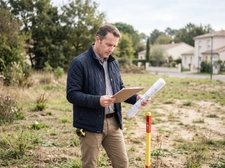
You've found a buyer for your land in France, the preliminary contract has been signed, and yet nothing is settled just yet. Between the signing of the preliminary contract and the signing of the final deed, it generally takes two to three months, sometimes much longer for a building plot subject to a condition precedent regarding planning permission. During this period, several documents and checks still need to be finalised: boundary surveying, a G1 soil study, a certificate of urban planning, easements, servicing of the land, or even parcel division. This article takes a concrete look at everything a seller still needs to check in order to secure the sale right through to the end.
In summary
- The G1 soil study is mandatory for any unbuilt buildable plot located in a zone with moderate or high clay shrink-swell risk, a zone that will expand even further in 2026.
- Boundary surveying is not systematically mandatory, but it becomes essential in the case of a subdivision, a parcel division, or doubt over property boundaries.
- Between the preliminary contract and the final deed, allow at least two to three months, and up to several months more if the plot is subject to planning permission or a pre-emption right.
- Easements, servicing of the land and compliance with the local urban plan (PLU) must be checked and declared before final signing, otherwise the seller may be held liable for hidden defects.
The preliminary contract is signed, but nothing is finalised yet
I often tell my selling clients: signing a preliminary contract is an important step, but it's not the finish line. It's more like the starting gun for an administrative race against the clock, during which several documents still need to be gathered before the notary can schedule the final signing. A plot of land, unlike an already-built house, comes with its own set of specific issues: the nature of the soil, access to utilities, property boundaries that have sometimes been unclear for decades. If poorly anticipated, these matters can delay the sale by several weeks, or even cause it to fall through.
Why this delay exists
Eight days after the preliminary contract is signed, the notary sends the documents to the town hall to request the certificate of urban planning and to clear the urban pre-emption right. The town hall then has two months to respond, and this period can extend up to seventy days in certain specific cases. This is an unavoidable period of time, and it is precisely during this window that the seller must finalise all the documents still pending.
What this means for you in practice
If you are selling a buildable plot with a condition precedent requiring the buyer to obtain planning permission, the timeframe can stretch to between six and eighteen months. This is not an anomaly, it's simply how French administrative procedures normally work. My advice: don't set a rigid personal deadline for yourself, but stay in regular contact with your notary and your advisor to track progress file by file.
The G1 soil study: a document that has become essential
Since 1 October 2020, the ELAN law has required a preliminary geotechnical study, known as a G1 PGC, for any unbuilt buildable plot located in a zone with moderate or high clay shrink-swell risk. In practice, this now affects nearly half of French territory, and the map is expanding further still: following the order (arrêté) of 9 January 2026, the new clay soil mapping will come into force on 1 July 2026 and will cover 55% of the territory, compared to 48% previously.
How to find out if you are affected
The first thing to do is to check the georisques.gouv.fr website, which gives you, in just a few clicks, the level of exposure of your plot. If your land is classified as moderate or high risk, the G1 study is mandatory and must be attached to the preliminary sale agreement or, failing that, to the final deed. This service, carried out by a geotechnical engineering firm, generally costs between 1,000 and 2,000 euros.
Who pays, and when to order it
It is up to the seller to provide this study, at their own expense. My practical advice: don't order it at the last minute. Engineering firms are often in high demand and turnaround times can reach several weeks. Plan ahead as soon as you seriously consider selling, even before you've found a buyer—this will save you valuable time and prevent any hold-up to the final signing.
Boundary surveying: securing the boundaries before signing
Boundary surveying is not systematically mandatory for selling a plot of land, but it becomes so in two very common situations: when the land is part of a subdivision, or when the boundaries with neighbouring plots are uncertain or disputed. A boundary survey report drawn up by a chartered surveyor (géomètre-expert) then legally establishes the property boundaries, with the precise coordinates of each boundary marker.
A document that protects everyone
I regularly see sales become complicated because a neighbour disputes a fence or a hedge that has been there for twenty years. Boundary surveying prevents this kind of unpleasant surprise after signing. If the land sold results from a parcel subdivision, boundary surveying even becomes a legal obligation: each newly created parcel must be clearly delimited, with its own access to the public road.
The cost to plan for
A chartered surveyor's services generally cost between 1,500 and 3,000 euros, depending on the complexity of the land and the number of markers to be set. This is a budget to factor in from the outset of your sale project, especially if you already know that the boundaries of your land have never been formally established.
A word from the expert
« With land sales, what most often holds things up is never the price, it's the time lost through failing to anticipate the technical documents: I've seen files blocked for six weeks because the seller hadn't commissioned their G1 soil survey at the right time, and others where the neighbour disputed a property boundary the day before signing at the notary's office because no one had bothered to have the land surveyed twenty years earlier; my advice, which I repeat to every selling client, is to deal with these matters as soon as the property goes on sale and not after finding a buyer, because a buyer who sees their project dragging on always ends up having doubts, and sometimes withdraws, whereas a well-prepared file immediately reassures and allows for reasonable signing timeframes, which, ultimately, is also the best way to sell at the right price without making last-minute concessions under time pressure. »
The certificat d'urbanisme and compliance with the PLU
The certificat d'urbanisme informs the buyer, and protects you as the seller, regarding the rules applicable to the parcel: buildability, public easements, taxes, pre-emption rights. There are two types: the informational certificat d'urbanisme, which provides information on the general rules, and the operational certificat d'urbanisme, which indicates whether the buyer's specific project is feasible.
Checking consistency with the local urban development plan
Each municipality applies its own local urban development plan (plan local d'urbanisme), which sets precise rules on buildability, height, siting or density. Before final signing, make sure nothing has changed since the property went on sale: a PLU can be revised, and a buildable parcel may see its building rights altered during the process. This is rare, but it happens, and it's better to know about it before the buyer discovers it instead of you.
Anticipating the pre-emption right
The town hall has a two-month period in which to exercise, or not, its urban pre-emption right. Until this period has elapsed, the sale cannot be finalised. This is a step entirely beyond your control as the seller, but one that absolutely must be factored into your projected timeline so as not to be caught off guard.
Easements and parcel subdivision: points that must not be overlooked
If your land is crossed by a pipeline, an electrical line, or if it benefits from or is subject to a right of way, these easements must be clearly identified and disclosed to the buyer. The chartered surveyor who carries out the boundary survey can also record these elements, which must then appear in the deed of sale.
The seller's liability in the event of an oversight
An undisclosed easement can expose you to liability for a hidden defect, even after signing. This is a point on which I am uncompromising with my clients: it is better to over-disclose than to under-disclose. If you have the slightest doubt about an easement, a long-standing right of way or a buried pipeline, have it checked before committing.
The special case of parcel subdivision
If you are selling only part of your land, a planning authorisation is required, either a déclaration préalable or a permis d'aménager depending on the case, and each parcel resulting from the subdivision must have its own access to the public road. This step must absolutely be completed before the sale, otherwise the notary will not be able to draw up the authentic deed.
The practical tip
- Check georisques.gouv.fr as soon as you put the property up for sale to find out whether a G1 soil survey is mandatory on your plot.
- Contact a chartered surveyor (géomètre-expert) as early as possible if your property boundaries have never been formally established, as intervention times can be long.
- Keep a copy of all correspondence with the town hall regarding the certificate of urbanism, as it may be useful in the event of a dispute.
- List in writing all known easements, even old or barely visible ones, before meeting your notary.
- If the land is not serviced with utilities, clearly state in the preliminary sale agreement who, the seller or the buyer, will cover the connection costs.
Servicing the land (viabilisation): a matter to negotiate before signing
A plot of land is considered serviced when it has the three essential connections: drinking water, electricity and sanitation, whether collective or individual. A serviced plot sells on average 15 to 20% higher than raw land, making it a strong argument in your negotiations.
Who covers the connection costs
If you sell the land "as is," it is in principle up to the buyer to bear the costs of servicing the land. But if you announced or promised serviced land in your listing, this cost falls to you. Hence the importance of clarifying this point as soon as the preliminary sale agreement is drafted, to avoid any misunderstanding at the time of the final signing.
The right reflex before putting it up for sale
Before even publishing your listing, take stock of the actual state of servicing of your land. This will allow you to set a consistent price and avoid tense discussions towards the end of the process. It is also an excellent way to enhance the value of your property: don't hesitate to have your property appraised by a professional who knows your area well and its technical specificities.
Making the right choices right up to the last moment
The signing of the deed of sale (acte authentique) remains the moment where everything is truly decided. This is when the notary verifies that all the documents, soil survey, boundary marking (bornage), certificate of urbanism, absence of undeclared easements, are gathered and consistent. An incomplete file at this stage can lead to a postponement of the signing, sometimes by several weeks.
Relying on a professional to avoid oversights
This is exactly the role of a good real estate advisor: to support you through these technical verifications, in connection with the notary and the various parties involved, surveyor, engineering firm, town hall. If you are not yet being supported, it is always useful to find a local real estate advisor who knows the specificities of your municipality and its urban development plan.
Staying responsive until the end
Between the preliminary sale agreement and the final deed, document exchanges sometimes follow one another quickly. My advice: respond quickly to requests from the notary or surveyor, as each day of delay on an administrative document can have repercussions on the entire sales timeline.
Communicating well with the buyer right up to the end
Land that sells well is also land whose buyer feels confident until the very end. Keep them informed of the progress of the process, share documents with them as they become available, rather than centralizing everything at the last minute. This transparency avoids many tensions and last-minute renegotiation requests.
Anticipating the buyer's classic questions
A serious buyer will almost always ask you about the nature of the soil, access to utility networks and the exact boundaries of the plot. It's best to have the answers ready, supported by documents, rather than discovering a problem along the way. This is also what distinguishes a smooth sale from one that drags on for months.
Don't hesitate to check comparable listings
To assess whether your land is correctly valued given its level of servicing and technical constraints, take a look at real estate listings for similar plots in your area. This will give you a concrete idea of the local market and help you adjust your strategy if needed.
Conclusion
Selling a plot of land doesn't stop at the signing of the preliminary contract — in fact, that's often when the real work begins. Between the G1 soil survey, the land surveying, the certificate of urbanism, easements and servicing (connection to utilities), every document matters to secure the transaction through to the final deed. By anticipating these steps from the moment the property goes on sale, you avoid unpleasant surprises, save time, and reassure your buyer at every stage. Don't hesitate to get support from a professional who knows your local market: this is often what makes the difference between a sale that drags on and a sale that is concluded smoothly, within the announced timeframe.
FAQ - Frequently Asked Questions
Is the G1 soil survey mandatory for all plots of land?
No, it is mandatory only for buildable undeveloped plots located in a medium or high risk zone for clay shrink-swell (retrait-gonflement des argiles). You can check the classification of your parcel on georisques.gouv.fr, and note that the mapping will be expanded as of 1 July 2026.
How long does it take between the preliminary contract and the final deed for a plot of land?
Generally allow two to three months for a plot that is already serviced and has no particular condition precedent. If the buyer makes their purchase conditional on obtaining a building permit, the timeframe can extend from six to eighteen months.
Who must pay for the land surveying, the seller or the buyer?
There is no legal rule imposing this on either party; it is freely negotiated between the parties and specified in the preliminary contract. In practice, it is often the seller who takes the initiative and bears the cost, in order to secure the sale and reassure the buyer.
What happens if an easement was not disclosed before the sale?
The seller may be held liable for a hidden defect (vice caché), even after the final deed has been signed. This is why it is always best to disclose any known easement, even an old or barely visible one, before committing to the sale.
Can an unserviced plot of land still be sold?
Yes, a raw plot of land can certainly be sold, but it is generally negotiated at 15 to 20% less than a serviced plot. The key is to clearly specify in the preliminary contract who will bear the future utility connection costs.
Author of the publication

Fabrice DOBROWOLSKI, Director of the Optimhome network
«Benefit from myexpert advice, based on many years of experience in real estate, to ensure the success of your buying or selling project. »