Pergola Installation in 2026: The Complete Guide
Are you wondering how to design a compliant and cost-effective pergola for your home or rental investment? Are you hesitating between a wood pergola, an aluminum pergola, or a bioclimatic pergola, while worrying about planning permission and administrative requirements? This 2026 pergola guide explains pergola types, materials, regulations, and budget considerations. It provides a clear pergola definition, practical steps, and cost examples. You will be able to manage your pergola project more effectively and estimate the added value it can bring to your property. Contact a local real estate advisor for tailored support.
Pergola Definition and Purpose
A pergola is a lightweight outdoor structure made up of posts and a partial or adjustable roof. It is designed to create shade and extend outdoor living space into a true open-air room. By definition, a pergola differs from a conservatory or sunroom: a pergola generally remains semi-open, while a conservatory is enclosed and insulated.
Depending on the type — attached pergola, freestanding pergola, or bioclimatic pergola — it can become a practical home extension. It can cover a terrace, shelter a swimming pool area, or enhance a rental property while preserving natural light. When well designed, a pergola can add property value and improve overall real estate appeal.
Examples of use include an attached pergola outside a kitchen to create an outdoor dining area, a freestanding pergola in the center of a garden as a summer lounge, or a commercial pergola for a restaurant terrace. Before making a decision, compare an outdoor pergola with other shelter solutions and anticipate the regulatory and tax implications.
Pergola vs Gazebo, Conservatory, or Awning
Pergola: a semi-open, adjustable structure. Use: shading and outdoor living extension. Formalities: often relatively simple for smaller structures.
Conservatory / Sunroom: an enclosed and insulated room. Use: year-round living space. Formalities: generally more complex, often requiring full planning permission.
Gazebo and awning: lighter, often removable solutions. Use: seasonal or temporary protection. Cost and durability: usually lower.
When should you choose each one? Opt for a conservatory if you want a heated room with additional protection from bad weather. Choose a pergola if you want outdoor shade without full enclosure but with a more premium feel. A gazebo is better suited to a budget-friendly or temporary solution.
When Should You Install a Pergola? Uses and Objectives
Install a pergola to enlarge a terrace, create an outdoor dining area, protect a poolside space, or improve the appeal of a rental property. A pergola as a home extension is ideal when you want to increase visual and practical appeal without altering the interior.
Selection criteria include pergola orientation for sunlight exposure, local climate conditions (for example, aluminum is often recommended near the coast), budget, and local planning rules such as the local zoning plan. Decide whether your objective is mainly aesthetic or functional to assess its impact on property value.
Quick Decision Checklist
Check pergola placement, distance from neighbors, easements, and condominium approval if required. For a commercial project, anticipate safety standards and choose a robust, low-maintenance pergola.
Types of Pergolas: Features and How to Choose
The main pergola categories suit different needs and constraints. These include the attached pergola, freestanding pergola, bioclimatic pergola, retractable pergola, pergola kit, and bespoke pergola. The right choice depends on placement, budget, style, and the level of structural stability required.
Quick guidelines: choose an attached pergola for a home extension and simpler utility connections. Choose a freestanding pergola for greater flexibility of placement. Choose a bioclimatic pergola for all-season comfort. A pergola kit reduces cost, while a bespoke pergola offers a more premium finish.
For commercial or luxury projects, a high-end pergola offers refined finishes, smart home integration, and even photovoltaic options for better durability and value.
Attached Pergola
An attached pergola is fixed against the façade. It provides stability and makes electrical connections easier. It is a popular solution for creating a covered terrace or extending the home next to a kitchen.
Points to watch: waterproofing where the structure joins the façade, planning requirements if the exterior appearance is modified, and possible impact on façade insulation. This solution is ideal for an outdoor dining area or covered terrace.
Freestanding Pergola
A freestanding pergola is an independent structure placed in the garden. It offers flexible positioning and can serve various purposes, such as a privacy screen or summer lounge.
Constraints include foundations, anchoring, and ground fixing strong enough to ensure stability in windy conditions. For common sizes such as 3 x 4 m, a ground assessment may be useful.
Bioclimatic Pergola
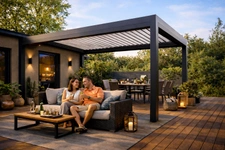
A bioclimatic pergola features adjustable louvers that control sunlight and ventilation. Depending on the model, it can also provide strong rain protection.
Options may include motorization, weather sensors, integrated LED lighting, and side screens. The cost is higher, but the extended usability can make a bioclimatic pergola a profitable investment.
Retractable, Motorized, and Pergola Kits
Retractable pergolas are available with fabric roofs, canopies, or retractable louvers. Pergola kits reduce the purchase price and are suitable for DIY installation. Motorized pergolas provide greater comfort and automation but usually require professional installation.
Choose a kit if your budget is limited and you have assembly skills. Choose a bespoke pergola for better durability and advanced technical options.
Bespoke and Luxury Pergolas
Custom pergolas suit high-end projects. They offer premium materials, refined finishes, home automation integration, and sometimes solar panels. They can create strong added value for upscale properties.
Points to watch: long-term warranties, compliance with standards, and possible coordination with an architect.
Pergola Materials, Finishes, and Technical Criteria
The material you choose determines the look, maintenance needs, and lifespan of the pergola. Common options include wood pergolas, aluminum pergolas, composite pergolas, and PVC pergolas. Wood offers warmth and suits climbing plants. Aluminum is durable and low-maintenance. Composite combines a wood-like appearance with strong resistance.
Technical criteria to check include pergola anchoring, pergola foundations, wind resistance, and snow load based on your location. For coastal areas, choose corrosion-resistant materials such as aluminum or recycled aluminum.
Finishes and accessories such as paint, wood stain, wood-effect finishes, integrated pergola lighting, and side screens improve both appearance and usability.
Wood Pergola
A wood pergola creates a natural look and works well with a planted pergola using climbing plants. It requires regular maintenance, including stain, insect treatment, and moisture control.
The price varies depending on the wood species, such as treated pine, oak, or Douglas fir, as well as the size. Choose durable timber suited to the local climate to extend lifespan.
Aluminum Pergola
An aluminum pergola offers durability, light weight, and low maintenance. It is ideal for motorization and integrated LED lighting. Models made from recycled aluminum are particularly appealing for eco-conscious projects.
In most cases, simple cleaning with soapy water is enough to keep it looking good.
Alternative Materials and Technical Fabrics
Composite materials offer a wood-effect appearance with lower maintenance. Technical fabrics and shade sails provide UV protection and make water drainage easier.
These solutions are useful when you want long-lasting performance without the constraints of wood, or flexible use through a retractable fabric roof.
Roofs, Screens, and Shade Sails
Roof options include adjustable louvers, polycarbonate, laminated glass, and retractable fabrics. The choice depends on the balance you want between rain protection, light, and heat control.
Side screens and shade sails improve privacy and wind protection. Plan electrical integration and waterproofing from the quotation stage.
Planning Rules, Permits, Taxes, and Insurance
Administrative requirements depend on the pergola’s surface area, whether the structure is enclosed, and the local zoning plan. For official information, consult the public service page on building permits and declarations.
Indicative thresholds: a prior declaration is often required for smaller pergolas. In protected areas, or if the pergola changes the exterior appearance of the property, stricter requirements may apply. Always check local rules.
Taxes and insurance: development tax may apply depending on the area created. VAT depends on the nature of the work and whether a professional contractor is involved. Inform your home insurer and ask the contractor for proof of professional insurance and a ten-year structural warranty if the pergola qualifies as structural work.
When to File a Prior Declaration
A prior declaration is often required for small pergolas, but thresholds vary by municipality. Prepare a location plan, site plan, descriptive notice, and photographs for your application.
Timeframe: typically around one month, depending on the local authority. Ask a local real estate advisor for help identifying sensitive points.
When Is Planning Permission Required?
Planning permission is required for pergolas creating a significant area, enclosed structures, or projects subject to local rules or protected zones. Allow for a full application file and around two to three months of review on average.
Local Rules, Condominium Approval, and Easements
The local zoning plan sets rules on placement, height, and sometimes materials. Landscape or heritage easements may restrict the project. In a condominium, the building manager or association often needs to approve any work affecting common areas or the façade.
Anticipate the distance to neighbors and, if possible, obtain written neighbor consent if the pergola touches the boundary line.
Taxes and Insurance
Development tax is calculated based on taxable surface area and local rates. VAT varies according to the type of work and whether a professional is involved. For rental properties, specific tax rules may apply, so consult a tax advisor.
Keep invoices and insurance certificates. They are useful proof of compliance when selling the property and help with insurance claims.
Pergola Cost in 2026: Prices, Quotes, and Financing
Pergola cost depends on the type, material, dimensions, and optional features. Budget items may include the structure, installation, foundations, electrical work, LED lighting, terrace heating, and labor.
Always request three detailed pergola quotes and compare technical specifications, warranties, and lead times. Plan a margin for additional costs such as foundations and electrical work.
Typical Price Ranges
Indicative 2026 ranges, to be checked locally: basic pergola kit approximately €300–€2,000 depending on size; mid-range installed aluminum pergola approximately €3,000–€10,000; motorized bioclimatic pergola approximately €10,000–€25,000+ depending on options. The 3 x 4 m pergola is a common benchmark for quotations.
Additional Costs
Examples of extra costs: pergola foundations such as pads, piles, or slab approximately €300–€2,000; pergola electrical connection approximately €300–€1,500; integrated LED lighting approximately €200–€1,200; terrace heating approximately €300–€2,000. Request specialist quotes for these items.
DIY vs Professional Installation
Installing a pergola yourself reduces cost but increases risks: non-compliance, poor workmanship, and no warranty. Professional installation costs more, but provides compliance, insurance, and guarantees.
Use a professional for complex structures, reinforced foundations, and electrical connections. Ask for insurance certificates and references before signing the quote.
Practical Cost Example: 3 x 4 m Pergola Simulation
Basic kit: structure €800, installation €300, minimal anchoring €150 → total approximately €1,250. Best for seasonal use and limited budgets.
Mid-range aluminum pergola: structure €3,000, installation €1,200, foundations €600, electrical connection €500 → total approximately €5,300. Best for regular, long-term use.
Motorized bioclimatic pergola: structure and motorization €12,000, installation €2,500, reinforced foundations €1,500, lighting €800, heating €800 → total approximately €17,600. Best for all-season comfort and strong added value.
These figures are indicative for 2026. Obtain local quotations to refine your budget and assess return on investment based on your local market.
Practical Guide: Project Steps, Best Practices, and Timeline
Here is a six-step roadmap to help you complete your pergola project successfully. Good preparation reduces risks and speeds up administrative procedures.
Essential checklist: prior declaration or planning permission file, plans, photos, three comparative quotes, zoning check, easement check, and condominium approval if needed. Keep all documents in writing.
Step 1: Choose the Type, Location, and Feasibility Study
Check pergola orientation, prevailing wind, site access, and reference dimensions such as 3 x 4 m. Review pergola placement against property boundaries and local planning rules.
The feasibility study should include measurements, façade photos for an attached pergola, electrical connection points, and material choice based on exposure.
Step 2: Administrative Procedures and Quote Requests
Gather the documents for the prior declaration or building permit application: site plan, elevation plan, and descriptive note. Request three comparative quotes and check technical sheets and warranties.
Key questions for contractors: insurance, ten-year warranty, foundation specifications, and maintenance terms.
Step 3: Site Preparation and Foundations
Carry out site marking, possible boundary surveying, underground service checks, and excavation for pads or slab. Choose suitable foundations: pads for stable ground, piles for soft soil, and slab for heavier loads.
Check pergola anchoring and wind resistance. Follow site safety instructions carefully.
Step 4: Installation, Finishes, and Final Acceptance
During installation, check vertical alignment, anchoring, and roof waterproofing. Test the motorization and lighting. At the end, request detailed invoices, insurance certificates, and maintenance instructions.
Carry out final acceptance of the works by listing any reservations and requiring them to be resolved within the contractual timeframe.
Real Estate Project? Your Optimhome Advisor Supports You
Are you planning to sell or buy a house, apartment, plot of land, commercial premises, or a luxury property? Your local Optimhome real estate advisor can support your project by assessing the impact of a pergola on property value. They can guide you through planning procedures, tax implications, and the selection of reliable contractors.
Get an accurate and reliable property valuation before or after pergola installation. Your advisor can help you prepare the planning file, choose the optimal pergola size, and highlight the property’s strengths for sale or rental. Contact your local Optimhome advisor for personalized guidance.
Conclusion
A pergola extends outdoor living space and should be chosen based on use, placement, and style.
Select the right material — wood, aluminum, or composite — while considering maintenance needs and lifespan.
Check all formalities, whether a prior declaration or planning permission, and review local zoning rules before starting.
Plan a complete budget including foundations, electrical work, and options such as motorization and LED lighting.
To secure the project, require detailed quotes, insurance certificates, and a ten-year warranty when necessary.
For a successful new-build, period property, rental, or luxury project, contact your local Optimhome advisor for a valuation, quotations, and expert tailored support.
FAQ
Do You Need Planning Permission for a Pergola?
Short answer: it depends. For a small, non-enclosed pergola, a prior declaration is often enough. If the pergola is enclosed or exceeds local thresholds, full planning permission may be required. Check the local zoning plan and contact the local authority.
How Much Does a Pergola Cost in 2026?
Short answer: prices vary. A basic kit ranges from a few hundred euros to around €2,000. A mid-range installed aluminum pergola generally costs €3,000–€10,000. A motorized bioclimatic pergola often costs €10,000–€25,000+. Request several local quotes.
Does a Pergola Increase Home Value?
Short answer: when well designed and compliant, a pergola can improve property appeal and increase real estate value. The impact depends on quality, finishes, and the local market.
Which Pergola Should You Choose: Wood or Aluminum?
Short answer: wood feels warm and natural and works well with plants, but it requires more maintenance. Aluminum is durable, lightweight, and compatible with motorization and integrated lighting. Choose based on budget, desired maintenance level, and style.
Can You Install a Pergola in a Rental Property?
Short answer: the tenant must obtain written permission from the landlord before any installation. In a condominium, approval from the building manager is required if the pergola affects common areas.
What Insurance Is Required for a Pergola?
Short answer: inform your home insurer. The contractor must provide proof of professional insurance. A ten-year structural warranty applies if the work is structural or subject to planning permission.
What Maintenance Helps Extend the Lifespan of a Pergola?
Short answer: maintenance depends on the material. Apply wood stain to timber, clean aluminum with soapy water, and carry out annual checks on fixings and motorized parts. Follow a simple maintenance plan.
Is a Bioclimatic Pergola Worth It?
Short answer: it costs more upfront, but it extends the use of outdoor space throughout the year and can increase property value. Its return on investment depends on usage, optional features, and the local market.
What Wood Should You Choose for a Pergola?
The choice of wood depends on budget, the look you want, and how much maintenance you are willing to accept. For a wood pergola, common options include treated pine, which is more affordable, Douglas fir, which performs well outdoors, and oak, which is more durable but also more expensive. For a long-lasting project, choose a timber species suited to the local climate and plan regular maintenance with stain or protective treatment.
What Is the Difference Between a Pergola and a Gazebo?
A pergola is a more durable structure, usually fixed to the ground or the façade, designed to create a true outdoor living area. A gazebo is lighter, often removable, and intended for more occasional or seasonal use. In practice, a pergola is better suited to a long-term home improvement project, while a gazebo mainly meets a temporary and more budget-friendly need.
What Is the Difference Between a Pergola and a Conservatory?
A pergola is a semi-open structure with a partial or adjustable roof, intended to create shade and outdoor comfort. A conservatory is an enclosed and insulated extension that functions as an additional room usable all year round. A conservatory generally involves more complex formalities and a higher budget, while a pergola remains lighter, more open, and often easier to install.
What Is a Bioclimatic Pergola?
A bioclimatic pergola is a pergola fitted with adjustable louvers that allow you to manage sunlight, ventilation, and, depending on the model, rain protection. It may also include options such as motorization, LED lighting, weather sensors, or side screens. Its main advantage is improved comfort over a longer part of the year.
Which Pergola Should You Choose?
The right choice depends on your objective. An attached pergola works well for extending the house or covering a terrace. A freestanding pergola is ideal if you want to create an independent space in the garden. A bioclimatic pergola is relevant if you want greater comfort and flexibility. The final decision should also take into account budget, material, orientation, local climate, and planning constraints.
What Is the Difference Between a Pergola and a Retractable Awning?
A pergola is a fixed or permanently installed structure supported by posts, creating a clearly defined outdoor space. A retractable awning is equipment fixed to the façade with extendable fabric, mainly intended to provide shade over a terrace or in front of a picture window. A retractable awning is generally less expensive and less substantial, while a pergola offers broader use and better property enhancement.
How Do You Build a Wood Pergola?
Building a wood pergola involves several steps: defining the location, checking local rules, choosing the dimensions, preparing the foundations, installing the posts, assembling the supporting frame, and then fitting the roof or slats. You also need to anticipate ground anchoring, wind resistance, and wood protection. For a simple project, a pergola kit may be suitable, but for a larger or more technical structure, professional installation is safer.
How Do You Anchor a Pergola to the Ground?
Pergola anchoring depends on the support surface and the type of structure. Concrete pads, piles, or a slab are generally used depending on the weight of the structure and the site conditions. The anchoring must be properly sized to ensure stability against wind and daily use. A freestanding or bioclimatic pergola often requires stronger anchoring than a small lightweight kit model.
Why Choose a Bioclimatic Pergola?
A bioclimatic pergola helps you manage outdoor comfort more effectively thanks to its adjustable louvers. It protects from the sun, improves airflow, and can offer better rain protection than a traditional pergola. It is particularly appealing if you want to use your terrace for longer throughout the year and add a more premium touch to your home.
Which Pergola Can Be Installed Without Authorization?
There is no single answer that applies everywhere, because formalities depend on surface area, placement, whether the structure is enclosed, and local regulations. In practice, small open pergolas are often subject to lighter procedures, and in some cases may not require any formal step depending on the local context. However, you should always check the zoning plan and local authority rules before starting work.
How Much Does an Aluminum Pergola Cost?
An aluminum pergola generally costs more than a basic kit, but it offers strong durability and low maintenance. Based on the benchmarks in this guide, a mid-range installed aluminum pergola often falls within a range of €3,000 to €10,000 depending on dimensions, foundations, and optional features. The price increases if you add motorization, lighting, or screens.
How Much Does a Wood Pergola Cost?
The cost of a wood pergola depends on the timber species, dimensions, quality of finish, and installation method. A simple or kit model can remain relatively affordable, while a more premium wood pergola with foundations and professional installation will cost more. Wood can be attractive in terms of purchase price, but its maintenance should be included in the overall long-term cost.
How Do You Clean a Bioclimatic Pergola?
Maintaining a bioclimatic pergola mainly involves regular cleaning of the louvers, frame, and water drainage system. Washing with soapy water is generally enough to remove dust, pollen, and common dirt. It is also useful to periodically check the fixings, motors, and proper operation of the louvers to extend the lifespan of the installation.
Why Install a Pergola?
Installing a pergola creates a more comfortable outdoor area protected from the sun and partly from bad weather. It can be used as a dining area, summer lounge, poolside shelter, or visual extension of the home. When chosen carefully, it also improves property appeal and can contribute to better value when selling or renting.
How Much Does a Bioclimatic Pergola Cost per Square Meter?
The price per square meter of a bioclimatic pergola varies significantly depending on size, motorization, finishes, and optional features. Based on the ranges given in this guide, a motorized bioclimatic pergola usually represents a higher overall budget than a standard pergola. In practice, the cost per square meter increases when you add integrated features such as LED lighting, side screens, or terrace heating.
Author :

Fabrice DOBROWOLSKI - Optimhome Network Development Director
Optimhome offers you personalized support for your real estate project. Benefit from all my advice, based on several years of experience, to ensure the success of your project.