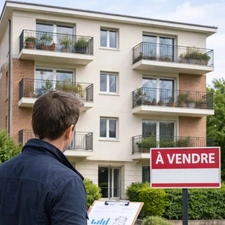
How can you secure regular income by buying real estate? Is it better to buy an apartment or invest in an apartment building to maximize profitability and leverage bank financing?
Investing in an apartment building means acquiring a multi-unit property with the aim of generating rental income and achieving a capital gain over time. This practical guide explains everything you need to know about apartment buildings: definition, financial advantages, purchase steps, the due diligence to carry out, and possible tax structures.
You will find methods for calculating profitability (gross yield, net yield, internal rate of return (IRR)), a concrete numerical example, and best practices in rental management to reduce vacancy. In this article, discover the different types of rental buildings, the reasons to invest, the buying process, profitability calculations, financing, taxation, and how to organize renovation work and day-to-day management.
Consider contacting a local Optimhome advisor to prepare your project and benefit from personalized support.
Apartment Building: Definition and Fundamentals
A simple definition of an apartment building: it is a property owned by a single owner and made up of several rented units. The goal is to generate regular rental income and build long-term wealth.
Its key components are the units, residential leases or commercial leases, monthly rents, and the management of common areas. The typology varies: residential rental building, mixed-use building, or a building with commercial premises.
Location, price per square meter, and usable floor area strongly determine apartment building profitability. Rental income is made up of the sum of monthly rents collected, minus charges and taxes.
From a legal standpoint, the building belongs to a single owner who collects the rents and assumes the obligations. Commercial leases, which are often longer and indexed differently, must be distinguished from residential leases, which provide more protection for tenants.
Before investing in real estate, estimate market rents, potential monthly rents, and likely rental vacancy. To define your project locally and obtain an accurate valuation, contact an Optimhome advisor.
Multi-Unit Building: Types and Differences
A multi-unit building may be a small urban property with 2 to 6 units, a building with 10 units or more, or a mixed-use building. It may also be organized as shared accommodation across several floors.
Each type has its advantages and constraints. Cost pooling reduces the burden per unit. Lease diversity limits income volatility. On the other hand, day-to-day management can be more demanding.
Examples: a 4-unit building in the city center offers significant tenant turnover and strong demand. A mixed-use building with commercial premises often provides higher profitability per unit, but depends on the health of the local retail sector.
Rental vacancy is generally lower for smaller units in high-demand areas. Shared accommodation can improve profitability but increases daily management requirements.
Rental Building vs Primary Residence: Why Choose an Apartment Building
A rental building serves different wealth and financial objectives than a primary residence. It is designed to generate cash flow, leverage, and long-term wealth transfer.
Bank leverage makes it possible to buy a larger asset with limited equity. If rents cover charges and loan repayments, the return on equity increases.
Management obligations are heavier than for a primary residence. You need to plan for tenant selection, rental management, and insurance such as non-owner landlord insurance. To save time, management can be outsourced to an agency or a local property manager.
In short, investing in an apartment building is relevant if you are looking for regular income, economies of scale, and wealth transfer. Seek advice from a professional to assess the balance between yield and constraints.
Why Invest in an Apartment Building for Sale? Benefits and Objectives
The benefits of investing in an apartment building are numerous: stable rental income, risk diversification, and economies of scale on charges and renovation work. Reselling the property as separate units can also generate a significant capital gain.
Gross yield varies depending on the market. In mid-sized cities, it often ranges between 6% and 8% gross. In large cities, it is generally lower, around 3% to 5%.
These ranges are indicative only. They depend on the neighborhood, the building’s EPC rating, and the local economic environment.
There are two main strategies: generate regular rental income or aim for capital gains through renovation and subdivision into units. The key is to align the objective and the financial structure to achieve the desired profitability.
Request a local profitability estimate for an apartment building and a numerical assessment from a local real estate advisor to validate your rental investment project.
Rental Income and Diversification: Measuring Profitability
Apartment building profitability combines several components: annual rents, vacancy rate, charges, property tax, and renovation work. Gross yield provides an initial indication, then net yield refines the analysis.
Simple formula: Gross yield = (Annual rents / Purchase price) × 100. Net yield ≈ (Annual rents − charges − property tax − management costs) / Purchase price × 100.
Cash flow is the available cash after payment of loan installments, charges, and taxes. IRR summarizes performance by integrating rents, initial costs, renovation work, and resale.
Include a realistic vacancy rate in your calculations, for example 3% to 5%. Test sensitivity scenarios for interest rates and rental vacancy.
Capital Gain on Resale and Leverage: Optimizing Value Ahead of a Building Sale
Bank leverage increases profitability if rental yield covers the cost of credit. Renovation, especially energy renovation of an apartment building, increases rental value and resale price.
Improving the building’s EPC rating reduces vacancy and attracts solvent tenants. Subdividing into units and reselling apartment by apartment can generate a significant capital gain.
Anticipate taxation on resale and consult a notary. The ownership structure (SCI, split ownership) and the nature of depreciation affect the taxation of the capital gain.
Advice: target neighborhoods with potential, prioritize visible renovation work, and keep a complete rental file to reassure future buyers.
How to Buy an Apartment Building: Key Steps and Due Diligence
Buying an apartment building follows a structured process: defining the project, sourcing, viewings, document checks, promise or preliminary sale agreement, financing, and notarized deed. Real estate due diligence is the decisive phase for securing the transaction. Six practical steps:
define your budget and objective;
search for the property through mandates or opportunity sourcing;
visit and inspect;
analyze leases and diagnostics;
negotiate and sign the purchase promise;
finalize financing and sign at the notary’s office.
Document each step to limit risks before investing in real estate. Prepare a solid file for the bank: valuation, market rents, and renovation plan. A local Optimhome advisor can assist you with sourcing and the purchase promise.
Searching for and Selecting the Property: Areas, Neighborhoods, and Typologies
The search for an apartment building starts with choosing the area: yield-oriented cities, student districts, or employment hubs. Key indicators are price per square meter, market rents, vacancy rate, and EPC rating.
Use comparison tools, local market observatories, and a search mandate entrusted to a local real estate advisor. Visit at different times of day to assess the environment and the real rental demand.
Negotiation and Purchase Promise for a Building: Tips for Buying at the Right Price
During negotiation, analyze charges, the works reserve fund, and the rental status. Check current notice periods and the availability date of commercial premises.
Include essential clauses: loan approval contingency, financing deadline, and reservation regarding diagnostics. The notary checks easements and mortgages before the notarized deed.
Documentary Checks and Lease Analysis
Checklist: condominium rules and specifications, minutes of general meetings, rent schedules, and receipts for the past three years. Request technical diagnostics (EPC, lead, asbestos) and all commercial and residential leases.
Lease analysis identifies below-market rents, indexation clauses, and problematic provisions. Consult the building manager to understand the health of the condominium and voted renovation works.
Tenant Review, Vacancy History, and Rent Compliance
Check tenant solvency through payslips, guarantees, and security arrangements. Request the history of unpaid rent to estimate rental risk.
Analyze past and present vacancy rates to assess demand. Check whether rents comply with market rents and any applicable rent control rules.
Plan for rent guarantee insurance or non-owner landlord insurance to secure rental income.
Calculating Apartment Building Profitability and Building a Financial Structure for Rental Investment
To make a decision, calculate gross yield, net yield, cash flow, and estimate IRR. Financing (rate, term, down payment) strongly influences cash flow and profitability.
Build a simple simulation table and test sensitivity scenarios. For an accurate simulation, request a personalized assessment from an Optimhome advisor.
Gross Yield, Net Yield, IRR: Formulas and Examples
Key formulas: gross yield = (Annual rent / Purchase price) × 100. Net yield ≈ (Annual rent − charges − property tax − renovation provisions − management costs) / Purchase price × 100.
Cash flow = Rents − (loan installments + charges + taxes). IRR summarizes performance by integrating purchase, rents, renovation work, and resale over time.
Numerical Example: Apartment Building Purchase Scenario (Case Study)
Assumption: 4-unit building purchased for €350,000, combined rents €2,400/month (€28,800/year), renovation work €40,000, annual charges €4,000, property tax €1,800, vacancy 5%, management fees 8%, down payment 15% (€52,500), amortizing loan of €297,500 over 20 years at 3.00%.
Item
Annual amount / note
Purchase price
350,000 €
Annual rents (gross)
28,800 €
Vacancy (5%)
−1,440 €
Net rents collected
27,360 €
Condominium charges + maintenance
−4,000 €
Management fees (8% of rents)
−2,188 €
Property tax
−1,800 €
Result before debt service
≈18,372 €
Loan installment
≈€1,652/month → €19,824/year
Annual cash flow (before tax)
≈−€1,452 (slightly negative)
Gross yield
(28,800 / 350,000) = 8.23%
Net yield (approx.)
(18,372 / 350,000) ≈ 5.25%
After renovation work, profitability changes depending on financing. Sensitivity: +1 point in the interest rate → higher installment and deteriorated cash flow. Vacancy at 10% → collected rents fall and net yield decreases.
This case study illustrates the importance of anticipating renovation work, vacancy, and the financial structure. For a detailed simulation, contact a local Optimhome advisor.
Financing, Structuring, and Optimizing the Taxation of Your Apartment Building
Financing may rely on an amortizing real estate loan secured by a mortgage or bank guarantee. The projected file (forecast rents, rental status, renovation plan) influences the loan term and interest rate.
From a legal standpoint, an SCI for an apartment building facilitates management and wealth transfer. For tax purposes, the choice between income tax treatment and corporate tax treatment depends on the strategy: corporate tax allows accounting depreciation; income tax simplifies exit.
Furnished rental status applies to furnished units. This status allows attractive accounting depreciation under certain conditions.
Real estate tax optimization (property deficit, actual tax regime, depreciation) must be studied with a tax expert. Consult a notary to secure the legal and tax structure.
Bank Structures and Guarantees: Loan, Mortgage, and Bank Guarantee
The standard guarantees are a mortgage or a bank guarantee. The choice between a fixed or variable rate depends on your risk tolerance.
A longer term reduces the monthly payment but increases the total cost of credit. Debt ratio and borrowing capacity are decisive for loan approval.
A complete file with valuation, cash flow plan, and projected charges helps negotiate a better rate.
SCI, Corporate Tax/Income Tax, and Tax Options: Which Status to Choose
An SCI facilitates collective management and wealth transfer through gifts or inheritance. An SCI taxed under income tax preserves tax transparency; an SCI taxed under corporate tax allows depreciation but makes exit more complex.
Furnished rental status is relevant for furnished units and offers depreciation benefits. Split ownership is an option for transferring wealth while limiting taxation.
Work with a tax expert to choose between SCI, corporate tax, income tax, or furnished rental status depending on your project.
Renovation Work, Energy Renovation, and Operational Management
Planning renovation work is essential. Prioritize insulation, heating, and ventilation to improve the building’s EPC rating and reduce charges.
Support schemes such as MaPrimeRénov’, Energy Savings Certificates, ANAH aid, or local subsidies may cover part of the expenses. Collective works in condominiums sometimes benefit from specific aid.
Prepare a multi-year renovation plan to spread costs over time. Coordinate the distribution of works by unit between common areas and private areas.
A building with a better EPC rating attracts more tenants and reduces vacancy. To assess aid and estimate renovation costs, request a study with your local Optimhome advisor.
Energy Renovation Work and EPC Compliance, Grants and Subsidies
The building’s EPC rating determines eligibility for letting in the most energy-intensive classes. Consult official public information for recent obligations.
Prepare your MaPrimeRénov’ or Energy Savings Certificate applications before work begins. Obtain several quotes and favor companies certified as RGE to access subsidies.
Allocation of Works by Unit and Multi-Year Plan: Managing Costs
In a condominium, check the multi-year renovation plan and the works reserve fund in the minutes of general meetings. Rank renovation works by priority: urgent, energy-related, and aesthetic.
For a building under single ownership, allocate costs between unit upgrades and common area renovation. Plan a working capital reserve to avoid cash flow tensions.
Finding, Buying, and Managing an Apartment Building: Services, Optimization, and Delegation
How do you find a profitable rental investment? How do you prepare the purchase and negotiate the transaction? Your Optimhome real estate advisor, an expert in the local market, supports you from A to Z in your acquisition project to invest in real estate. Browse our apartment building listings for sale throughout France to find the best opportunities.
Management can be handled internally or delegated to a real estate advisor specialized in rental management. Outsourcing allows you to delegate tenant selection, rent collection, and renovation work management. The benefits are numerous: reduced vacancy, quick handling of claims, and improved administrative security. A local Optimhome real estate advisor can help you define the most suitable solution.
Conclusion
Buying an apartment building is a powerful lever for generating rental income and building lasting wealth.
Success relies on rigorous analysis: yield calculation (gross, net, IRR), due diligence, and lease verification.
The financial structure (amortizing loan, mortgage, down payment) and the choice of legal status (SCI, corporate tax/income tax, furnished rental status) influence taxation.
Energy renovation and a multi-year renovation plan improve rental value and reduce vacancy.
Outsourcing rental management and securing rents (rent guarantee insurance, non-owner landlord insurance) are practical ways to limit operational risks.
Test several scenarios (rates, vacancy, renovation work) and request a numerical simulation before committing to the purchase.
To bring your project to life and secure it, contact a local Optimhome advisor. They will help you estimate, finance, negotiate, structure, and manage your apartment building.
FAQ
Apartment Building: What Yield Can You Expect in 2026?
In 2026, in mid-sized cities, gross yields are often between 6% and 8%. Net yield depends on charges, vacancy, and financing. As a general benchmark, expect between 4% and 6% net.
Buying an Apartment Building: What Down Payment and What Loan?
Banks often require a personal contribution of 10–20%. Favor a suitable amortizing real estate loan, backed by a mortgage or a bank guarantee. The rate, term, and debt ratio determine the final cash flow.
Apartment Building: Should You Create an SCI?
An SCI facilitates management and wealth transfer. The choice between an SCI taxed under income tax or corporate tax depends on the project and tax objectives. Consult a tax expert and a notary to decide.
Apartment Building: What Aid Is Available for Energy Renovation?
Several aid schemes exist: MaPrimeRénov’, Energy Savings Certificates, ANAH aid, and local subsidies. They can significantly reduce renovation costs and improve the EPC rating. Eligibility varies depending on the owner’s status and the nature of the works.
Apartment Building: How Can You Reduce Rental Vacancy?
Optimize the rental mix (furnished, shared accommodation, retail premises), improve the EPC rating, and set market rents. Pay attention to marketing and outsource rental management to reduce vacancy.
Apartment Building: What Are the Differences Between Furnished and Unfurnished Rental?
Furnished rental often offers higher rents and accounting depreciation benefits. Unfurnished rental provides a different form of contractual stability. The choice depends on your strategy and tax profile.
Apartment Building: How Is the Capital Gain on Resale Calculated?
The capital gain depends on the applicable tax regime and the holding period. Tax allowances may apply depending on how long the property has been held. Depreciation under furnished rental status can affect the taxable base. Check with a notary.
Apartment Building: Should You Favor a New or Older Property?
A new property guarantees compliance and low initial renovation costs but has a higher purchase price. An older property often costs less to buy and offers revaluation potential through renovation work. Decide according to your cash position and yield objective.
For any additional questions or for a personalized simulation, contact a local Optimhome advisor and benefit from comprehensive support to make your apartment building project a success.
What Is an Apartment Building?
An apartment building is a property owned by a single owner, made up of several rented units, with the aim of generating regular rental income. It may be a residential building, a mixed-use building, or a property that also includes commercial premises.
Its logic is both wealth-based and financial: the owner collects rents, bears the charges, organizes renovation work, and seeks to generate yield as well as a capital gain over time.
How Do You Invest in an Apartment Building?
Investing in an apartment building first requires defining a clear objective: cash flow, net yield, wealth building, or resale by unit. Then you need to select an area, analyze market rents, estimate rental vacancy, review leases, and build a coherent financial structure.
The investment must always be based on full due diligence: rental status, diagnostics, EPC rating, charges, property tax, renovation work to be planned, and revaluation potential. It is this analysis that truly secures the transaction.
Where Should You Buy an Apartment Building?
The right location depends on your strategy. To target yield, mid-sized cities and certain employment areas often offer better ratios between purchase price and rents. For stronger long-term value growth, attractive city centers or well-connected neighborhoods may be more relevant.
Priority should be given to areas where rental demand is real, with low vacancy, a good level of services, transport, schools, and consistency between price per square meter and achievable rents.
How Do You Estimate the Value of an Apartment Building?
The value of an apartment building is estimated based on several criteria: local price per square meter, building condition, rent levels, lease quality, vacancy rate, EPC rating, and renovation potential. You need to combine an asset-based approach with an income-based approach.
In practice, you look both at comparable sales and at the building’s ability to generate durable rental income. A reliable valuation must therefore take expected yield, charges, and local market conditions into account.
How Do You Find a Profitable Apartment Building?
A profitable building is found by targeting the right areas, then rigorously analyzing each property before purchase. You need to compare the asking price, the rents that can actually be collected, charges, property tax, renovation work, and vacancy risk.
Profitability is often determined at the time of purchase. A building that looks attractive at first glance may become underperforming if rents are underestimated, leases are fragile, or renovation work is heavy. You therefore need to reason on net profitability, not just gross yield.
How Do You Buy an Apartment Building?
The purchase follows a multi-step process: define the budget, search for the property, visit it, analyze the documents, negotiate, sign a purchase promise or preliminary sale agreement, then finalize the financing before the notarized deed. Checking leases, diagnostics, and rental status is essential.
You must also secure the transaction with suitable contingency clauses, especially loan approval. Support from a notary, a real estate advisor, and a tax expert can save time and prevent costly mistakes.
How Do You Sell an Apartment Building?
To sell an apartment building, you first need to prepare a complete file: rental status, leases, rent receipts, diagnostics, property tax, renovation history, and EPC rating. An investor will first buy a yield and visibility on income.
The sales strategy depends on the project: bulk sale to an investor, or subdivision into units for separate resale. The second option can generate a better capital gain, but it requires more time, formalities, and sometimes preparatory renovation work.
How Much Does an Apartment Building Cost?
The cost of an apartment building depends on the number of units, the city, the neighborhood, the condition of the building, and the rent levels. There is therefore no single price: a small building with 2 to 4 units in a mid-sized city may cost far less than an urban building located in a high-demand area.
To the purchase price, you must add notary fees, possible agency fees, renovation costs, a cash safety reserve, and sometimes a budget for energy or technical upgrades.
How Do You Divide an Apartment Building?
Dividing an apartment building means legally creating several separate units, often with a view to selling them individually or improving wealth organization. This operation requires a prior technical, legal, and planning review.
You need in particular to check feasibility against local planning rules, prepare a descriptive division statement, sometimes create a condominium structure, and anticipate surveyor, notary, and compliance costs for the units.
How Do You Finance an Apartment Building?
Financing generally relies on an amortizing real estate loan, with a down payment, mortgage, or bank guarantee. The bank analyzes the quality of the project, rent levels, likely vacancy, charges, and your borrowing capacity.
A good structure may also include an SCI, a choice between income tax and corporate tax treatment, or furnished rental on certain units. Financing must be thought through together with taxation, because apparent yield alone is not enough to assess real performance.
How Do You Manage an Apartment Building?
Managing an apartment building means monitoring rents, leases, tenant move-ins and move-outs, renovation works, insurance, claims, and ongoing maintenance. This management can be handled directly or entrusted to a specialized agency.
Good management has three objectives: reduce rental vacancy, secure collections, and preserve the condition of the asset. Rigorous management improves profitability and also makes future resale easier.
Why Buy an Apartment Building?
Buying an apartment building allows you to pool costs, collect several rents from the same asset, and build an income-generating estate. It is also a way to benefit from bank leverage on a more coherent real estate asset than buying one unit at a time.
The main benefit is to combine yield, internal tenant diversification, and value appreciation potential. It is a suitable strategy for those seeking regular income and a long-term wealth perspective.
What Yield Can You Expect From an Apartment Building?
Yield depends heavily on location, unit type, building condition, and financing. Based on the benchmarks given in the article, a gross yield of 6% to 8% is common in some mid-sized cities, while large cities often offer lower levels.
The most important metric remains net yield, followed by real cash flow after installments, charges, vacancy, and taxation. A building may show an attractive gross yield while still performing poorly if charges or renovation costs are too high.
Author :

Fabrice DOBROWOLSKI - Optimhome Network Development Director
Optimhome offers you personalized support for your real estate project. Benefit from all my advice, based on several years of experience, to ensure the success of your project.