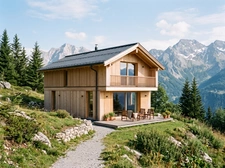
Buying in the mountains is governed by the 1985 Montagne Law, which limits construction to areas that are already urbanized in order to preserve natural and agricultural spaces. This legal framework, combined with the natural risks specific to mountainous terrain (avalanches, ground movements), makes construction or extension projects more complex but does not prevent buyers from acquiring an existing property under good conditions. With appropriate support, particularly from an Optimhome real estate advisor, it is entirely possible to secure a purchase at altitude, whether for a second home or a future base for skiing and hiking.
Key Points
- The 1985 Montagne Law requires urban development to remain continuous with areas that are already built up and strictly regulates new construction.
- Natural risks (avalanches, landslides, rockfalls) are documented in Mountain Risk Prevention Plans (PPR), which should be consulted before any purchase.
- Financing and insurance for a property in the mountains may involve specific conditions related to altitude, exposure and the nature of the property (second home, chalet, furnished tourist accommodation status).
- Climate change and variable snowfall are reshaping the market, placing greater value on altitude, exposure and the summer/winter versatility of properties.
Why Mountain Real Estate Remains So Attractive
For several years, French mountain ranges have been attracting a growing number of buyers looking for clean air, space and outdoor activities. The health crisis accelerated this trend by highlighting the appeal of a second home away from major cities, but the movement has become a lasting one. The Alps, the Pyrenees, the Jura, the Massif Central and the Vosges offer a very wide range of properties: traditional chalets, apartments in tourist residences, renovated farmhouses and rare building plots.
Buying in the mountains often responds to two complementary objectives. On the one hand, a second home for weekends and holidays, with a pronounced seasonal use. On the other, a medium-term lifestyle project: a base that will become a primary residence upon retirement, or a property designed for partial remote working. This dual purpose strongly influences search criteria, particularly the need to be able to enjoy the property in both summer and winter.
The Principle of the 1985 Montagne Law
The law relating to the development and protection of mountainous areas, known as the Montagne Law, was adopted in 1985 to reconcile economic development with the preservation of natural and agricultural spaces in mountainous areas. It applies to all municipalities classified as mountain areas, representing a significant proportion of French territory.
Continuous Urban Development
The central principle of the law is that of continuous urban development: new construction should primarily be located in continuity with existing towns, villages and hamlets. This rule aims to limit the fragmentation of the landscape, meaning the dispersal of isolated buildings across agricultural or natural land. In practical terms, this means that an isolated plot, even if connected to utilities, may be refused planning permission if it does not comply with this principle of continuity.
New Tourist Units (UTN)
The Montagne Law also regulates the creation of new major tourist facilities (ski lifts, large-capacity accommodation, reception facilities) through the New Tourist Units (UTN) regime. Depending on their scale, these projects are subject to local or regional authorization, with an environmental impact assessment. For an individual buyer, this means that the future development of a resort may be slower or more constrained than elsewhere, an element to be incorporated into a long-term investment strategy.
More Complex Planning and Construction Rules
Beyond the general principle of continuity, several specific constraints apply to construction or extension projects in mountain areas:
- Height, volume and exterior appearance rules are often stricter, in order to preserve the local architectural identity (roofs, materials, roof pitches).
- Constraints relating to the preservation of agricultural, pastoral and forest land, which may limit changes in the designated use of certain buildings.
- Planning permission processing times can sometimes be longer, particularly when the project requires the opinion of several authorities (Architecte des Bâtiments de France, site commission, DDT).
- Greater attention to connections to utilities (water, electricity, sewage), which are more costly and complex at altitude or in isolated areas.
For a purchase of an older property without an extension project, these rules have a more limited impact, but they remain decisive if the objective is to enlarge a chalet, convert attic space or transform a barn into a dwelling. It is recommended to consult the municipality's Local Urban Plan (PLU) before making a commitment, ideally with the support of a professional familiar with local specificities.
Natural Risks to Anticipate
Mountain areas expose real estate to specific natural risks that are not, or are only rarely, encountered in lowland areas. These risks are listed in Mountain Risk Prevention Plans (PPR), legally enforceable documents that each relevant municipality must prepare.
Avalanches, Ground Movements and Rockfalls
Depending on the exact location of the property, the PPR may identify a risk of avalanche, landslide, rockfall or torrential flooding. These zoning classifications divide plots into areas where construction is prohibited, construction is permitted subject to conditions, or construction is permitted without particular restrictions. Before making any offer to purchase, it is essential to consult the municipality's PPR, generally available at the town hall or on the prefecture's website, and to check the statement of natural and technological risks (ERNMT) provided by the seller.
Impact on Price and Resale
A property located in a risk zone does not necessarily have to be ruled out, but its price should reflect this constraint, and its future resale may be more complex. Conversely, a property outside a risk zone, with good exposure and easy year-round access, is a long-term asset for value appreciation. An online property valuation combined with the expertise of a local advisor makes it possible to assess these factors objectively before setting a purchase or sale price that is consistent with the market.
Financing and Insurance: Specific Features to Know
Banks and insurers take the property's mountain location into account in their risk assessment, which may result in conditions that differ from those applicable to a conventional purchase in an urban area.
From a Financing Perspective
For a second-home purchase, banks generally require a larger down payment than for a primary residence, often more than 20%. The value of the property as collateral may be assessed cautiously if the property is located in a proven risk zone or if its use is highly seasonal. A strong application, including an up-to-date online property valuation, helps reassure the lending institution about the property's actual value.
From a Home Insurance Perspective
The insurance policy must be adapted to the property's exposure: natural disaster coverage, protection against the weight of snow on the roof, water damage caused by melting snow, and even specific coverage in the event of an avalanche zone identified by the PPR. Rates can vary significantly depending on the property's classification, altitude and the age of the roof. It is advisable to request several quotes and to check the coverage exclusions carefully before signing.
Choosing the Right Location: Altitude, Exposure, Accessibility
The choice of location remains the most decisive criterion for both the practical value and the investment value of a mountain property.
- Altitude determines snowfall, the length of the ski season and the summer climate; resorts located above 1,800-2,000 metres currently offer a better guarantee of lasting snow cover.
- Exposure (south, east, west) affects sunlight, energy consumption and the rate at which snow melts on access routes and the roof.
- Winter accessibility is essential: proximity to a regularly snow-cleared road, walking distance to the slopes or shops, and parking availability.
- Summer/winter versatility is becoming an increasingly sought-after criterion, with easier access to hiking trails, mountain biking or water activities outside the ski season.
An advisor with in-depth knowledge of the area can help balance these criteria according to the budget and intended use. This is precisely the role of an Optimhome real estate advisor, who can provide detailed local knowledge and support the buyer in checking planning and risk documents.
A Market Changing in Response to Climate Change
Increasingly variable snowfall is gradually reshaping the attractiveness of resorts. High-altitude resorts, benefiting from more reliable snowfall and often from access to glaciers or extensive ski areas, are seeing their appeal strengthen. Conversely, medium- and low-altitude resorts must diversify their offering toward four-season activities in order to remain attractive, which directly influences local property values.
This development is prompting many buyers to favor versatile properties capable of generating practical value throughout the year rather than only during the winter months. The potential for seasonal rental, proximity to hiking trails or lakes, and the quality of the building (insulation, heating) are becoming selection criteria as important as immediate proximity to the slopes. Consulting Optimhome property listings makes it possible to compare prices according to altitude and exposure, and to identify areas that are best resisting these climate-related changes.
Conclusion
Buying in the mountains remains an appealing project, provided that buyers have a good understanding of the specific framework established by the Montagne Law and the resulting constraints: limited urban development, regulated planning permissions, natural risks to be checked through the PPR, and financing or insurance conditions that may sometimes be stricter. These specific features should not discourage a well-prepared project, but they do require increased vigilance regarding planning documents, risk status and the property's exposure.
In a context where climate change is gradually reshaping the map of the attractiveness of mountain ranges, the choice of altitude, exposure and the property's seasonal versatility becomes central. Relying on a reliable valuation and on the expertise of a professional in the sector helps secure the purchase and anticipate the property's long-term value.
FAQ
What does the 1985 Montagne Law concretely change for a buyer?
It limits new construction to areas that are already urbanized, which reduces the supply of isolated building plots. For the purchase of an existing property, its impact is more limited, but it becomes decisive in the event of an extension or new-build project.
How can I find out whether a property is located in a natural risk zone?
You must consult the municipality's Risk Prevention Plan (PPR), available at the town hall or prefecture, as well as the statement of natural and technological risks that the seller must provide during the sale. This document specifies the exact zoning of the plot concerned.
Is it more difficult to obtain a loan for a second home in the mountains?
Banks generally require a higher personal contribution for a second home than for a primary residence, often above 20%. The location in a risk zone may also influence the lending institution's assessment of the property's value.
What altitude should be favored for a sustainable investment?
High-altitude resorts, generally above 1,800 metres, currently offer a better guarantee of snowfall in the face of climate variability. This criterion should nevertheless be balanced with the area's accessibility and potential for summer use.
Is specific insurance required for a chalet in the mountains?
Yes, it is recommended to check that the policy covers the weight of snow on the roof, damage caused by melting snow and, where applicable, risks identified by the PPR such as avalanches. Comparing several quotes makes it possible to adjust the level of coverage to the property's actual profile.
How can a local real estate advisor help with this type of project?
An advisor familiar with the area understands the planning documents, risk zoning and price trends specific to each village or resort. They can therefore guide the buyer toward properties that match their budget while securing the regulatory aspects of the project.
Author of the publication

Fabrice DOBROWOLSKI, Director of the Optimhome network
« Benefit from my expert advice, based on many years of experience in real estate, to ensure the success of your buying or selling project. »